
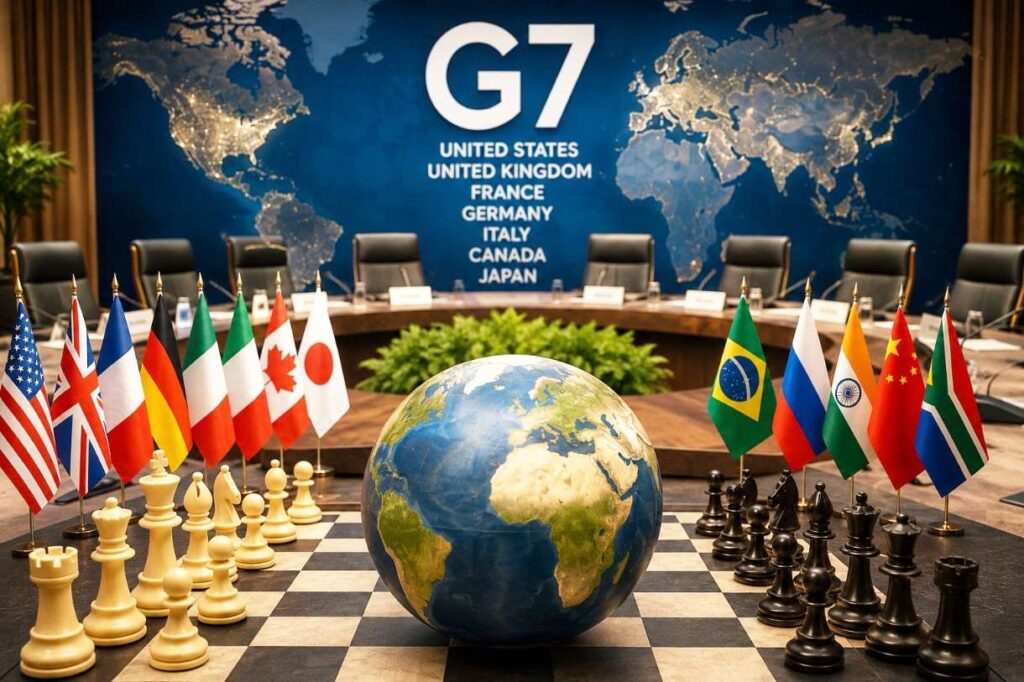
The G7 is often described as a relic of a bygone world order. In reality, the distribution of international power has fundamentally changed since this forum was established in the mid-1970s. At that time, the leading Western industrial nations dominated the majority of global economic output. Today, alongside traditional economic powers, China, India, and many developing countries play a leading role in the development of the world economy.
However, it would be premature to underestimate the influence of the G7. Although the group’s relative share of global economic output has significantly declined, it remains a central venue for political coordination among the most important industrial democracies. The true significance of the G7 today no longer lies in economic dominance but in its ability to build common strategic orientations.
From economic club to geopolitical actor
When the heads of state and government of the USA, UK, France, Germany, Italy, and Japan first met in 1975, economic policy issues were the main focus. The oil crisis, inflation, and currency fluctuations demanded close coordination among Western industrial countries. Canada later joined, forming today’s G7 group.
For decades, the group reflected economic reality. In the 1980s and 1990s, the members accounted for a large share of global economic output, controlled the most important financial centers, and influenced the rules of the international economic order.
But globalization has shifted the balance of power. China’s economic development is one of the most important geopolitical developments since the end of the Cold War. At the same time, countries like India, Brazil, Indonesia, and Saudi Arabia have become increasingly prominent. The world economy has become more multipolar, and the G7’s ability to unilaterally determine global developments has thus diminished.
Real power: Political coordination
Despite these changes, the G7 still maintains significant influence. The members continue to represent a substantial portion of the global gross domestic product, dominate many high-tech sectors, own leading financial markets, and are the center of the Western security architecture.
Most importantly, the forum allows for rapid political coordination among major democracies in North America, Europe, and East Asia. Unlike international organizations with complex decision-making processes, the G7 operates informally. This flexibility enables the group to act effectively during times of crisis.
This has been clearly demonstrated since Russia attacked Ukraine. Western sanctions against Moscow would hardly have been possible without close coordination within the G7. Similarly, support for Ukraine, stabilizing energy markets after Russia’s supply disruptions, or discussions on managing strategic technologies have all depended on this cooperation.
In future issues, coordination is becoming increasingly important. Regulating artificial intelligence, securing critical supply chains, accessing rare mineral resources, or enhancing the resilience of digital infrastructure are all common challenges for the G7 countries. Common standards and coordination rules can have an impact beyond the borders of the member states.
Limits of Western power
At the same time, the structural limits of the G7 are becoming clearer. Many global challenges cannot be solved without the participation of major developing countries.
Climate change is the most typical example. Even the most ambitious climate protection measures by the G7 will not be effective if China and India do not contribute significantly. The same goes for global trade. The People’s Republic of China is currently the most important trading partner for many countries and plays a central role in most industrial supply chains.
Added to this is the issue of mineral resources. Many minerals necessary for the energy transition are mined or processed outside the G7. When talking about lithium, cobalt, nickel, or rare earth elements, we must inevitably consider actors outside the Western industrial group.
The economic momentum in the coming decades will increasingly depend on population markets and growth in Asia, Africa, and Latin America. The idea that a small group of Western countries can single-handedly decide the direction of the world economy no longer fits the reality of the 21st century.
Challenges from BRICS
This shift is clearly reflected in the rise of the BRICS countries. Initially just a loose association of large developing countries, the group has in recent years evolved into a geopolitical forum with growing confidence.
With the addition of more members, BRICS increasingly asserts that it represents the interests of the so-called Global South. Many countries see it as an alternative to the Western-dominated organizations in the post-war order.
However, the importance of BRICS should not be overestimated. Unlike the G7, they do not have similar political cohesion or a common value foundation. The interests of China, India, Brazil, or Saudi Arabia differ greatly on many strategic issues. Border disputes, geopolitical competition, and differing economic priorities make it difficult to develop a unified viewpoint.
This is also the advantage of the G7 format. The members share fundamental political and economic principles, so they can often quickly develop common perspectives.
Normative power instead of economic dominance
The role of the G7 has changed. While the group previously relied mainly on economic advantage to influence, today its significance is based more on normative and political power.
International standards are often first established in major Western economies. This includes regulations on digital matters, financial market rules, export controls, or technology security standards. Thanks to the economic importance of these markets, the decisions of the G7 countries can have a global impact.
This type of influence receives less attention compared to traditional power politics but often has long-lasting effects. Whoever defines the standards will shape the rules of the game for future developments.
The current debate about artificial intelligence clearly illustrates this. While technological competitors around the world seek to position themselves, advanced democracies are trying to develop common boundaries regarding safety, transparency, and responsibility. The resulting norms can have broad significance beyond the member countries.
The history of the G7 is also a story of adapting to a changing world order. The forum today is neither all-powerful nor irrelevant. It no longer represents the entire global economy but remains a central coordinating mechanism for those countries that still hold significant economic, technological, and military resources.
This is what creates the current paradox: the G7 is less dominant than three decades ago, but in an increasingly fragmented world, it remains indispensable. When international crises escalate, geopolitical tensions rise, or new technologies require global rules, the focus is still on the position of the major Western democracies. The G7 may no longer be the world’s executive, but it remains one of its most important landmarks.
Author: Andreas M. Brucker