
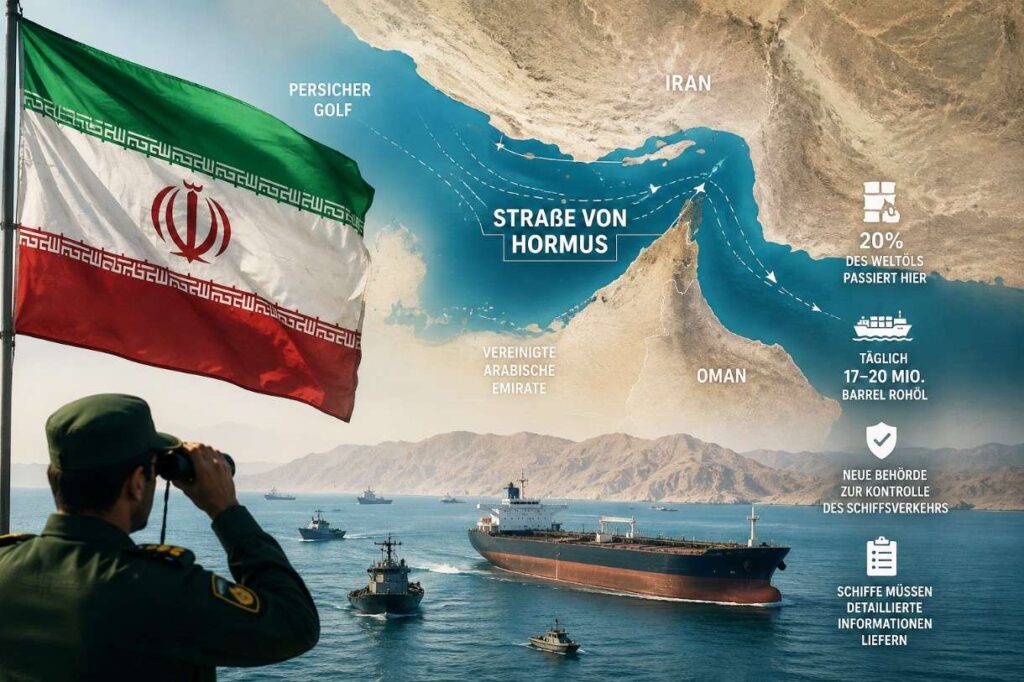
Amid the escalating conflict in the Middle East, Iran has taken a step that goes far beyond symbolic war rhetoric. Tehran officially announced the establishment of a new authority to manage the Strait of Hormuz – the narrow passage through which about one-fifth of the world’s traded crude oil is transported. This measure indicates that the Iranian leadership intends to permanently institutionalize its de facto control over this strategic waterway.
The newly created “Persian Gulf Strait Authority” (PGSA) is to provide “real-time information on operations” in the Strait of Hormuz in the future. The announcement was made public on Monday by both the Supreme National Security Council and the Revolutionary Guards. Tehran has so far remained silent about the exact competencies of the authority. However, industry media already report that passing ships will in future have to provide detailed information about owners, insurance, crews, and planned routes.
This fundamentally shifts the dynamics in the Persian Gulf. What was once a military threat posture is increasingly becoming an administrative control regime.
A Strait with Global Explosive Potential
The Strait of Hormuz is one of the most sensitive geopolitical chokepoints of the global economy. According to estimates by international energy agencies, between 17 and 20 million barrels of crude oil as well as significant volumes of liquefied natural gas pass through daily. Especially the Gulf states of Saudi Arabia, Qatar, Kuwait, and the United Arab Emirates rely on this passage to conduct their energy exports to Europe and Asia.
Even minor disruptions in shipping traffic can have immediate effects on global energy markets. History has shown this multiple times: during the Iran-Iraq war in the 1980s, during the tanker attacks in 2019, or after the killing of Iranian General Qassem Soleimani in early 2020. However, until now, control over the passage formally remained within the framework of international maritime law.
The newly announced authority marks a qualitative difference. For the first time, Iran implicitly claims not only to maintain a military presence but also to administer and regulate the transit.
Control as a Strategic Pressure Tool
Since the beginning of the recent regional escalation, Tehran has systematically expanded its position in the Gulf. According to Western security analyses, the Revolutionary Guards control large parts of maritime surveillance, while foreign shipping companies have been forced to drastically increase their insurance premiums.
The introduction of the PGSA could pursue several objectives.
First, Iran thereby creates an instrument to legitimize its measures. Instead of spontaneous military interventions, the impression of institutionalized security management arises. This allows Tehran to portray controls, delays, or inspections in the future as administrative necessities.
Second, the authority increases the economic leverage against Western states. The mere uncertainty about possible restrictions on tanker traffic is often enough to raise oil prices. For energy-import-dependent economies in Europe or East Asia, this represents a significant risk.
Third, the measure is likely also motivated by domestic politics. The Iranian leadership presents itself as the protector of a key global trade route and demonstrates strength against the USA and Israel. Especially in times of economic hardship and international sanctions, this symbolism has great significance.
The West Between Deterrence and Dependency
Western states’ responses have so far been cautious. Behind the scenes, however, concerns are growing about the creeping normalization of Iranian control over the passage.
The situation is particularly problematic for Europe. The European Union has been trying for years to diversify its energy supply and reduce dependencies – initially on Russia, now increasingly also on geopolitically unstable transit regions. Nevertheless, the Persian Gulf remains indispensable for the global energy market.
At the same time, the finance ministers of the G7 countries are meeting in Paris to discuss the economic consequences of the Middle East conflict. Besides rising energy costs, the focus is also on impacts on supply chains, fertilizer transports, and inflation. Several countries are apparently considering support measures for particularly affected industrial sectors.
The nervousness can be explained, not least, by past experiences with energy crises. Even short-term disruptions in oil markets can trigger global price movements. Given already weak economic prospects in Europe, the fear of a new phase of economic uncertainty is growing.
Israeli Attacks and American Threats
At the same time, the military situation is worsening further. Israel has again carried out airstrikes in Lebanon, which, according to Lebanese sources, killed seven people, including a commander of the Palestinian Islamic Jihad. Despite an extended ceasefire, the northern front between Israel and pro-Iranian forces remains highly unstable.
Washington’s rhetoric is also increasing pressure. US President Donald Trump publicly warned Iran of massive consequences if no agreement is reached in the stalled negotiations with the United States. His statements that “nothing will be left of Iran” mark another escalation in the tone between the two countries.
This constellation significantly raises the risk of miscalculations. The Strait of Hormuz is not only an economic corridor but also a military hotspot with a permanent presence of American, British, and Iranian naval units.
A Precedent for the International Order
From an international law perspective, the Iranian initiative operates in a gray zone. Although the Strait of Hormuz directly borders Iranian territorial waters, it is considered a transit passage under international maritime law with guaranteed passage for international shipping.
If, however, Iran effectively decides which ships must provide what information or under which conditions passage occurs, this could set a precedent with far-reaching consequences. Other states might establish similar control mechanisms in strategic straits — for example, in the South China Sea or the Arctic.
More is at stake than just the stability of energy markets. It is about whether key trade routes will be increasingly subject to national power politics in the future.
The coming weeks are likely to show whether the new authority remains primarily a political signal or whether Tehran actually begins to systematically regulate shipping traffic. But Iran has already demonstrated that it is using its geostrategic position offensively – not only militarily but increasingly institutionally and administratively. For the global economy, this means a new form of geopolitical uncertainty whose effects could reach far beyond the Middle East.