
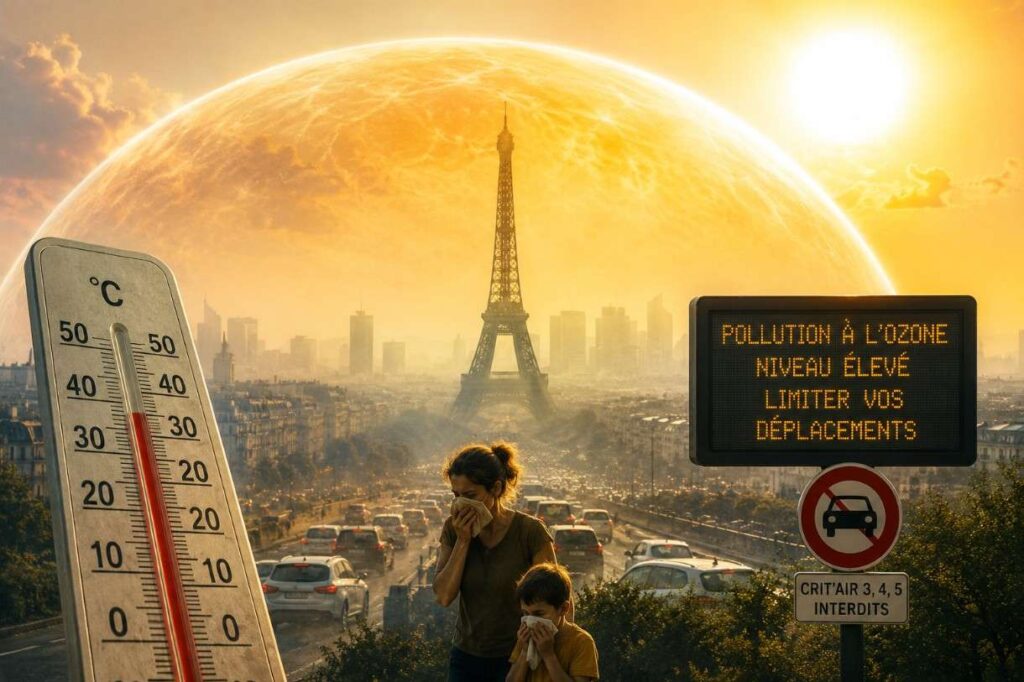
Paris is groaning under the heat. The asphalt shimmers, the air stands still between rows of houses and boulevards, and an invisible veil of ozone hangs over the capital region. From Friday, a differentiated traffic regulation, called “circulation différenciée” in French, will apply in Paris and the Petite Couronne. Besides the capital, Hauts de Seine, Seine Saint Denis, and Val de Marne are also affected.
The trigger is the expected ozone pollution. High temperatures, strong sunlight, and pollutants from traffic and industry form an unfavorable mix. Ozone does not form directly at the exhaust, but in the atmosphere when precursor substances react under the sun. Sounds technical? In everyday terms, it simply means: the air feels heavier, and the health risk increases for sensitive people.
Only vehicles with Crit’Air sticker 0, 1, or 2 are allowed to drive in the affected area. Cars with categories 3, 4, and 5 as well as vehicles without a sticker must generally remain stationary. The rule applies within the area enclosed by the A86 motorway. The motorway itself remains passable. Controls are carried out by the police, and violations may result in a fine.
However, the state provides for exceptions. Emergency vehicles, public transport, taxis, vehicles of people with disabilities, and certain professional groups with special permits are still allowed on the road. There is no way without flexibility, especially in a region where millions of people need to travel daily to work, school, or the doctor.
But what does this mean for everyday life?
Many commuters will have to change their plans. Metro, RER, bus, bicycle, or carpooling come more into focus. That is annoying, of course. Anyone already sweating on the platform in the morning does not need an extra dose of bureaucracy. Still, the measure aims at a concrete goal: fewer pollutants in the air, less strain on lungs and circulation.
Older people, children, pregnant women, and persons with respiratory or cardiovascular problems should be particularly careful. Authorities recommend avoiding physical exertion during the hottest hours, drinking enough, seeking shade, and spending time in cooler rooms. A short walk at the wrong time quickly feels like a marathon through a bakery in this weather.
And how much does such a step help on a blazing hot day?
In the short term, the traffic regulation reduces some of the emissions. It does not solve the whole problem but targets where authorities can act quickly — at traffic. In Île-de-France, this instrument has now become a fixed part of the air quality plan. Whenever severe pollution threatens, it is put into use.
Whether the regulation applies beyond Friday depends on further developments. The responsible authorities continuously monitor air quality and weather conditions. For Paris, this means a weekend under observation: fewer engines, more caution, and the hope that the air will soon feel lighter again.
An article by M. Legrand