
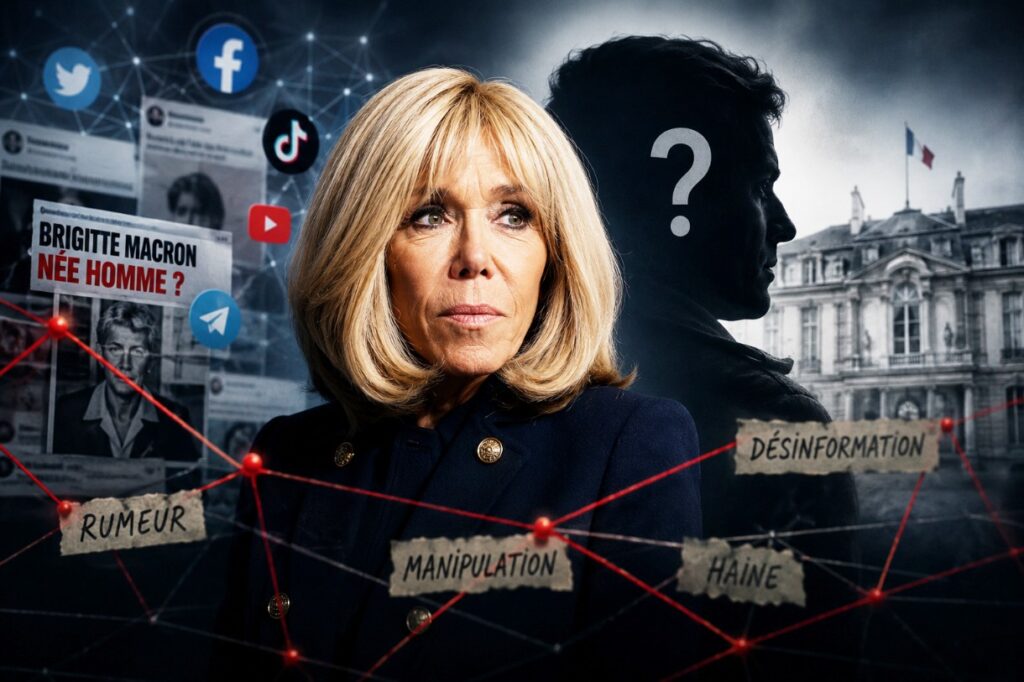
On June 7, France 5 aired the documentary “La Fabrique du mensonge: Brigitte Macron, l’ombre de la rumeur.” The film focuses on a conspiracy narrative that has been circulating on social networks for several years: the claim that Brigitte Macron was born male and assumed the identity of her brother Jean-Michel Trogneux. However, the documentary pursues a much larger goal than merely refuting a long-disproven claim.
At the center is the question of how a previously marginal conspiracy theory could develop into an international political phenomenon. The authors trace how the narrative first appeared within circles of COVID skeptics and conspiracy believers. From there, it found its way into right-wing populist networks in France and later also in the United States. What initially seemed like an obscure internet rumor gradually evolved into a topic with significant media reach.
The film particularly impressively shows the role of social networks. Images were taken out of context, supposed similarities constructed, and speculations presented as facts. The mechanisms behind this appear almost banal: content that triggers strong emotions spreads faster. Algorithms reward attention—regardless of whether the underlying claims are true or false.
The documentary makes it clear that Brigitte Macron was not targeted by chance.
Several experts explain that the French First Lady represents a particularly sensitive attack point for political opponents. Those who sow doubt about her person indirectly also target her husband, President Emmanuel Macron. Behind many attacks there is therefore less a personal interest in Brigitte Macron and more an attempt to undermine trust in political leadership.
It is also notable that the filmmakers allow people involved in spreading the rumors to speak. This does not produce a uniform picture. Some appear firmly convinced of their claims. Others seem like actors in a digital business model that lives off attention, reach, and public outrage. Clicks, likes, and notoriety often constitute a currency of their own on the internet.
The film also considers the affair as an example of societal prejudices that commonly converge within modern conspiracy narratives. Experts speak of a mixture of sexism, age discrimination, homophobia, and transphobia. Such topics are especially suitable for emotionally charged campaigns because they address existing fears and resentments.
One central fact remains unchanged: there is no credible evidence for the claim that Brigitte Macron was born male. The documentary therefore focuses less on the truthfulness of the rumor than on the paths of its dissemination. It shows how unsupported claims can take on a life of their own and how political interests, social networks, and economic incentives intertwine in this process.
This creates the portrait of an era in which rumors no longer just circulate at the local pub but can reach millions of people within hours. The story of Brigitte Macron serves as an example of a larger phenomenon: the power of modern disinformation and its ability to sustainably influence political debates.
Author: C.H.