
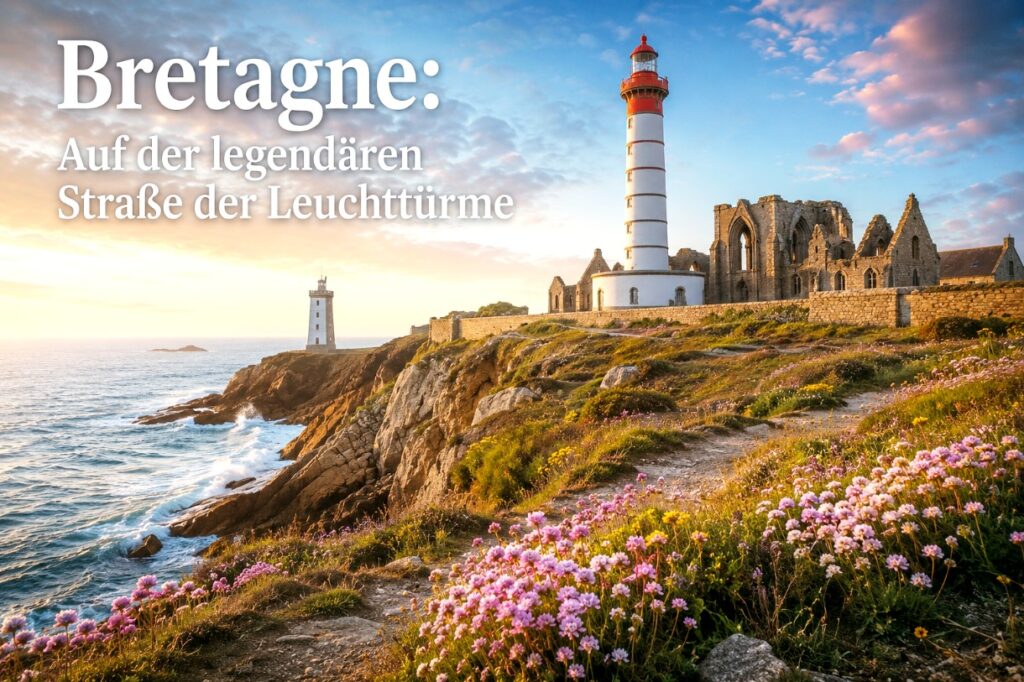
At France’s westernmost tip, the land does not simply end. It dissolves into rugged cliffs, small islands and narrow rocky promontories against which the Atlantic relentlessly crashes. Rising above this wild coastal landscape are the lighthouses of Finistere. For generations, they have guided seafarers safely through treacherous waters. Today, they form one of Brittany’s most impressive travel routes – a journey full of history, nature and maritime atmosphere.
The “Route des Phares” follows the northwestern coast from the Cote des Legendes through the Pays des Abers to the Iroise Sea, then on to the Bay of Brest and finally the Crozon Peninsula. Over roughly 200 kilometres, travellers encounter around 20 lighthouses. Hardly any other coastal region in Europe brings together so many of these stone sentinels in such a compact area.
The Pontusval lighthouse in Plouneour Brignogan Plages immediately demonstrates why this route enjoys its legendary reputation. The white structure with its red lantern appears almost delicate amid the mighty granite boulders. In sunshine, the coast seems peaceful and almost dreamlike. But when an Atlantic storm approaches, the same landscape turns into an impressive spectacle of wind, spray and roaring waves. Anyone who has seen the sea hurl itself against the rocks here will not soon forget the sight.
Further west begins the Pays des Abers. Deeply indented sea inlets extend far inland, giving the region its distinctive character. Small fishing harbours nestle along the shores, boats rest on the sandy seabed at low tide, while kelp and algae cover the rocks. Salt fills the air, seagulls circle above the water, and the sea sets the rhythm of everyday life. Is this not precisely the Brittany many people imagine?
One of the most impressive highlights awaits off Plouguerneau. There, the Ile Vierge lighthouse rises on a small island. At 82.5 metres, it is considered Europe’s tallest stone lighthouse. Nearly 400 steps lead up to the viewing platform. The climb is worthwhile twice over, as the interior surprises visitors with thousands of shimmering opaline glass tiles that bathe the staircase in soft light. At the top, a sweeping view opens out over the sea, the offshore islands and the rugged coastline.
Not all lighthouses stand securely on land. Some withstand the forces of nature on tiny rocks in the middle of the Atlantic. The Phare du Four is among the best known. Especially in heavy seas, the tower seems to emerge directly from the waves. Its construction once demanded enormous courage from the workers. Materials and crews often reached the rock only during brief weather windows – every journey involved risks.
Another gem of the route is the restored Kermorvan lighthouse near Le Conquet. It stands at the end of a narrow promontory and, together with other signal lights, guards the entrance to the harbour. From here, the view stretches far across the Iroise Sea. The atmosphere changes almost by the hour, depending on how clouds, light and tides interact.
Pointe Saint Mathieu is especially striking. There, the red-and-white lighthouse rises directly beside the ruins of a medieval abbey. Past and present merge in a unique way. Right next to it, a memorial recalls the sailors who lost their lives at sea. This place is moving – quiet, dignified and full of history.
The Lighthouse Road can easily be explored by car. However, visitors experience the landscape even more intensely on foot along the famous GR 34 coastal hiking trail or by bicycle along the coast. Again and again, small coves, secluded beaches and quiet viewpoints invite travellers to pause. Why rush when it is precisely the slower pace that makes this route so special?
The Route des Phares offers far more than beautiful photo opportunities. It tells of shipwrecks and rescues, of the hard work of lighthouse keepers, and of people who approached the sea with respect. The lights now operate fully automatically, yet their allure remains unchanged. They not only guide ships safely through the night, but also lead travellers to a Brittany where wind, waves and horizons set the rhythm of life.
An article by M. Legrand