
Get on, lean back, be amazed.
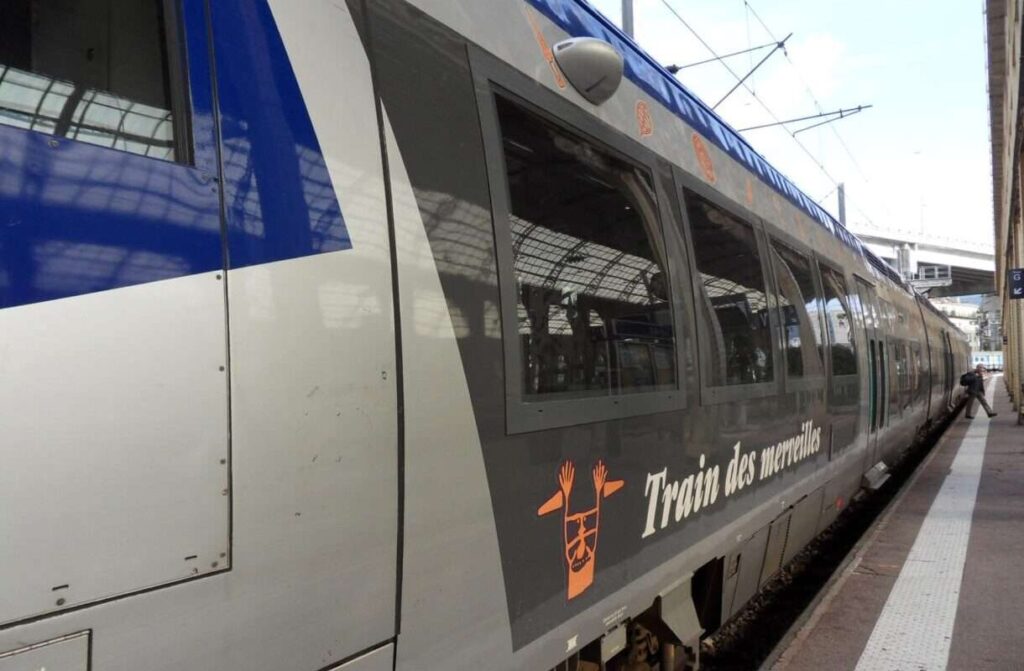
Between the Mediterranean and the High Alps runs a railway line that tells more than any travel guide. The Train des Merveilles connects Nice with Tende – opening a chapter of European history hidden between rocks, tunnels, and bridges. In just over two hours, a journey unfolds that doesn’t feel like transportation, but like a slow immersion into another world.
Ready for a change of perspective?
Overview: From Azure Blue to Rock Gray
The starting point feels familiar. Nice is vibrant, palm trees line the boulevards, the scent of sea and espresso is in the air. The station is bustling, rolling suitcases click over stone slabs, someone laughs somewhere. Nothing indicates that a few minutes later an alpine drama begins.
The train starts moving, glides past suburbs, disappears between hills.
And suddenly everything changes.
The coastline fades behind, the light appears clearer, harsher. The line winds into the hinterland, steadily climbs. Over 80 tunnels pierce the rock, viaducts boldly stretch across gorges. At the end of the 19th century, construction of this line began; in 1928 it took its current form. Engineers defied the wild topography of the Southern Alps – with pickaxes, dynamite, and a generous portion of courage.
You can almost feel how the character of the landscape changes. Mediterranean lightness gives way to alpine seriousness. The vegetation becomes denser, then sparser. A river appears, then disappears again. Every bend reveals a new panorama.
Is this still France – or already Italy?
Worth seeing along the route
Breil-sur-Roya – Village in a river bend
After about an hour, Breil-sur-Roya appears like a miniature set. The village nestles against a river bend of the Roya, pastel-colored houses reflecting in the water. This place once belonged to Italy; it officially changed nationality only in 1947. This past still resonates today – in family names, dialects, recipes.
A short walk from the station leads over a small bridge into the center. Narrow streets, shady squares, a church with Baroque elements. Here time seems to tick more slowly. People greet each other, people know each other.
And people like to tell stories.
Saorge – The floating village
Further north, Saorge spectacularly perches on the hillside. From the train, it looks as if someone stuck a village onto the rock face. The houses rise terraced, one above the other, side by side, interlocked.
The path from the train station to the village leads steeply uphill – sturdy footwear is worthwhile. Once at the top, a labyrinth of stairways and arches opens up. In the 17th century, an important Franciscan monastery was established here, which can still be visited today. The location offered protection and strategic advantage, as this region was a border area between Savoy and France for centuries.
Saorge feels otherworldly.
Almost surreal.
Tende – Alpine town with a Piedmontese heart
At the end of the line awaits Tende. Cobbled streets, ochre facades, old fortifications. The Italian border is just a few kilometers away, and you can feel it immediately. The architecture resembles Piedmontese towns, and the atmosphere feels both alpine and Mediterranean.
A walk from the train station leads through narrow alleys up to the Collegiale Notre Dame de l’Assomption – a baroque jewel with an ornate façade. High above the town rises Fort Central, part of a 19th-century defense system. From up there, the view extends far across valleys and peaks.
This is where the line ends – but not the amazement.
Vallée de la Roya – Force of nature and lifeline
The Roya shapes the entire region. Deeply incised, the valley cuts through the mountains, accompanied by the railway line like a faithful shadow. Time and again, the train crosses the river, sometimes high up on bridges, sometimes close to the shore.
In October 2020, Storm Alex devastated the valley. Landslides, destroyed houses, interrupted traffic routes. The railway line also suffered severe damage. The reconstruction meant far more than infrastructure to the people here – it symbolized solidarity. Without this connection, isolation threatened.
The return of the train felt like a sigh of relief.
Vallée des Merveilles – Stone Memory
The name of the train refers to the Vallée des Merveilles in the Mercantour. High up in the mountains are tens of thousands of prehistoric rock engravings from the Bronze Age. Figures, animals, symbols – carved into stone, preserved over millennia.
This region was never considered empty or meaningless. Early cultures already crossed these passes, leaving traces. Although the train does not run directly to the engravings, it brings travelers closer to this archaeological treasure area.
History literally lies beneath your feet here.
Cultural Highlights – Between France and Italy
The border location shapes mentality and everyday life. Until 1947, Tende, Breil-sur-Roya, and Saorge officially belonged to Italy. After World War II, a referendum decided on the new affiliation. Many families suddenly lived in another country – without moving.
This dual identity is reflected in the dialect. You hear French and Italian sounds in one sentence. Street names sound familiar and foreign at the same time. Church festivals combine baroque splendor with alpine down-to-earthness.
Especially worth seeing: the baroque churches in Tende and Saorge, richly decorated, with gilded altars and elaborate frescoes. They tell of the influence of Italian architects and the prosperity of past trading times.
And then there are the little things.
A conversation in the village square.
A smile at the bakery.
A “Ciao” instead of “Bonjour.”
Culinary Highlights – Hearty, honest, surprising
Who thinks of Mediterranean cuisine when they think of the Alps? Here influences blend. Ravioli filled with herbs from the mountains, accompanied by a glass of red wine from Piedmont. Socca made from chickpea flour recalls the coast, while game dishes and polenta reflect alpine tradition.
In Breil-sur-Roya, a stop at a small bistro near the river is recommended. Homemade pasta, rich broths, and a dessert with chestnuts – down-to-earth and refined at the same time.
And honestly: is there anything better than seeing a steaming bowl of pasta in front of you after a train ride in crisp mountain air?
Exactly.
The Luxury of Slowness
The Train des Merveilles does not chase speed records. It takes its time. And that is exactly its charm. While high-speed trains connect metropolises, this line connects outlying areas. It does not open economic axes, but habitats.
You look out the window, let your thoughts wander. No Wi-Fi, no rush – just landscape. Tunnels follow bridges, light follows shadow. The route feels like a story told in chapters.
Whoever embraces it discovers more than just views. You feel transitions – climatic, cultural, emotional.
And yes, it feels really good.
Recommendations for Travelers
A seat on the right side offers especially beautiful perspectives of the Roya Valley when traveling from Nice to Tende. In the early morning, fog lies over the river, in the afternoon warm light bathes the rocks in golden tones.
Planning time for stops along the way is worthwhile. Breil-sur-Roya is suitable for a lunch break, Saorge for an extended walk, Tende for an overnight stay with hiking in the Mercantour area.
Pack hiking boots.
Curiosity too.
And maybe a small notebook – because this journey leaves impressions that want to be captured.
The Train des Merveilles shows that traveling by train can be more than just getting from A to B. It connects coast and mountains, past and present, France and Italy. Between tunnel tubes and mountain peaks, a quiet drama unfolds that gets by without many words.
You board in Nice and arrive in another world.
So simple.
So special.
A travel report by V.O.Yager