
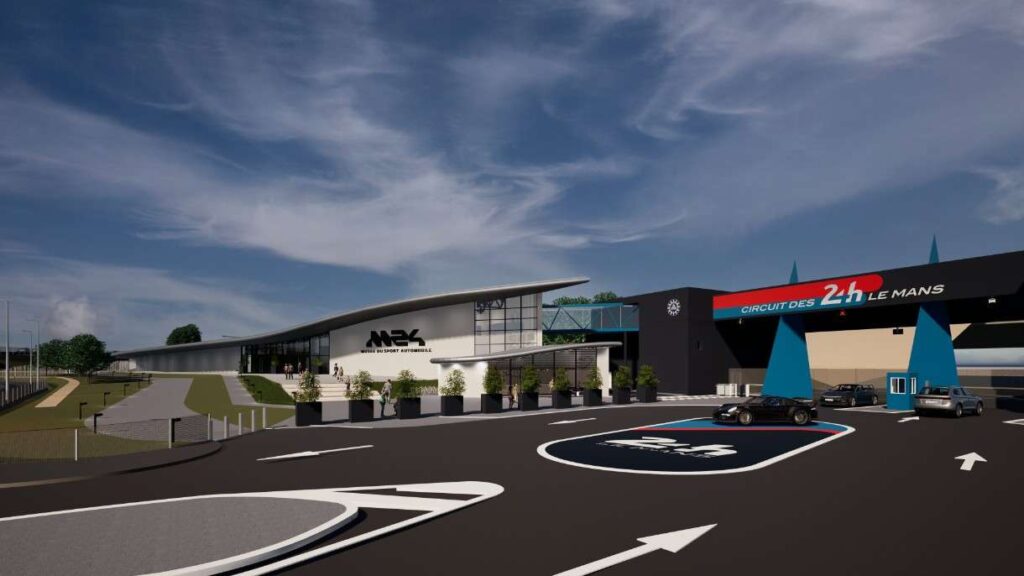
Le Mans smells of gasoline, adrenaline, and legends. For over a hundred years, not only wheels have been turning here, but entire generations of motorsport fans have been circling in excitement. Now, on May 28, 2026, a place will open its doors that captures these emotions like a roaring twelve-cylinder on the Hunaudières straight: the new M24 – Musée du Sport Automobile.
Right next to the famous Circuit des 24 Heures, this won’t be a classic museum with dusty display cases and bored school groups. The M24 focuses on an experience that catapults visitors straight into the history of motorsport. Light, sound, projections, historic vehicles, and digital technology merge into a journey through more than a century of racing history.
And honestly: who hasn’t wanted to feel how the night of Le Mans sounds?
The museum’s location already holds symbolic power. Just a few steps from the legendary track awaits a place where past and future come together. Precisely where drivers push themselves to their limits, the M24 tells stories of triumphs, tragedies, and technical revolutions.
The name deliberately sounds modern. Short. Precise. Almost like a racing code.
But behind the project is much more than a pretty architectural idea. The museum aims to make motorsport emotionally understandable – even for people who previously couldn’t tell the difference between a prototype and a GT car. That’s exactly what makes it so appealing.
Visitors don’t just walk through rooms.
They dive in.
One area is dedicated to the early years of motorsport. There, historic race cars meet film sequences from times when drivers raced over dusty tracks without much safety equipment. Leather helmets, simple instruments, and mechanical masterpieces show how brave the pioneers were back then.
It’s hard to imagine that these men reached speeds that today’s drivers would nervously activate cruise control for.
The staging of the famous 24 Hours of Le Mans is especially impressive. Visitors experience the transition from day to night, simulated pit stops, and the soundscape of a race under floodlights. The M24 uses cutting-edge projection technology to make the atmosphere tangible. Engines roar, radios crackle, and spectators cheer.
For a moment, everything feels almost frighteningly real.
Of course, the legendary vehicles are not missing either. Icons from different decades stand there like rolling works of art. Some shine flawlessly; others deliberately carry the marks of past races. Small scratches often tell more stories than glossy paint.
Ferrari, Porsche, Audi, Ford, or Peugeot – the big names of endurance racing shape the exhibition as much as bold outsider teams, whose stories often touch deeply. Because Le Mans never lived only from the favorites’ victories. It was the dramas and surprises that wrote the biggest chapters.
Some visitors may linger longer in front of the famous Ford GT40, which once broke Ferrari’s dominance. Others might lose themselves in the futuristic hybrid prototypes of the present day. What’s exciting about this? The museum explains technical developments so clearly that even complex innovations suddenly make sense.
No dry engineering jargon.
But lively technical stories.
The M24 is by no means aimed only at hardcore fans. Families, children, and curious holidaymakers in France will also find their way in. Interactive stations invite visitors to become part of the motorsport world themselves. Visitors test reflexes, simulate racing strategies, or experience virtual drives over the legendary Le Mans circuit.
That gets the pulse racing quickly.
The link between history and future is particularly clever. The museum doesn’t just look back. Electromobility, sustainable propulsion technologies, and modern safety concepts also receive plenty of space. This way, motorsport doesn’t appear as nostalgic self-praise but as an innovation lab for the mobility of tomorrow.
That’s exactly why the new patronage fits perfectly into the concept.
Because none other than Lewis Hamilton supports the M24 as official ambassador. The seven-time Formula 1 world champion embodies the modern era of motorsport like few others. Speed, precision, technology, and social change blend uniquely in his personality.
His involvement gives the museum international attention. At the same time, it sends a clear signal: The M24 does not want to be a regional niche project but a globally recognized institution of motorsport.
Hamilton himself has stood for innovation and change within racing for years. Sustainability, diversity, and technological progress shape his public role as much as sporting records. This exact mix is also reflected in the museum’s concept.
The creators rely on emotion instead of dry chronology. Instead of simply putting years on the wall, they tell stories about people. About mechanics, drivers, engineers, and teams. About sleepless nights in the pit lane. About risky decisions in the rain. About victories at dawn.
Anyone who loves motorsport immediately recognizes the magic of Le Mans in this.
And those who had little connection so far suddenly understand why this race enjoys cult status worldwide.
Architecturally, the building will likely attract attention too. Modern lines meet industrial elements reminiscent of workshops and racing garages. Large glass surfaces open views onto the circuit. This blurs the boundary between exhibition and real racing world almost completely.
Especially on event days, the atmosphere there will probably feel like a gigantic paddock.
Le Mans itself benefits enormously from the reopening. The city already holds a legendary reputation within the motorsport world. But the M24 significantly expands the tourist offer. Visitors will no longer travel just for the race, but all year round.
This brings life to hotels, restaurants, and cafés.
And honestly, this fits Le Mans quite well. The city charmingly combines historic old town alleys with modern motorsport culture. Strolling through medieval streets in the morning and marveling at race cars in the afternoon? Sounds like a damn good day plan.
The region also offers French joie de vivre gastronomically. Small bistros serve regional specialties, while motorsport fans discuss legendary overtaking maneuvers over a glass of wine late into the evening. In France, enjoyment and passion tend to blend wonderfully.
That’s why the M24 could quickly develop into a must-stop for travelers to France – even outside major motorsport events.
Added to this is the emotional component. Many people connect personal memories with Le Mans. Some recall sleepless nights watching on TV, others their trips with friends or their first visit to the race track. The museum taps exactly into these feelings.
It doesn’t just tell motorsport history.
It tells memories.
Perhaps this is the greatest strength of the project. The M24 feels less like a museum and more like a living time machine. Visitors don’t just walk past cars; they travel through epochs full of passion, risk, and technical genius.
The sounds. The images. The stories.
Everything draws you in.
Anyone who has ever stood by the Le Mans track knows this special tingling just before the race starts. Seconds of tension before engines explode like an orchestra of steel and fire. The M24 tries to capture exactly this feeling permanently.
And the odds are pretty good that it will succeed.
Because modern museums no longer live just from exhibits. They live from emotions. From participation. From amazement. That’s exactly where the concept focuses. Instead of creating distance, the M24 brings visitors right into the action.
Maybe some guests will even leave the museum with the spontaneous desire to return directly to Le Mans – this time for the real 24-hour race.
That would probably be the nicest compliment.
Practically, the museum is ideally located right at Circuit des 24 Heures. Motorsport fans can conveniently combine the visit with a tour through the Pays de la Loire region or a stopover on their way to the Atlantic coast. Paris is also only a few hours away.
The official address is:
M24 – Musée du Sport Automobile
9, Place Luigi Chinetti
F 72100 Le Mans
France
More information can be found on the official website of M24 – Musée du Sport Automobile
With the M24, Le Mans receives much more than just a new museum. A passionate meeting point for racing fans, technology enthusiasts, and curious travelers is created. Past and future merge into an experience that resonates long after – almost like the echo of a race car in the night.
A travel report by V.O.Yager