
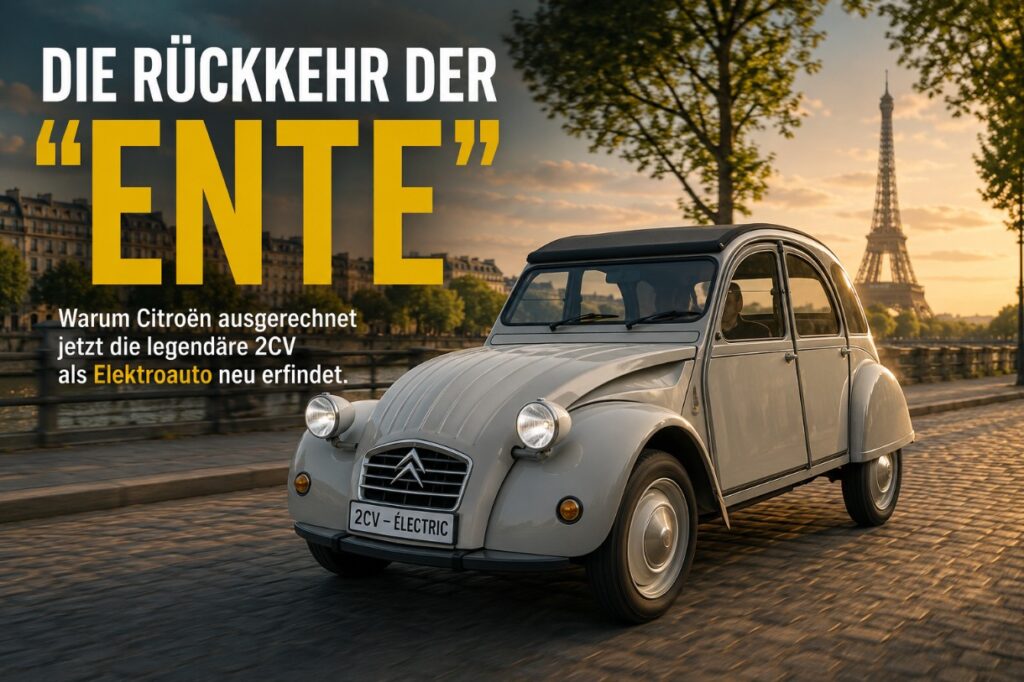
Some cars transport people. Others transport memories. The Citroën 2CV always belonged to the second kind. The “Duck” didn’t just rattle along country roads — it told a story about France, about freedom, and about that peculiar delight in imperfection that nowadays seems almost extinct.
And now it’s coming back. Electric. Of all times.
At first, this sounds like one of those nostalgic marketing tricks that car manufacturers have been exploiting their past with for years. A few round headlights here, a bit of retro charm there — and there you have a business model called longing. But with the Duck, the case is more complicated. Perhaps even more serious.
Because the old 2CV was never glamorous.
It rattled, swayed, and often sounded like an overwhelmed vacuum cleaner in a headwind. On German highways, it seemed about as competent as a folding chair in a hurricane. Exactly for this reason, millions of people loved this car. The Duck refused to partake in prestige thinking with an almost defiant pride.
Whoever drove a Duck back then quietly but clearly told the world: I’m not going along with this madness.
In France, this car still holds an almost mythical status today. The Duck is part of the landscape there like baguettes, roundabouts, and philosophizing café visitors. Students drove it during the revolts of the 1960s, farmers on bumpy field paths, young families to the Mediterranean. It fit everywhere — precisely because it never wanted to impress.
And maybe that’s exactly what explains its return.
Because Europe’s automotive industry is in the middle of a strange crisis. Electric cars are considered the future but seem to many people to be luxury products for urban high earners. The vehicles grow bigger, so do the prices. Anyone walking through Paris, Berlin, or Milan nowadays sees heavy electric SUVs that look like they want to cross the Alps—although they mostly just park in front of organic food stores.
This almost inevitably raises a question: When exactly did mobility become so complicated?
Citroën seems to read this mood surprisingly well. The new electric Duck isn’t meant to be a tech monster or a futuristic status symbol with screen walls and light shows like an airport lounge. Instead, many signs point to a radically simple concept: light, affordable, practical.
Almost humble.
And suddenly the return of the Duck feels less like nostalgia and more like a political statement. Originally known as the 2CV, the car emerged after the war as a democratic mobility project. France didn’t want to build a luxury car then, but a vehicle for people who couldn’t afford one. The famous brief essentially was that a farmer had to be able to transport eggs across a field without breaking them.
Today, Europe is at a similar point again. Once more, it’s about the question of who can afford mobility. Once more, it’s all about societal change. Only this time, the upheaval doesn’t smell like gasoline, but like lithium and charging stations.
Of course, skepticism remains.
Can you modernize an anti-prestige icon without ruining its character? Numerous retro projects have already failed precisely on that point. The new Fiat 500, for example, lives strongly on its past, but now seems like an accessory for city centers with old building rents beyond all reason.
The Duck, on the other hand, must never look polished. It needs that slightly offbeat, improvised feel — as if someone accidentally invented a car that nevertheless works. Maybe even precisely for that reason.
You can already sense how strong the longing for simplicity has become. For things that don’t constantly demand attention. No digital barrage, no software update while parking, no cockpit like an overwhelmed electronics market.
Get in, drive off, done.
So simple. Crazy, isn’t it?
Maybe that’s why the electric Duck has its greatest chance right now. Not despite its past, but because of it. While Europe wavers between Chinese competition, climate goals, and industrial anxiety, this small French car suddenly reminds us of something almost forgotten: Progress doesn’t always have to look flashy.
Sometimes, a rattling symbol on four narrow wheels is enough.
An article by M. Legrand