
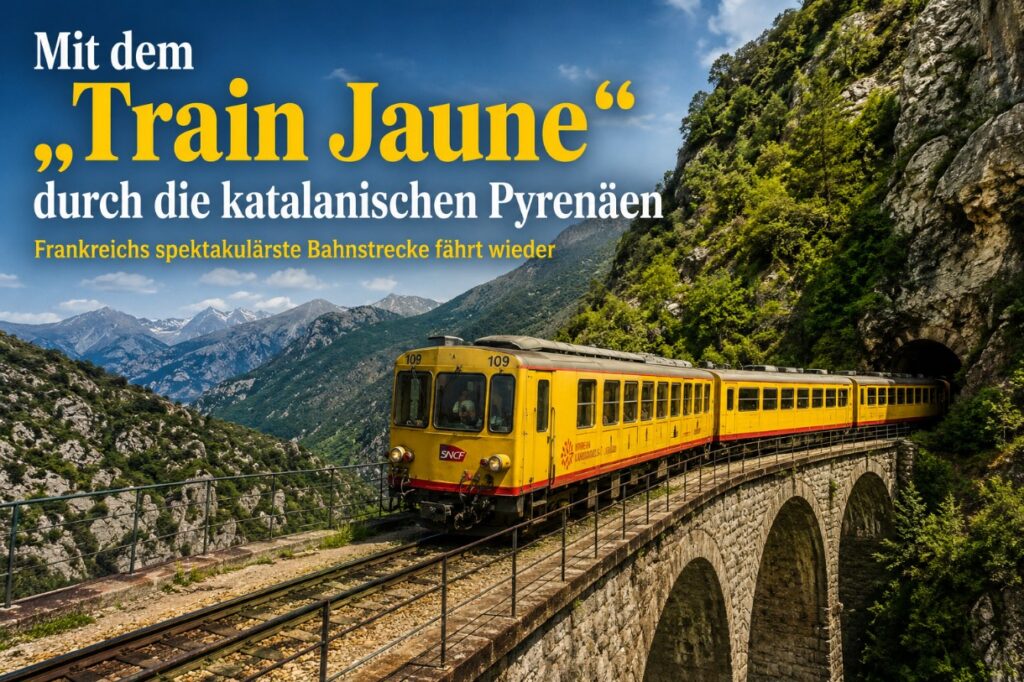
There are railway lines you use. And then there are railway lines you remember.
The “Train Jaune” belongs to the second category. Those who board the bright yellow train in the Catalan Pyrenees enter not just a means of transport, but a small world of its own. A world where time changes its pace. Slower. More attentive. Almost as if someone has switched off the hectic pulse of everyday life for a few hours.
Since this spring, the legendary train has been running again along its entire route between Villefranche-de-Conflent and Latour-de-Carol. For the residents of the region, this means the return of a familiar companion. For travelers, one of France’s most extraordinary train journeys is once again available.
The first few kilometers already make it clear that different rules apply here. The tracks follow not the command of speed, but the course of the landscape. The train leisurely climbs upward, crossing valleys and gorges, passing rocks, forests, and small villages nestled against the mountain slopes like swallow’s nests.
Sometimes it seems as if the train is not traveling through the landscape but through a painting.
The Pyrenees here reveal a side that even many French people hardly know. While the Mediterranean coasts attract visitors year after year and the Alps draw visitors with their famous winter sports resorts, the Cerdagne lies almost hidden between sky and stone. Vast high plateaus alternate with deep incisions. Cloud shadows drift over the peaks, while small rivers sparkle silver in the valleys below.
And right through the middle runs this yellow train.
Its story began at the start of the 20th century. At that time, opening up the remote mountain region was considered a technical challenge. Roads were scarce, many places hard to reach. The railway was meant to connect, supply, and bring the region out of isolation.
No one could have guessed back then that this infrastructure project would become a tourist icon more than a hundred years later.
Today, much about the route feels pleasantly out of time. The stations often resemble the sets of a French film. Small buildings, simple platforms, hardly any advertising boards. Instead of loudspeaker announcements, the silence of the mountains predominates.
Those who get off hear the wind.
Maybe a dog barking in the distance.
Maybe the ringing of a church bell.
Nothing more.
The route is particularly impressive at the famous Pont Gisclard. Here, the railway crosses a delicate suspension bridge boldly spanning a gorge. Even people who usually have little appreciation for engineering tend to gaze out the window a little longer at this spot.
The train seems to hover for a moment between heaven and earth.
It is moments like these that distinguish the “Train Jaune” from many other railway lines. The journey does not follow a spectacular program. It lives from small observations. From changes in light on the mountain slopes. From abandoned shepherds’ paths. From the suddenly appearing villages whose names were previously unknown to many travelers.
Travelers here discover a landscape that resists fast consumption.
And that is precisely its charm.
In an era where mobility is often equated with efficiency, the yellow train almost feels like a friendly provocation. While high-speed trains shrink distances, the “Train Jaune” celebrates them. It reminds us that travel once meant more than just reaching a destination as quickly as possible.
When was the last time we looked out the window without simultaneously glancing at a smartphone?
When did we allow ourselves to simply be on the move?
The open observation cars provide their own answer. Those who sit there feel the mountain air directly. No glass separates the traveler from the surroundings. The scent of pine, the freshness of higher altitudes, and the soft rattling of the wheels merge into an experience that has become surprisingly rare.
Almost every passenger eventually reaches for their camera.
And almost every one puts it down again after a short time.
Because no photo can capture what makes this landscape special.
The “Train Jaune” also tells the story of a region with a strong identity. The yellow-red colors of the train refer to the Catalan roots of the area. Here, close to the Spanish border, French and Catalan influences have intertwined for centuries. Street signs, architecture, cuisine, and language bear traces of this special cultural proximity.
Hence, the train is much more than an attraction. It is part of the regional memory.
A symbol.
A connection between past and present.
Perhaps that explains its enduring popularity. The “Train Jaune” offers something that has become rare in Europe: a trip that has not been optimized. No staged experience. No theme park on rails. No artificial nostalgia effect.
Just a train.
A route.
And a landscape that tells enough stories.
Those who get off at the end of the journey in Latour-de-Carol have only covered 63 kilometers. On the map, that seems unspectacular. In the mind, it often feels like much more.
You get off and realize: some journeys are not measured in kilometers.
But in impressions.
And that is the secret of the yellow train.
An article by M. Legrand