
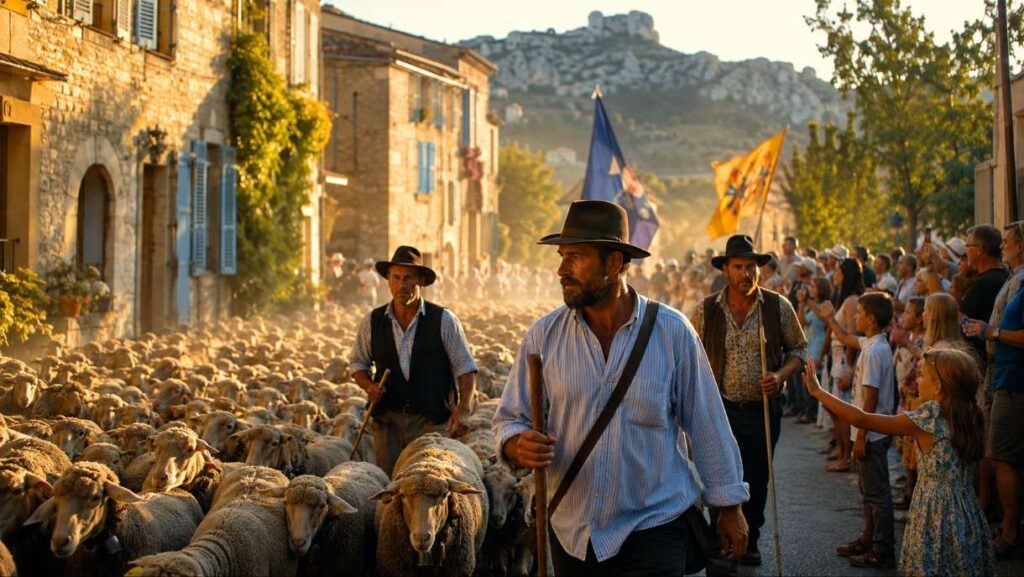
In early summer, Provence smells of wild thyme, warm stone, and lavender. But even before the first tourists raise their cameras, another sound announces the new season: the dull ringing of countless bells. Then thousands of sheep pass through narrow alleys, past cafés, old fountains, and astonished children. The Transhumance transforms places like Saint-Rémy-de-Provence for a day into a stage of dust, fur, and tradition.
And suddenly, you find yourself right in the middle of it.
An old shepherd shouts brief commands to his dogs, donkeys carry sacks with provisions, little lambs frantically try to keep up with the herd. Anyone experiencing this for the first time quickly understands: this is about much more than just a charming village festival. The Transhumance is at the heartbeat of Provence.
Since 2023, this centuries-old migratory tradition has officially been listed as intangible cultural heritage by UNESCO. But in truth, no certificate was needed to recognize its value. For many families in the region, it has been an integral part of life for generations.
On Whit Monday, May 25, 2026, thousands of animals will once again pass through the streets of Saint Rémy. More than 4,000 sheep, goats, rams, and donkeys take part in the famous Fête de la Transhumance. Shepherds in traditional felt hats accompany the herds towards the Alpilles and further to the summer pastures in the Alps. For visitors, it feels like a living painting. For the locals, it marks the beginning of an ancient rhythm.
A Custom Born of Harsh Necessity
The history of the Transhumance did not arise from romance. It arose from survival.
As early as the Middle Ages, herders drove their animals from the hot plains of Provence up to cooler mountain regions. While the fields below dried up, the herds found fresh grass and water in higher areas. Without these migrations, many shepherds could hardly have fed their animals.
Back then, humans and animals often covered hundreds of kilometers on foot.
For days.
For weeks.
Today, trucks cover part of the distance. Still, traditional paths, known as “drailles,” continue to exist. These historic lifelines run through southern France and some paths have remained nearly unchanged for centuries through the same valleys and hills.
Traveling along these routes offers a different perspective on Provence. Not through the windshield of a rental car, but through the eyes of those whose daily lives have depended on weather, grass, and seasons for generations.
And frankly — when nowadays do you still experience a tradition that exists for anything other than Instagram?
Saint Rémy Transforms
On normal days, Saint Rémy almost seems polished. Elegant little boutiques, shady squares, cafés with pastel-colored chairs. Alongside those, the typical Provençal shutters that look as if someone cut the sky into shape.
During the Transhumance, everything changes.
Early in the morning, spectators line the streets. Families stand at barriers with baguettes under their arms, children sit on their parents’ shoulders. The scent of coffee blends with hay and animal wool.
Then movement begins.
First you hear bells only.
Then dogs barking.
And suddenly, a woolly wave pours through the old town.
The animals stream closely packed past, shepherds walk attentively alongside, visitors hurriedly jump aside when a particularly curious sheep strays off course. Somewhere someone laughs and shouts “Attention!”, while a donkey stands stoically dead center in the way. No one plans this — and that’s exactly why people love this festival.
The atmosphere almost feels like a medieval fair, only more authentic. No artificially staged spectacle. No theme park feeling. But real life.
The Landscape Lives Because of the Herds
Many tourists see the sheep merely as a pretty postcard backdrop. Yet the animals perform an important task for the region.
Grazing keeps large areas open and prevents uncontrolled bush growth. Especially in the dry south of France, this plays a significant role in fire prevention. Where sheep regularly graze, the amount of easily ignitable vegetation often decreases.
The animals tend the landscape in their very own way.
Slowly.
Persistently.
Almost silently.
At the same time, shepherds help preserve traditional livestock breeds that might otherwise have long since disappeared without this form of agriculture. Many regional breeds are considered robust and perfectly adapted to the harsh climate.
That may sound unspectacular at first. But such details ultimately decide whether a cultural landscape retains its character or eventually appears interchangeable.
Between Myth and Reality
Of course, many visitors romanticize the life of shepherds.
You see a man with a hat in front of violet lavender fields and immediately think of freedom, nature, and slowed-down happiness. Reality, however, has many more edges and corners.
Shepherds often work seven days a week. Heat, storms, and lack of sleep are part of the daily routine. Added to this are economic pressures, rising costs, and conflicts over grazing land. Younger generations are increasingly reluctant to choose this profession.
Some herds now additionally face challenges from wolves, which are spreading again in parts of France. This regularly triggers heated debates between conservationists and farmers.
An old shepherd from Provence once dryly put it: “People love our sheep — as long as they only have to take pictures.”
There is quite a bit of truth in that.
Cultural Highlights Around the Transhumance
Those who attend the Fête de la Transhumance experience more than just a procession. Around the event, Saint Rémy transforms into a large Provençal cultural festival.
Music groups play traditional melodies with tambourines and flutes. Dancers wear historical costumes, artisans demonstrate old crafts, and producers sell olive oil, honey, and herbs from the region at small markets.
And everywhere you hear Provençal — the regional language that still survives in many places despite modern times.
The Alpilles in the background give the scene an almost cinematic quality. The limestone cliffs glow golden in the evening light, while the last herds slowly move out of town.
No wonder painters like Vincent van Gogh were fascinated by this area. The artist once lived in Saint Rémy and immortalized the landscape in some of his most famous works.
Cuisine Between Village Square and Mountain Trail
When Provence celebrates, it never does so without good food.
During the Transhumance, the air is filled with the scent of grilled meat, herbs, and fresh bread. Small stands sell tapenade, goat cheese, and spicy sausages. Especially popular: Agneau de Provence, lamb from local breeding.
Many visitors accompany this with rosé wine from the surrounding vineyards.
Or Pastis.
Not necessarily before noon — but hey, some tourists are quite relaxed about that.
Sweets are also an essential part of the experience. Navettes with orange blossom aroma or crispy Calissons from Aix en Provence end up almost automatically in every shopping bag.
The best part? Many products come directly from the families whose animals later parade through the streets.
An Experience for Travelers
Those who only visit Provence in high summer often miss its most vivid side. The Transhumance shows the region raw, loud, and at the same time incredibly warm-hearted.
You don’t just stand by.
You feel the energy.
Children laugh, dogs bark, bells echo between the façades. For a moment, the modern world disappears into the background. Instead, only this ancient procession of humans and animals counts.
And suddenly, you understand the phrase: “C’est notre patrimoine, notre tradition.”
It’s not just about sheep.
It’s about belonging.
About memory.
About a landscape that would look different without its shepherds.
Those who have the opportunity to visit Saint Rémy during the Transhumance should arrive early and bring plenty of time. The most beautiful impressions often arise not during the big procession itself, but in the small moments afterward — when shepherds sit exhausted by a fountain or children try to pet a stubborn lamb.
Exactly there, the true Provence reveals itself.
Not polished.
Not polished for travel brochures.
But lively, dusty, and damn real.
A travel report by V.O.Yager