
The Côte d’Azur is one of those places that has long since detached itself from its geographical reality. It exists as a promise, as an image of longing, as a carefully polished postcard. Nice, Cannes, Monaco – these names alone evoke entire worlds of images: shimmering yachts, palm-lined promenades, white parasols in front of azure blue water. When people think of the Riviera, they think of the sea.
And herein lies the paradox.
Because just a few kilometers behind the beaches begins a landscape that has little in common with this image. There, the mountains rise. Roads wind through gorges and forests. Villages cling like swallow nests to steep slopes. The Mediterranean remains visible, but it loses its starring role. In the hinterland of the Alpes-Maritimes, a new focus is emerging on the region that stood for decades in the shadow of the coastal glamour.
Perhaps it took the excess of the familiar for the unknown to become interesting again.
While the beach chairs stand crowded side by side on the coast, many travelers now seek something different. Less spectacle, more reality. Less spectacle, more history. The hinterland offers exactly that – and without much staging.
This shift in perspective is especially striking in the Monts d’Azur. There, visitors are increasingly discovering the landscape from an unusual angle: from above.
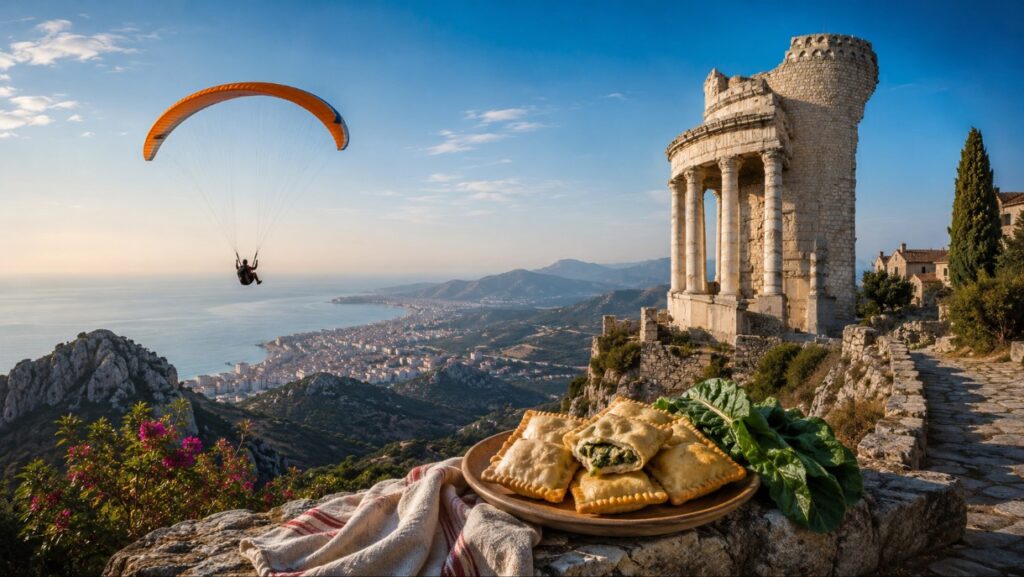
Paragliding, once a niche sport for adventurers, is developing here into a new form of travel. Those who let themselves be carried by a paraglider from the mountain ridges into the air experience the region like a living relief map. Dark forests pass below their feet. Limestone cliffs rise from deeply incised valleys. In the distance, the Mediterranean sparkles like a silver line on the horizon.
From below, mountains often appear massive and immovable.
From above, they tell stories.
One can see ancient paths, abandoned terraced fields, and the peculiar logic of a landscape shaped for centuries by the interplay between man and nature. The coast suddenly seems distant. Almost incidental.
Who would have thought that precisely a flight through the thermals could open the view to the true Côte d’Azur?
But the hinterland is not sustained only by its panoramas. Its real strength lies deeper. It is embedded in the layers of time.
One place illustrates this better than any other: La Turbie.
High above Monaco stands the Trophée d’Auguste, a monument that was already old when most European capitals did not yet exist. More than two thousand years ago, Emperor Augustus had the massive structure built to celebrate his victories over the Alpine tribes. The monument is said to have once been around fifty meters high. For the world at that time, it must have appeared as a stone demonstration of power.
Today, parts of the original construction are missing. Nevertheless, the site possesses an astonishing presence.
One stands among the pale stones and looks out over the sea, the coast, and the mountains. Monaco lies at the foot of the monument like a miniature city. Behind it, Italy blurs on the horizon.
There are viewpoints that impress.
And there are viewpoints that make relationships visible.
La Turbie belongs to the second category.
Suddenly, it becomes clear why the Romans chose this particular spot. Here, paths, interests, and claims to power intersected. The Alps were not seen as a romantic landscape but as a strategic key area. Whoever controlled the passes controlled trade, military movements, and communication.
History at such places does not feel like a chapter in a textbook. It feels tangible, almost present.
Perhaps this is one of the great charms of the hinterland. The past is not behind glass showcases. It meets you in marketplaces, on church walls, or along ancient paths.
And sometimes even on the plate.
A few kilometers further east, above Menton, lies Castellar. The village is one of those places one could easily overlook. Narrow alleys, natural stone facades, shutters in faded colors. Nothing pushes itself forward. Nothing loudly demands attention.
But it is precisely here that a culinary tradition continues, which goes far beyond an ordinary regional dish.
The Barba Jouan.
Even the name sounds like a character from an old village tale.
It is fried ravioli, traditionally filled with chard. At first glance, they appear simple. Almost inconspicuous. But anyone who talks to people who have been making them for generations quickly realizes that more is being preserved here than a recipe.
It is about memory.
About movements passed down from grandmothers to grandchildren.
About kitchens where clouds of flour danced through the air and family stories were retold between dough sheets and fillings.
The dough must be thin, say the producers. Very thin. Only then does the filling unfold its full effect. Every fold sits in its place. Every ravioli is made with a care that seems almost out of time in a world of industrial food.
And that is precisely why such specialties touch many people today more deeply than any starred cuisine.
They tell of belonging.
Of a region that does not need to reinvent its identity because it has never completely lost it.
While many rural areas in Europe are searching for a new self-understanding, many communities in the Alpes-Maritimes are rediscovering their cultural treasures. Old crafts are gaining new appreciation. Historical traditions are turning into resources for the future. Young entrepreneurs are opening small manufactories. Local producers present regional specialties with renewed confidence.
This does not seem nostalgic at all.
Rather, it feels like a quiet form of modernity.
Because the contemporary traveler no longer seeks only sights. They seek experiences. Encounters. Stories that cannot be reproduced arbitrarily.
A selfie in front of a luxury yacht all looks the same.
A conversation with a village baker about a family recipe stays in the memory.
Perhaps this explains the current upswing of the hinterland. It offers something that has become scarce in many famous destinations: surprises.
The region does not even attempt to compete with Monaco for glamour or challenge Cannes in terms of celebrity. It relies on different values. On landscapes that do not appear polished. On history that is allowed to bear patina. On villages whose beauty unfolds only at second glance.
There is a remarkable serenity in this.
And perhaps even a small lesson.
Not every region needs to be loud to be heard.
Not every place requires big attractions to touch people.
Between the flight paths of paragliders, the ancient stones of the Trophée d’Auguste, and the handmade Barba Jouan, a new narrative of the Côte d’Azur is emerging. A narrative in which luxury plays hardly any role. Instead, it’s about landscape, memory, and cultural depth.
Those who indulge in this discover a Riviera beyond all clichés.
A Riviera that does not shine, but glows.
And therein lies its special charm.
An article by M. Legrand