
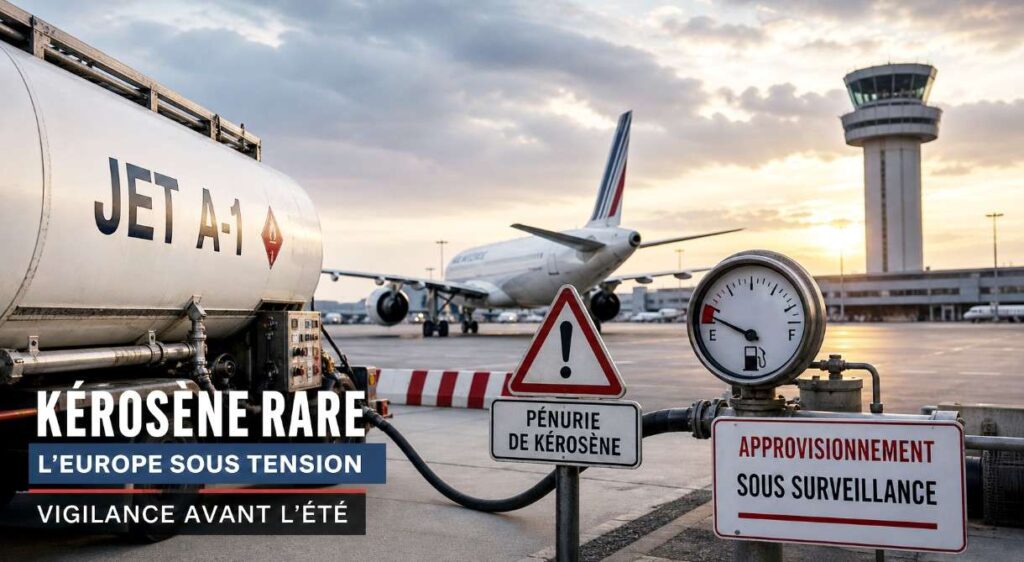
The warning signs are increasing, yet the political leadership in Paris is striving for calm. In view of growing tensions in the supply of aviation fuel, France’s Transport Minister Philippe Tabarot emphasized that the situation is “under control.” Strategic reserves have not yet been touched – a statement intended to signal stability while behind the scenes a complex supply situation is intensifying.
In fact, several European airports report logistical bottlenecks, and airlines are watching the development with growing concern. With the upcoming summer season, traditionally the busiest time of the year, the question of supply security is becoming more urgent.
Fragile supply chains instead of acute raw material shortages
The current situation is not a classic energy shortage. Crude oil is still available on global markets. The bottleneck lies deeper in the value chain: in refining, transport and distribution of Jet A-1, the standardized aviation fuel.
In Europe, this chain has increasingly condensed in recent years – and at the same time become more vulnerable. Several refineries have been shut down for economic or climate policy reasons, others are undergoing maintenance cycles. Parallel to this, geopolitical shifts, especially as a result of the Russian war of aggression against Ukraine, have sustainably changed established supply flows.
Russian petroleum products, which previously accounted for a significant share of European supply, have largely disappeared from the market. Replacement deliveries must be organized over longer distances – often by ship instead of pipelines. This not only increases costs but also the vulnerability to disruptions.
Additional burdens arise from short-term factors: labor disputes in ports, technical malfunctions in refineries, or low water levels on important inland waterways such as the Rhine. The latter is a central transport route for fuels in Central Europe. When the water level drops, the loading capacity of inland vessels is significantly reduced.
Airports in Adaptation Mode
Despite these tensions, the situation is currently not critical in terms of widespread supply stoppages. Major hubs like Paris-Charles-de-Gaulle or Orly continue to operate regularly. However, operators and airlines are increasingly resorting to flexible control measures.
This includes the so-called “tankering.” Aircraft take on additional amounts of kerosene at their departure airport to require less or no refueling at the destination. This practice is operationally proven but has drawbacks: higher weight leads to increased consumption and thus higher costs and emissions.
Industry analysts point out that such measures are an indicator of latent supply insecurity. They do not replace a stable infrastructure but merely bridge temporary bottlenecks.
Political communication between reassurance and reality
The statements of Philippe Tabarot follow a familiar pattern of government crisis communication. The goal is to maintain trust without denying the problem. Especially in air traffic, where even small disruptions can lead to chain reactions, public perception plays a central role.
A premature warning of impending shortages could trigger market reactions – such as panic buying of fuel or operational overreactions by airlines. Conversely, an overly optimistic presentation carries the risk of losing trust if the situation worsens.
The fact that France has so far refrained from using its strategic reserves is a deliberately set signal. These reserves are intended for extraordinary crises – such as military conflicts or massive supply failures. Their untouched status suggests that the government currently assesses the situation as manageable.
Structural dependence on the fossil system
Beyond the current bottlenecks, a fundamental problem becomes apparent: the continuing dependence of aviation on fossil fuels. Despite ambitious climate goals, the path to alternative propulsion systems is long and fraught with significant uncertainties.
According to the International Energy Agency, sustainable aviation fuels (SAF) currently account for only a fraction of global consumption. Their production is costly and technologically not yet capable of meeting demand on a large scale. Regulatory requirements, such as at the EU level, also increase the pressure for transformation, but cannot solve structural bottlenecks in the short term.
Electric or hydrogen-based drives are considered long-term options but are currently not realistic for long-distance traffic. Therefore, the industry will rely on conventional kerosene for the foreseeable future – and thus remain vulnerable to disruptions along the entire supply chain.
Stress Test Before the Peak Season
With a view to summer 2026, the question arises whether the existing systems can withstand the expected rise in demand. European airports are expecting a significant increase in passenger traffic, which in many regions is reaching or exceeding pre-crisis levels again.
If current tensions worsen – for example, due to further logistical disruptions or geopolitical escalations – airlines could be forced to adjust flight schedules. In extreme cases, cancellations of individual routes could also be conceivable.
So far, there are no concrete indications of this. Rather, it shows a system that is under pressure but continues to function. It is precisely this constellation that makes the situation so sensitive: it is stable enough to maintain operations – and at the same time fragile enough to react sensitively to additional burdens.
The decision to leave strategic reserves untouched underscores the available room for maneuver. But it is also a quiet admission: the buffers are limited, and their use would be a signal of a significantly more serious crisis.
In this field of tension, it becomes clear that energy supply in air traffic is no longer just a matter of supply and demand. It is an expression of a complex interplay of geopolitics, infrastructure, and transformation pressure – and thus a measure of the resilience of modern economic systems.
Andreas M. Brucker