
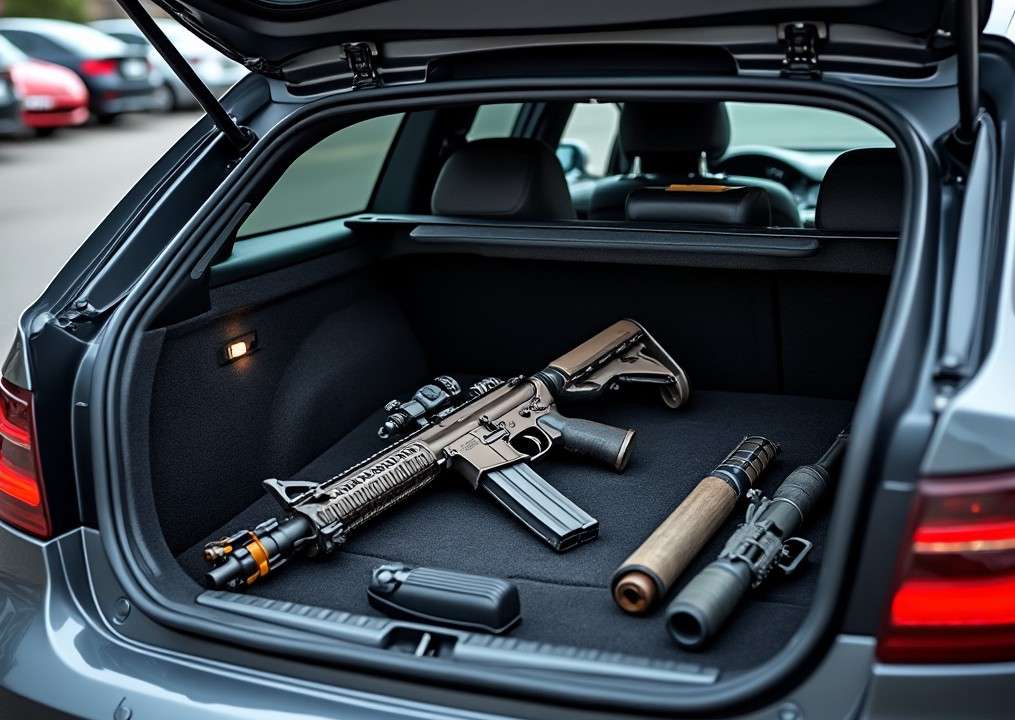
It is shortly after four in the morning when the Beauval neighborhood in Meaux (Seine-et-Marne) is torn from sleep. A series of deafening shots shatter the silence of the night. Windows tremble, walls vibrate – this is how the residents describe it. What many initially thought were fireworks turns out to be a targeted attack with a Kalashnikov-type weapon.
A single-family house is the target. Facade, doors, shutters, panes – all riddled with bullets. Investigators find a total of 28 shells of 7.62 caliber, along with an unexploded hand grenade. Only a breath separates this night from a tragedy. Three projectiles hit the neighboring house, one flying twenty centimeters above the head of a five-year-old girl sleeping in the living room.
“I was told that it was a miracle,” the mother later tells journalists from the broadcaster TF1. She avoids going into the room where the bullet hit. The family has filed charges for attempted murder.
A crime scene like from a war movie
The scene seems surreal. Meaux, less than 50 kilometers from Paris, is actually a quiet, middle-class area. But the traces in the masonry tell a different story: a war weapon was fired here.
An AK-47 – or a comparable assault rifle – is not a weapon grabbed at random. It fires projectiles with enormous penetrating power and can empty entire magazines in seconds. In a densely built-up neighborhood, this means: every bullet that misses its target can be deadly.
That night in Meaux therefore represents more than one crime among many. It symbolically stands for a dangerous development: the normalization of war weapons in urban areas.
Where do such weapons even come from?
The investigators are feverishly searching for the perpetrators – and for the routes through which such weapons enter the country. The traces often lead through Southeastern Europe, where tons of stockpiles circulated on the black market after the Yugoslav wars. In France, these weapons are distributed via criminal networks, mostly in the drug milieu.
How do they get into a residential neighborhood? Who stores them? Who profits from it? These are questions that go beyond Meaux – pointing to the structures of illegal arms trafficking, which is no longer just a big city problem.
Act of revenge or demonstration of power?
The investigators assume a targeted attack, probably an act of revenge in the context of organized crime. The chosen weapon, the number of shots, the timing – everything points to a planned operation, not a spontaneous shooting.
But there is also another interpretation: a power signal. In some milieus, such attacks serve as a message – a brutal form of communication. “Look what we can do,” it says. The bullet that nearly hit the child thus becomes a symbol of intimidation.
Between Fear and Anger – The Voice of the Neighbors
Since then, a mixture of shock and silent anger has prevailed in the residential area. Many families report insomnia, children flinching at the slightest bang. “We don’t live in Lebanon,” says an elderly resident incredulously.
For him it is clear: If war weapons are firing in the streets at night, it is no longer just about isolated cases, but about the loss of trust – in the safety of one’s own home, in protection by the state.
State Response and Political Questions
The police have launched extensive investigations, and forensic work is in full swing. Yet the underlying feeling remains: When Kalashnikovs appear in suburbs, it is no coincidence, but a symptom.
What can the state do? More presence, tougher controls, better surveillance? Or are deeper approaches needed – social, preventive, psychological – to break the cycle of violence?
France has experienced an increase in such incidents for years: Marseille, Nîmes, Grenoble, now Meaux. The shift from pistols to assault rifles marks a dangerous escalation.
A Warning Signal with Explosive Power
The assassination attempt in Meaux ends – if one may say so – without serious harm. No deaths, no serious injuries. Yet the image of the bullet above a child’s head is etched into the collective memory.
It is a wake-up call. Because anyone who believes that this violence only happens “elsewhere” is mistaken. It can strike anywhere – literally.
Perhaps that is the most disturbing lesson of this night: The boundaries between war and peace, between security and chance, have become more fragile than we think.