
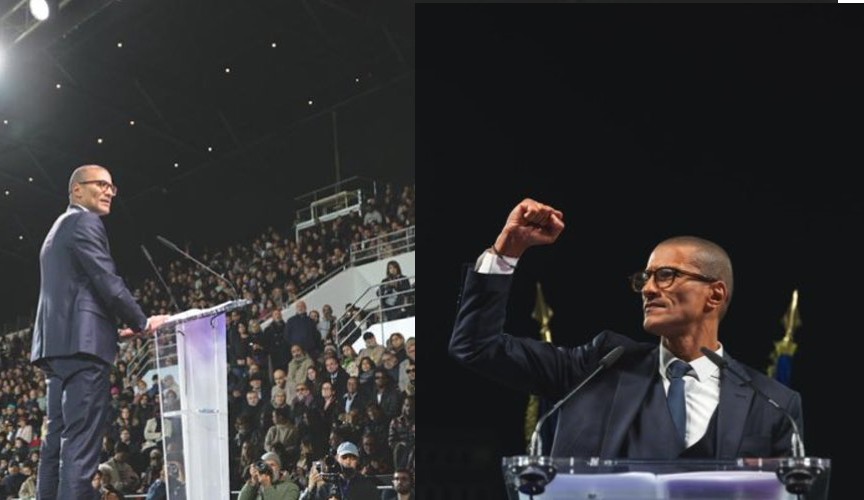
The French left has been searching for a new identity for years. Amid Jean-Luc Mélenchon’s dominant but polarizing movement, the persistent crises of the socialists, and the declining relevance of the Greens, a personality capable of uniting different electorates is still missing. Now, on the national stage, a politician emerges who claims precisely this role: Karim Bouamrane. The socialist mayor of Saint-Ouen has officially announced his candidacy for the 2027 presidential election, thus opening a new debate on the future of the French left.
From suburban mayor to national figure
Karim Bouamrane is one of the most remarkable emerging politicians in recent years. The 53-year-old mayor of Saint-Ouen-sur-Seine, a historic working-class town north of Paris, became particularly well-known nationally during the 2024 Olympic Games. Part of the Olympic Village was located within his municipality, so Bouamrane was often the point of reference for the national media.
His biography corresponds to a narrative that has become rare in France: son of a Moroccan mason, raised in the suburbs, social rise through education and political commitment. At a time when issues of social mobility and integration dominate political debate, his life story offers a contrast to the often elite careers of top French politicians.
Bouamrane uses this profile consciously. He presents himself as a representative of a republican left that aims to combine social justice and economic dynamism. In doing so, he not only addresses the traditional voters of the Parti Socialiste, but also seeks to win over part of the centrist electorate.
The alternative to Mélenchon
From a political point of view, Bouamrane consciously positions himself against the line of Jean-Luc Mélenchon and his movement La France insoumise. While Mélenchon relies on a confrontational opposition strategy and regularly criticizes political institutions, Bouamrane supports a governing social democracy modeled on the European example.
This difference is not only programmatic in nature, but touches on the fundamental strategic question of the French left. Since the presidential elections of 2017 and 2022, the left has gradually rallied around Mélenchon’s movement. The NUPES alliance and later the Nouveau Front Populaire were largely formed under his influence.
Bouamrane considers this development a misstep. He argues that closeness to the positions of La France insoumise discouraged many moderate voters. According to him, the left can return to winning majorities only if it maintains credibility in economic policy, supports European integration, and focuses on institutional stability.
This position inevitably also leads him to conflicts with parts of the current leadership of the socialists. In the Parti Socialiste, there has been a debate for years about whether an autonomous social-democratic line or a close collaboration with the radical left is the more promising strategy.
A movement outside the party apparatus
It is noteworthy that Bouamrane does not organize his ambitions solely through the traditional structures of the Parti Socialiste. Already in 2024, he founded the movement «La France humaine et forte», which serves as a political network and platform for ideas.
This strategy resembles the developments that have profoundly changed French politics in recent years. Emmanuel Macron also reached the presidency in 2017 by building a movement of his own outside the traditional party apparatus. Mélenchon also relied with La France insoumise on a form of organization less dependent on traditional party structures.
Bouamrane is now attempting a similar path. However, so far he lacks national structures and financial resources available to established presidential candidates. His movement is still under construction and must prove it can have resonance beyond the Paris region.
The crisis of the socialists as an opportunity
For the Socialist Party, Bouamrane’s candidacy could represent both an opportunity and a burden. The party has experienced a dramatic decline since the end of François Hollande’s presidency. While for decades the socialists were one of the two main political forces in France, today they are only a secondary player.
In the 2022 presidential election, the socialist candidate Anne Hidalgo received only 1.75% of the votes, the worst result in the party’s history. Despite some successes in parliamentary elections and municipal mandates, a convincing national leadership is still lacking.
Bouamrane could fill precisely this void. His supporters see in him a politician who is not burdened by the defeats of past years nor involved in internal power struggles within the party. His origin from the banlieues also gives him credibility in environments that have progressively moved away from the traditional left.
At the same time, there is a risk of further fragmentation. With François Hollande, Fabien Roussel, Yannick Jadot, and possibly other candidates, a broad field of potential competitors to the left of the political center is already emerging. The more personalities run, the harder it will be to reach an agreement on a common candidate.
Can Bouamrane surprise France?
The real challenge, however, lies at the national level. French presidential elections are traditionally dominated by personalities with extensive political experience and high visibility. So far, Bouamrane holds neither a government position nor a national mandate.
However, he has some qualities that could prove advantageous in the current political context. He is younger than many of his potential competitors, embodies social mobility, and addresses issues that concern both urban middle classes and inhabitants of the suburbs. His more economy-friendly orientation could also attract voters who do not identify with either Macronism or the traditional left.
Whether all this will give rise to a serious presidential candidacy will depend on several factors: his ability to build a national network, the evolution of the socialists, and last but not least, his skill in uniting at least part of the many currents of the French left.
It is already certain that his candidacy will revitalize the strategic debate within the left. After years of confusion, the question returns to the table of whether a modern social-democratic alternative can have a future in France. Karim Bouamrane aims for a positive answer. Whether this can really open the path to the Élysée Palace will be decided in the coming months.
Author: P. Tiko