
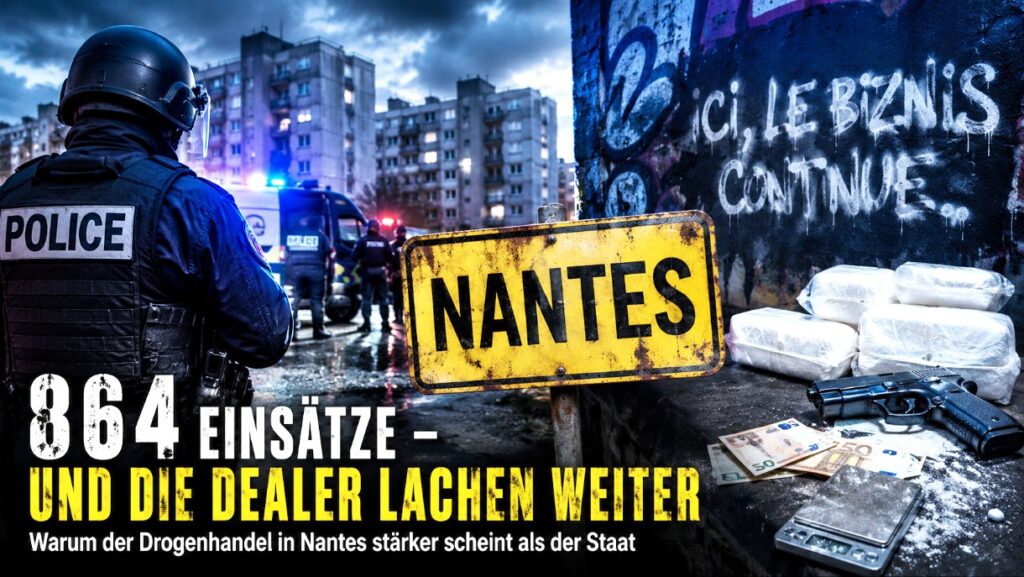
864 police operations since the beginning of the year.
You have to let that number sink in.
That means more than four operations per day. Day after day. Week after week. Month after month. Police cars, inspections, arrests, raids, flashing lights, press releases, reports of success. A gigantic effort, paid for by taxpayers, accompanied by politicians who demonstrate determination at every opportunity.
And yet shootings continue in Nantes.
People are still dying.
Drug trafficking is still flourishing.
Something is not right.
Perhaps those responsible should muster the courage to ask the obvious question: What exactly has actually changed?
61 kilograms of drugs seized. Hundreds of arrests. Weapons confiscated. Bans on entering certain areas imposed. Businesses closed.
That sounds impressive. Almost like a trailer for an action movie.
But while the statistics grow, the dealers seem surprisingly calm. Apparently, they possess a remarkable ability: They vanish briefly, wait out the next police inspection, and then continue as before.
You might almost think the criminals are always one step ahead of the authorities.
Or two.
Or ten.
Because if, after hundreds of operations, people are still being shot on the streets, then this is no longer just a security problem. We are talking about a system that has deeply entrenched itself in certain neighborhoods. Parallel worlds that are hardly impressed by press conferences and martial announcements.
The truth is uncomfortable.
You can clear one drug dealing spot.
You can clear ten drug dealing spots.
You can clear a hundred drug dealing spots.
But as long as the networks behind them continue to exist, it’s like trying to put out a forest fire with a glass of water.
Of course the police are needed. Of course dealers must be prosecuted and weapons confiscated. No one argues otherwise.
But if the same problems return year after year, if violence even increases, then it is no longer enough to just recite the same figures and hope for the next big operation.
The citizens of Nantes deserve honesty.
They have a right to know why, despite hundreds of operations, the shootings do not disappear.
They have a right to know why entire neighborhoods continue to suffer under the rule of criminal groups.
And they have a right to expect more than statistics.
Because eventually every record of success loses its shine.
At the latest when the bullets keep flying.
864 operations later, the situation does not look like a victory for the state.
But rather like proof that the state is fighting a problem it still does not really have under control.
That is the real message behind this number.
And that is exactly why it should not reassure anyone.
A commentary by Andreas M. Brucker