
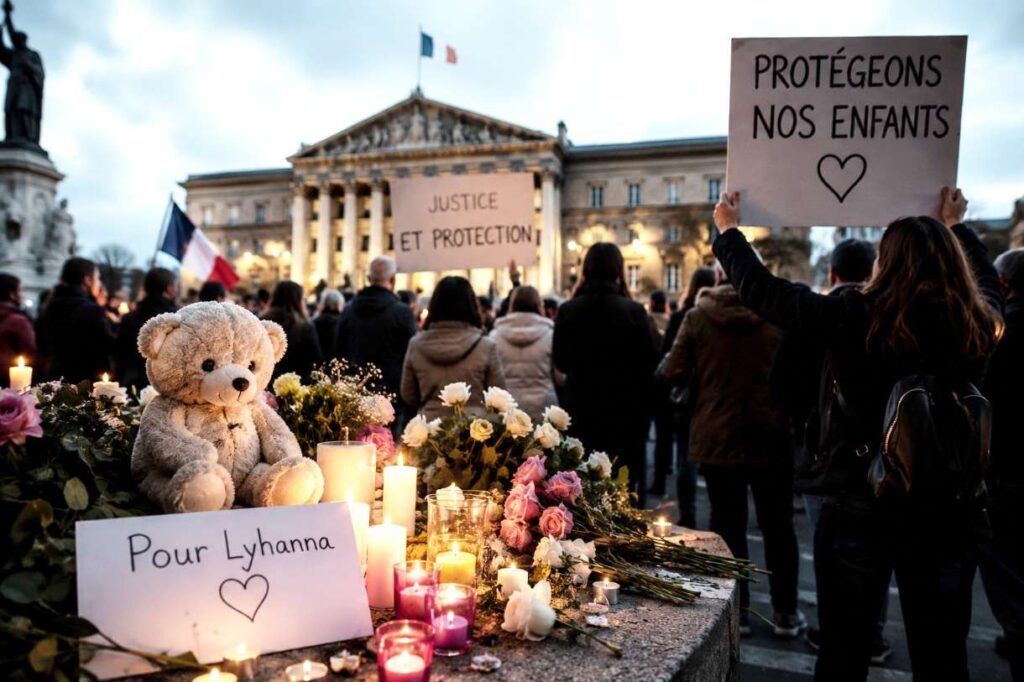
There are sentences you should never hear in a functioning constitutional state. One of them is: “The authorities were informed.” Because if the authorities were informed and still nothing happens, information turns into an alibi and responsibility becomes a minor issue.
After the Lyhanna case, we now experience the familiar ritual of concern. Politicians express their shock. Ministers promise clarification. Experts demand consequences. Investigation committees are set up. Files are reviewed. Press conferences are held. And somewhere between all these carefully formulated statements, the crucial question disappears: Why did a child have to die when warning signs had apparently long been present?
The answer to this now almost seems to be its own administrative unit in France: No one was responsible, but everyone was involved.
The modern state is a remarkable entity. It often knows very precisely when the tax declaration is due. It knows how high the parking fee downtown must be. It knows which forms must be submitted in triplicate. But when it comes to protecting a vulnerable child, it suddenly turns out that the responsible office was waiting for another responsible office, which in turn relied on feedback from a third responsible office.
You could laugh about this if it were not so tragic.
Of course, crimes are primarily the responsibility of the perpetrators. No one should pretend that individual guilt can be shifted onto authorities. But it would be equally wrong to release the state from its responsibility. Because a state legitimizes its power primarily with a promise: We protect the weak. We guarantee security. We intervene when danger threatens.
When this promise is broken, more than just anger arises. Distrust emerges.
It is precisely this distrust that is the real political explosive in the case. Not just the outrage over the crime itself, but the conviction of many citizens that institutions can indeed manage, document, and record, but increasingly fail at their core task.
And then one wonders about the success of the political fringes.
How convenient it would be if the problem lay solely in the strength of the Rassemblement National. Then the debate could concentrate on the dangers of the opposition. But in reality, the problem runs deeper. Parties like the RN benefit not because they are particularly brilliant strategists. They benefit because reality provides their arguments.
Every error by authorities becomes a campaign poster.
Every missed decision becomes a political campaign.
Every file left unattended eventually becomes a vote at the ballot box.
That is the real tragedy. Established parties complain about the consequences while often producing the causes themselves.
Particularly remarkable is the speed with which calls for new laws are made after such cases. France already has thousands of laws. Apparently, there is a notion that every state failure can be healed through additional paragraphs. Perhaps the country will soon need a law against the non-functioning of authorities. The penalty for that could be yet another commission.
But the truth is more banal and unpleasant.
Not everything fails due to a lack of laws. Much fails because existing rules are not applied, responsibilities are unclear, or institutions are overwhelmed in terms of personnel and organization.
The death of a child thus becomes a mirror of state weaknesses.
Therefore, the debate should not end with campaign slogans. Neither the government nor the opposition will do justice to Lyhanna if her fate merely becomes political fodder. The real question is not who ultimately benefits from this case.
The real question is why a state that knows regulations, procedures, and responsibilities for almost every area of life may have failed precisely where its legitimacy begins: in protecting a child.
So far, there are many explanations.
But no convincing answer yet.