
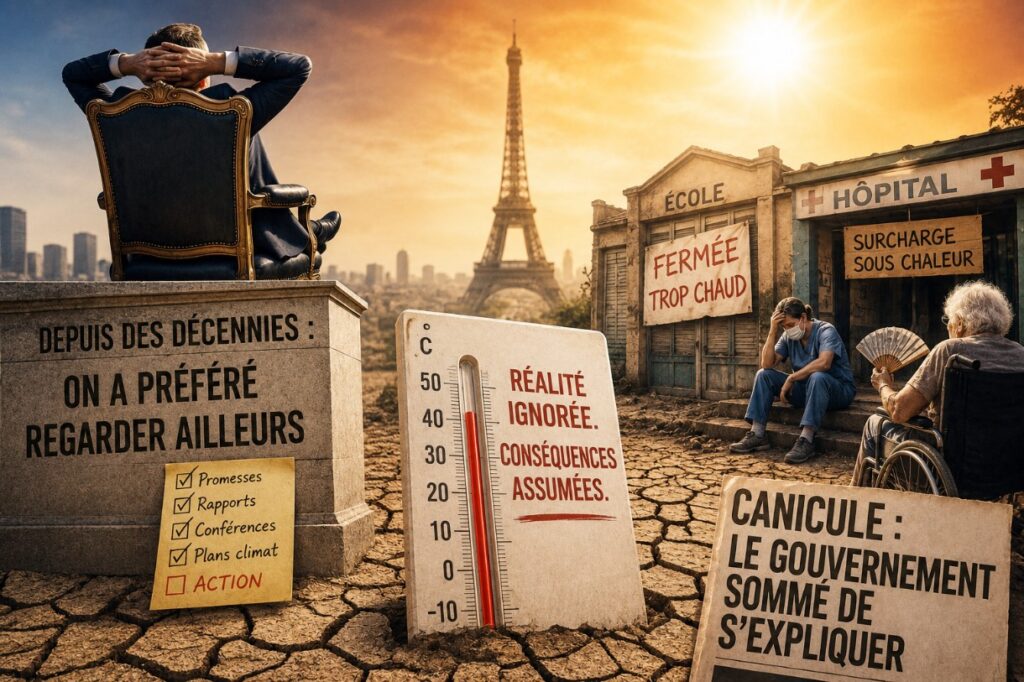
Suddenly there is alarm. Ministers step in front of the cameras, crisis units meet, schools close, hospitals struggle with unbearable temperatures, and everywhere people insist on how extraordinary this heatwave is. Really? The only thing extraordinary is the political memory lapse.
For decades climate scientists have warned that extreme weather will become more frequent, longer and more intense. For decades studies have sat on the desks of governments. For decades people have talked about climate adaptation. And for just as long it has been postponed, debated, relativized and pushed into the next budget.
Now children stand in overheated classrooms, nursing homes fight for their residents, hospitals turn into ovens, and suddenly no one is supposed to have suspected that France could experience hot summers. One could almost laugh – if the consequences were not so bitter.
Of course emergency plans are now being activated. Water distributed. Warnings sent. Press conferences held. All important, no question. But it is reminiscent of someone who wants to repair the roof only after the living room has long since been flooded.
The real scandal is not this heatwave. The real scandal is that it is no longer a surprise. It was announced. Again and again. Scientists warned. Urban planners warned. Environmental groups warned. Even state agencies published scenarios that have today become frighteningly precise reality.
And what did politics do? It regularly discovered its love of Sunday speeches. Climate protection? Of course. Adaptation? Very important. More green spaces? Someday. Renovate schools? As soon as funds are available. Modernise hospitals? Maybe after the next election.
Instead programs were announced, working groups formed and strategy papers published – documents that today would probably serve excellently as fans against the heat.
Particularly notable is the outrage of those politicians who now loudly demand clarification. Many of them belong to parties that themselves bore government responsibility for years or blocked necessary investments by citing empty coffers. Apparently political responsibility in France has a remarkable trait: it basically always applies only to everyone else.
This is no longer about ideological trench warfare. No one seriously claims that a single government caused human-made climate change. Yet many governments – regardless of their political colour – have let valuable time slip away. While the atmosphere warmed, political willingness to act cooled down above all.
The consequences are visible everywhere today. Cities store the heat like enormous concrete ovens. Schools resemble greenhouses. Nursing homes contend with temperatures that can become life-threatening for very elderly people. Workers on construction sites or in agriculture work under conditions that a few decades ago would have been considered exceptional.
And yet every new heatwave is treated as if it had sneaked in overnight. Again everything is surprising. Again preparations are lacking. Again short-term measures are sold as decisive crisis management.
Perhaps that is the real problem: It is not the heat that surprises politics – but that citizens increasingly remember how long they have been warned about it.
Nature does not negotiate. It knows neither election dates nor coalition agreements. It does not reward press releases and is not impressed by political declarations. It follows the laws of physics.
And precisely for that reason it is no longer enough to react to symptoms. Those who ignore warnings for decades and then celebrate the fire extinguisher because the house is already burning should not be surprised by criticism.
The time for excuses is over. Heatwaves will return. The real question now is whether politics will finally begin to build for the climate of the 21st century – or continue trying to cool reality with press conferences.