
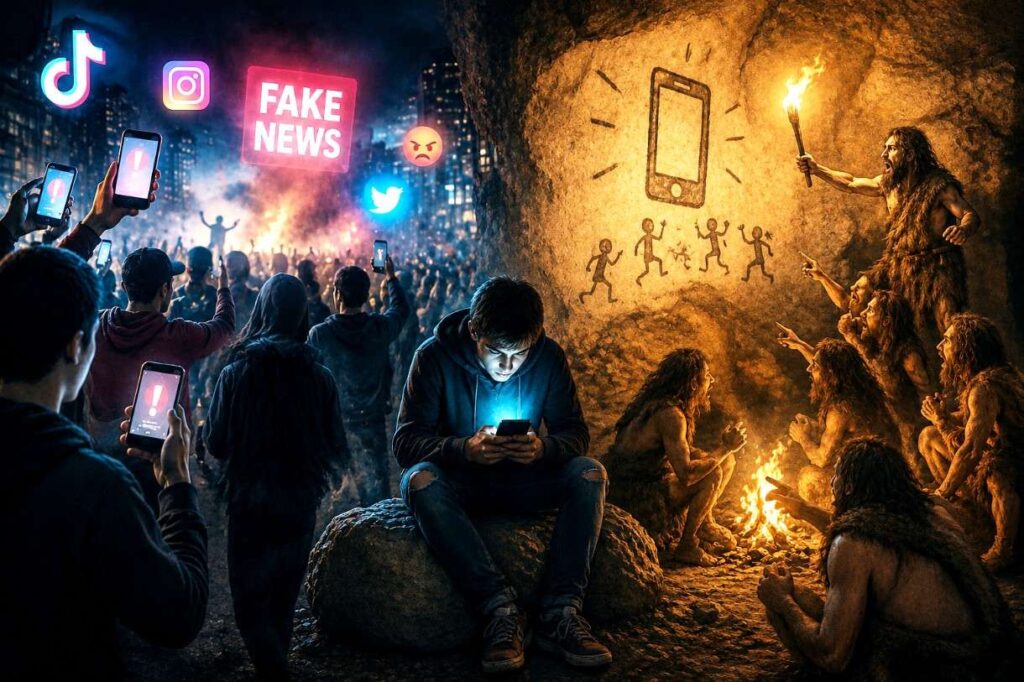
In the past, it took rumor mills, regulars’ tables, and at least a few days for an absurd claim to spread through a town. Today, a TikTok video, a dramatic sound effect, and three seconds of attention span suffice – and dozens of young people rush off as if someone had triggered a fire alarm that switched off their reason.
Straßburg provides the latest example.
An invented report about a supposedly police-killed youth spreads online. No one verifies. No one asks questions. No one thinks. Why would they? Thinking now apparently counts as outdated technology – roughly as modern as a fax machine.
So teenagers march into the city center, destroy public furniture, shut down traffic, and react to something that never happened.
One almost has to admire this development.
Humanity took millennia to develop reading, writing, science, and critical thinking. Universities emerged, libraries were built, enlightenment and education were fought for. And now? Now a video with dramatic music is enough to throw all these achievements overboard in a few minutes.
Congratulations.
We have the knowledge of all humanity in a smartphone in our pocket and yet use this device only to forward unchecked rumors.
What progress.
Social media was once celebrated as a tool for networking. It was supposed to connect people, spread knowledge, and strengthen democratic participation. Instead, they increasingly turn into gigantic accelerators for outrage, hysteria, and collective short circuits.
The irony could hardly be greater.
Never before have so many people had access to so much information. At the same time, the ability to distinguish between truth and nonsense seems to vanish faster than a Snapchat post.
What is especially frightening is the speed. Today, often only hours pass between the publication of false news and the first riots. In the past, a rumor had to at least pass through neighborhoods, cafes, and schoolyards. Today it jumps at the speed of light through millions of smartphones.
And every click acts like a small applause for the lie.
Of course, teenagers are not solely responsible. They grow up in a digital world where attention matters more than truth. Platforms don’t reward those who are right. They reward those who scream the loudest, shock the most, and evoke the strongest emotions.
Anger sells better than facts.
Outrage clicks better than research.
Panic runs better than reason.
The result is something we increasingly see on the streets.
A society that considers itself highly modern reacts to digital smoke signals like a prehistoric tribe to drumming on the horizon. Someone shouts something. The crowd rushes off. Questions are asked later – if at all.
The real tragedy is that the technical possibilities are magnificent. Education has never been so accessible. Facts have never been able to be checked so quickly. So many sources of information have never been open.
But instead of using the digital world as a library, many treat it like a rumor pub with no closing time.
Perhaps therein lies the bitterest realization: technological progress does not automatically make people smarter. A smartphone does not replace judgment. Fast internet does not replace education. And a hundred million videos do not replace a single own thought.
The modern world has artificial intelligence, quantum computers, and space programs.
But sometimes a fake TikTok video is enough to show that mentally, we have arrived back where our ancestors stood thousands of years ago:
By the campfire.
Someone tells a story.
And everyone believes it.
A commentary by Andreas M. Brucker