
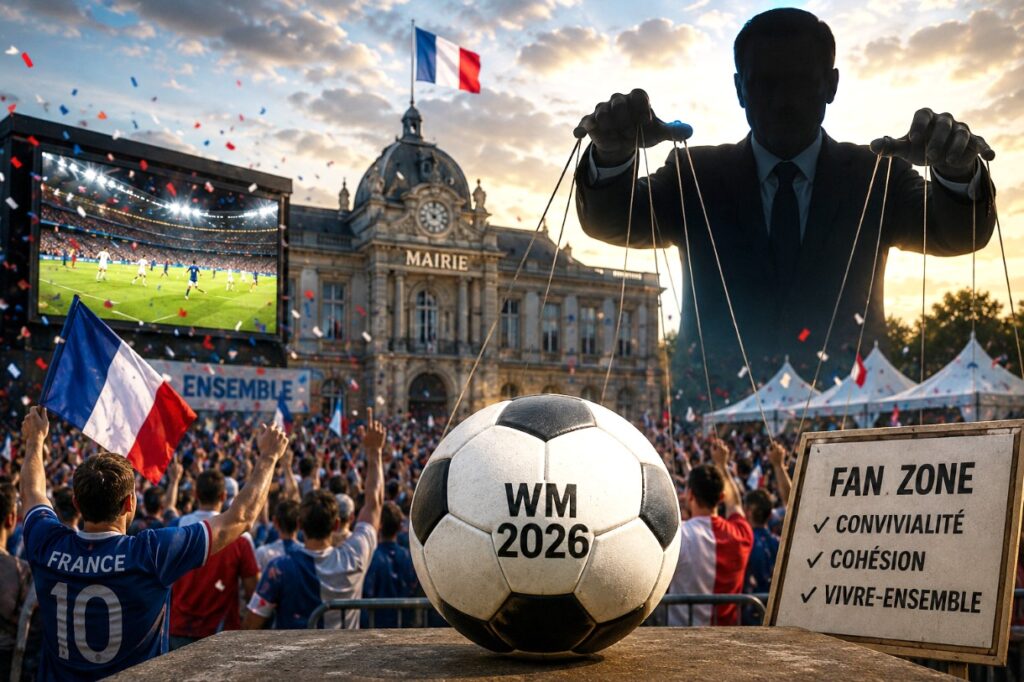
The Football World Cup is back. For a month, billions of people will follow the matches of the best national teams in the world. The streets will fill with jerseys, restaurants and bars will become meeting points for fans, public squares will transform into arenas of collective joy. This image is familiar. But alongside the sports competition, another rivalry is played out – much less visible, but just as politically important: the staging and appropriation of the event by politics.
An illuminating example comes from the Alsatian city of Mulhouse. With the announcement of a public fan zone for the 2026 World Cup, Mayor Frédéric Marquet did not just present a sports support program. He also presented the event as an instrument of social cohesion and as a signal sent to the younger generation. The intention seems understandable. At the same time, it illustrates a trend that has been observed for years: major sporting events are increasingly becoming platforms for political communication.
The Symbolic Power of Sport
Policy makers have long understood the integrative power that sporting successes can generate. A victory by the national team often evokes more collective emotions than many political campaigns. Football creates identification beyond social, cultural, and political boundaries. It is precisely here that its value for politics lies.
A well-attended fan zone gives the image of a dynamic city. Public broadcasts reflect closeness to citizens. Images of joyful people in front of giant screens are ideal for social media, municipal publications, and political communication. Sport provides positive emotions, strong attention, and a rare form of social unity – resources particularly attractive in polarized times.
An International Phenomenon
This development is not limited to France. The host countries of the 2026 World Cup – the United States, Canada, and Mexico – are investing considerable resources in accompanying events, fan festivals, and public meeting places. Officially, the collective experience and passion for football are at the center. At the same time, these projects serve territorial promotion, urban marketing, and political showcasing.
Major sporting events have always been closely linked to political interests. From the Berlin Olympic Games in 1936 to the World Cup in Argentina in 1978, up to the recent debates surrounding Qatar 2022, history shows that sport and politics are rarely separate worlds. The 2026 World Cup is no exception. Certainly, this time the focus is less on the international image of a single state, but at the local level, the political use of the tournament remains evident.
Between community and staging
The crucial question is therefore not whether politics uses sporting events, but how it does so.
In principle, nothing opposes cities and municipalities organizing fan zones. These events create meeting spaces, stimulate local gastronomy, and also allow people with limited financial means to participate in the collective experience. In a context of increasing social fragmentation, common public experiences can make a positive contribution.
The problem arises when symbolic policy replaces concrete policy. A fan zone can strengthen the community, but it does not solve structural problems. It neither improves the quality of education nor reduces youth unemployment or social inequalities. When political communication suggests that societal challenges can be overcome by isolated major events, a gap is created between the staging and reality.
The attention economy
The World Cup nowadays functions as a colossal generator of attention. Sponsors use it to market their products. The media compete for audience and advertising revenue. Digital platforms profit from the global discussions. And political actors try to adapt their messages to the emotional dynamics of the tournament.
It is not necessarily about manipulation. Politics rather follows the same mechanisms as other social actors. Those who want to capture attention turn towards topics that mobilize people. Football is undeniably one of them.
However, a critical perspective is necessary. Because the greater the emotional impact of an event, the stronger the temptation to use its reach for one’s own purposes. The boundary between legitimate civic communication and political staging often remains blurred.
When the summer of 2026 sees North American stadiums filled and millions of fans around the world cheering in front of their screens, the sporting competition will be at the center. But just as revealing will be what happens outside the stadiums. Fan zones, public events, and calls for social cohesion tell a second story – that of politics, communication, and public perception.
Football remains a celebration of emotions. It is precisely for this reason that for decades it has also been a favored instrument of political staging. The 2026 World Cup will impressively demonstrate how closely these two spheres are linked.
Author: P. Tiko