
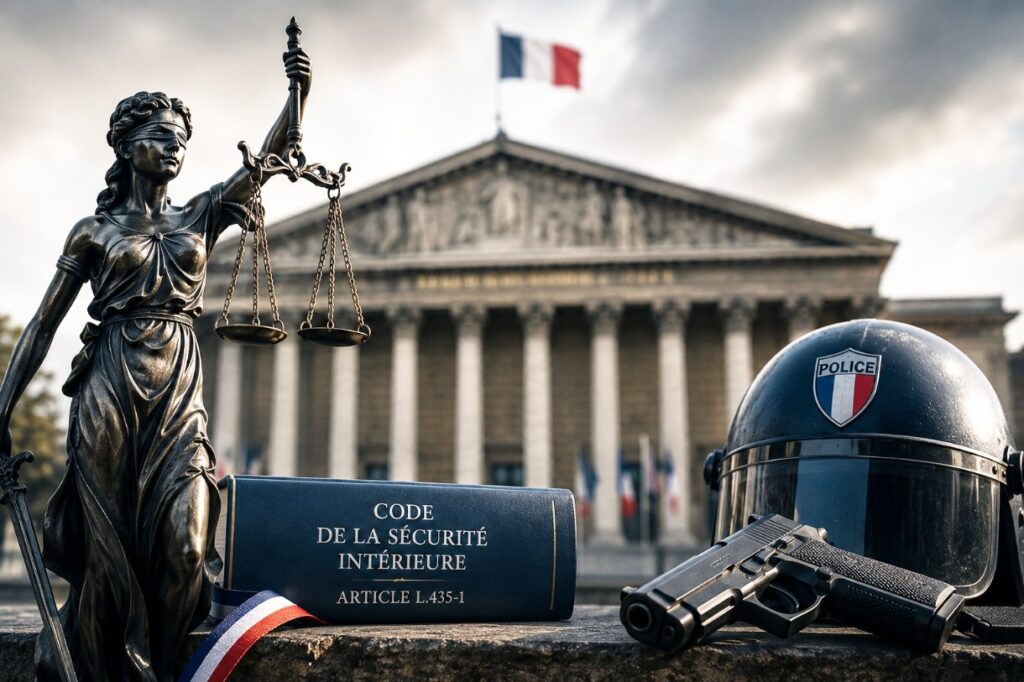
France has taken another step in a debate that has been controversial for years concerning police violence and internal security. On 7 July 2026, the National Assembly adopted at first reading a law intended to grant police officers and gendarmes expanded legal protection in the use of their firearms. The government describes the reform as a necessary safeguard for law enforcement. Critics, however, see it as a considerable weakening of rule-of-law oversight mechanisms and warn of far-reaching consequences for the judicial investigation of fatal police interventions.
Before the law can enter into force, it must still pass the Senate and then complete the remaining parliamentary process.
From the concept of self-defence to the presumption of lawful use of weapons
The original bill provided for a presumption of self-defence (“présomption de légitime défense”) for police officers and gendarmes. However, this wording had already raised considerable legal concerns at the preliminary stage. For this reason, the government opted for a legally softened but nevertheless far-reaching reformulation.
From now on, it will no longer be presumed that an officer acted in self-defense. Instead, it will be assumed that the use of a firearm fell within the operational situations provided for by law and that the requirements of “absolute necessity” and “strict proportionality” were met. However, this presumption can be rebutted. Prosecutors and courts can overturn it through contrary evidence.
For this reason, the government emphasizes that the law does not create impunity for police officers. Rather, the aim is to prevent forces on duty from automatically falling under general suspicion after every use of firearms.
The current regulation dates back to 2017
The reform is based on an existing regulation. Following a legislative amendment in 2017, Article L.435-1 of the French Security Code sets out in detail the conditions under which the police and gendarmerie may use firearms.
A shot is permitted only in strictly defined situations, for example to repel attacks that immediately endanger life, to protect third parties, or to prevent extremely serious crimes that are about to be committed. In addition, the principle already applies today that every use of a weapon must be “absolutely necessary” and “strictly proportionate.”
These material requirements do not change under the new law. The real novelty concerns the criminal assessment following the use of firearms. While prosecutors previously assessed first and foremost whether all legal conditions had been met, the initial position now shifts in favor of the officers involved.
Legal experts therefore speak less of a change in substantive police law and more of a shift in the burden of proof in investigative proceedings.
The government invokes greater protection for officers on duty
Interior Minister Laurent Nuñez defended the reform as a necessary response to the growing pressure on security forces. Police officers and gendarmes must make decisions in fractions of a second, often at risk to their lives. The fact that complex criminal investigations were automatically initiated against them after every use of a weapon creates considerable legal uncertainty and could, in extreme cases, lead to dangerous hesitation.
The governing majority argues that the reform merely clarifies that officers should initially be regarded as acting lawfully until evidence to the contrary emerges. Criminal investigations would nevertheless remain possible. Convictions would also by no means be ruled out if a disproportionate or unlawful use of the weapon were proven.
The measure was supported not only by the governing parties, but also by the conservative Republicans and the deputies of the Rassemblement National.
The left-wing opposition warns of a “license to kill”
The left-wing parliamentary opposition rejected the compact law. Representatives of La France insoumise, the Socialists, the Greens and the Communists described the reform as a dangerous break with the principles of the rule of law. The term “permis de tuer” – a “license to kill” – was repeatedly heard in the chamber.
According to opponents, the legal presumption inevitably changes the starting position of every criminal investigation. In future, investigating authorities would first have to rebut the presumption of legality. This would make judicial oversight more difficult and weaken the position of potential victims or their relatives.
Various organizations of judges, criminal defense lawyers and human rights associations had already spoken out against the law beforehand. The French “Défenseure des droits” had also expressed serious constitutional concerns.
Heated debate and protests in Parliament
The proceedings took place under extraordinarily tense circumstances. The left-wing opposition tried to slow down the parliamentary process with numerous amendments and points of order. The government ultimately resorted to procedural tools to allow the vote to take place nevertheless.
The law was ultimately passed with 313 votes in favor and 199 against.
After the announcement of the voting result, protests also broke out in the galleries. Representatives of initiatives representing the relatives of victims of police gunfire shouted loudly, “No justice, no peace,” and were then escorted out of the chamber.
Parallel to the parliamentary process, a petition against the law gathered several hundred thousand supporters within a few weeks.
Constitutional issues could continue to occupy the legislature
It remains uncertain whether the law will survive in its current form. Numerous constitutional scholars emphasize that France is bound both by its own Constitution and by the case law of the European Court of Human Rights.
Especially when the use of lethal force is at stake, Strasbourg case law requires particularly effective and independent investigations. Critics doubt that a statutory presumption in favor of the forces involved is fully compatible with such requirements.
Supporters counter that the presumption was expressly formulated as rebuttable and would therefore prevent neither investigations nor judicial proceedings. Only future rulings will show whether this argument will withstand subsequent constitutional review or scrutiny at the European level.
With the first reading in the National Assembly, the political debate has therefore by no means come to an end. In the Senate, the bill will probably once again be the subject of intense debate. Even after a possible successful conclusion of the parliamentary process, it is likely that the Constitutional Council or subsequently the European courts will rule on the new legislation. Regardless of the final outcome, the reform once again highlights the difficult balance between protecting law enforcement agencies and the legal oversight of state violence – an area of tension that has occupied France for years and will continue to shape the political debate.
Andreas M. Brucker