
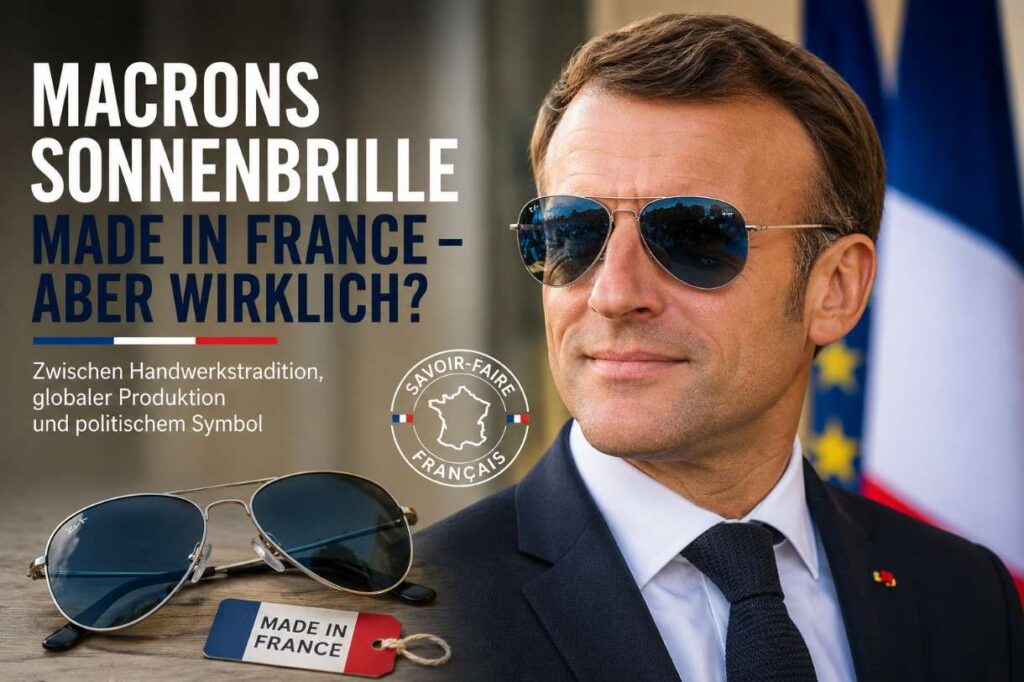
For several years now, they have almost become part of the French president’s uniform: Emmanuel Macron’s dark sunglasses. There is hardly a summer photo without these distinctive models, which, between official visits, walks on the beach and military ceremonies, mean far more than simple protection from the sun. In France they have become a small political symbol: elegant, discreet and unmistakably French.
At least at first glance.
Because around the president’s glasses the same question regularly arises: do these accessories really come entirely from France? The answer is more complicated than the perfectly staged images from the Élysée Palace suggest.
The models Macron usually wears generally come from premium French brands in the Jura. The region around Morez and Oyonnax has been considered for decades the heart of the French eyewear industry. There you find traditional manufacturers, small family businesses and specialized workshops that to this day preserve the French savoir‑faire of the sector.
And it is precisely this image that fits perfectly with the president’s political narrative.
Macron has long favored visible symbols of French production. Tailored suits, watches, leather shoes or bicycles: many things should preferably come from domestic manufacturing. The message they convey is clear: France still has industry, craftsmanship and quality. In a country that has suffered factory closures and the loss of numerous jobs, this symbolism carries enormous weight.
But when it comes to glasses, the situation quickly becomes blurred. Or rather: globalized.
Because even where “Made in France” appears on the temple, often only part of the production actually comes from France. Some frames are made entirely in Jura — from cutting the acetate to final assembly. Other models, by contrast, combine international supply chains. The hinges come from Asia, certain materials from Italy, the lenses from other European countries. The final manufacturing steps are carried out in France.
Legally, this is usually sufficient to be able to use the coveted country-of-origin label.
It is precisely here that the debate regularly arises. Critics accuse the industry of using patriotic imagery even though production is deeply internationalized. Defenders argue that in a globalized economy there are hardly any industrial products made 100% in a single country anymore.
And in fact, Macron’s glasses tell much more about France than just a question of fashion. They reflect a country that proudly defends its historical artisanal traditions, while at the same time remaining deeply integrated into global production chains. 21st-century “Made in France” often consists less of total national autonomy and more of design, assembly and brand identity.
Perhaps that is why the president’s glasses are so fascinating.
They sound French — although their story is already European and global.