
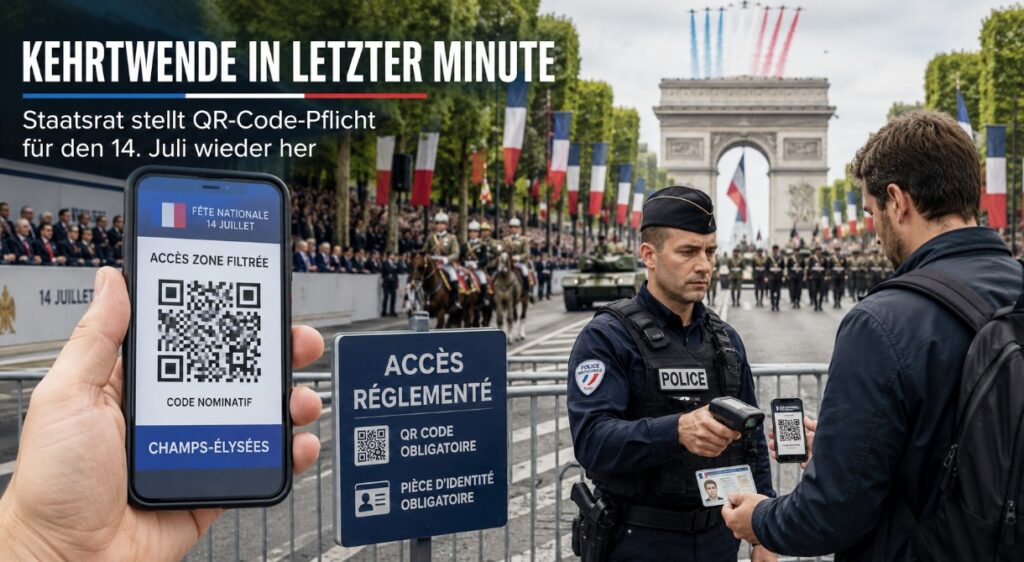
Just hours before the start of the traditional military parade for France’s National Day, the French Council of State (Conseil d’Etat) made a surprising reversal. After the Paris Administrative Court on Monday suspended the requirement to present a QR code for access to the cordoned-off areas of the Champs-Elysees, the country’s highest administrative court reinstated the measure during the night of July 14.
Access to the particularly secured areas of the parade therefore remains subject to prior registration.
QR Code and ID Requirement Reinstated
Visitors wishing to enter the controlled zones along the Champs-Elysees must once again present a personalized QR code. In addition, a valid identification document is required, and its details must match those on the QR code.
The security checks are intended to ensure that only previously registered individuals are granted access to the sensitive areas of the event.
Security Interests Prevail
The Conseil d’Etat justified its decision by citing the exceptional security requirements surrounding the military parade. In the court’s view, the imminent start of the event and its considerable security-policy significance justify maintaining the access restrictions.
Particularly significant was the attendance of an exceptionally large number of international heads of state and government, including Ukrainian President Volodymyr Zelenskyy. Added to this are the special protection requirements of a major military event in the center of the French capital.
In the court’s view, under these exceptional circumstances, the public interest in the security of the event outweighs objections to the registration procedure.
An Unusual Legal Sequence
Within just a few days, the legal dispute developed into a remarkable judicial clash.
Initially, the Paris Police Prefecture introduced a mandatory advance registration system with a personalized QR code for spectators for the first time. The civil liberties organization Vigie Liberte subsequently secured an interim suspension of this requirement before the Paris Administrative Court.
The French government immediately appealed the decision. During the night from July 13 to 14, the Conseil d’Etat overturned the Administrative Court’s ruling. As a result, the QR code requirement became mandatory again just hours before the first entry checks began.
Significance Beyond This Individual Case
The decision could have implications beyond National Day. For the first time, France’s highest administrative court has confirmed that, under exceptional security conditions, a pre-entry access system involving personal registration and a QR code may be permissible.
At the same time, this is solely a decision in expedited proceedings. Whether the registration procedure will also withstand a comprehensive legal review in the main proceedings remains open. The fundamental question of the extent to which the state may order digital access controls at major events is therefore likely to continue occupying French courts in the future.
Andreas M. Brucker