
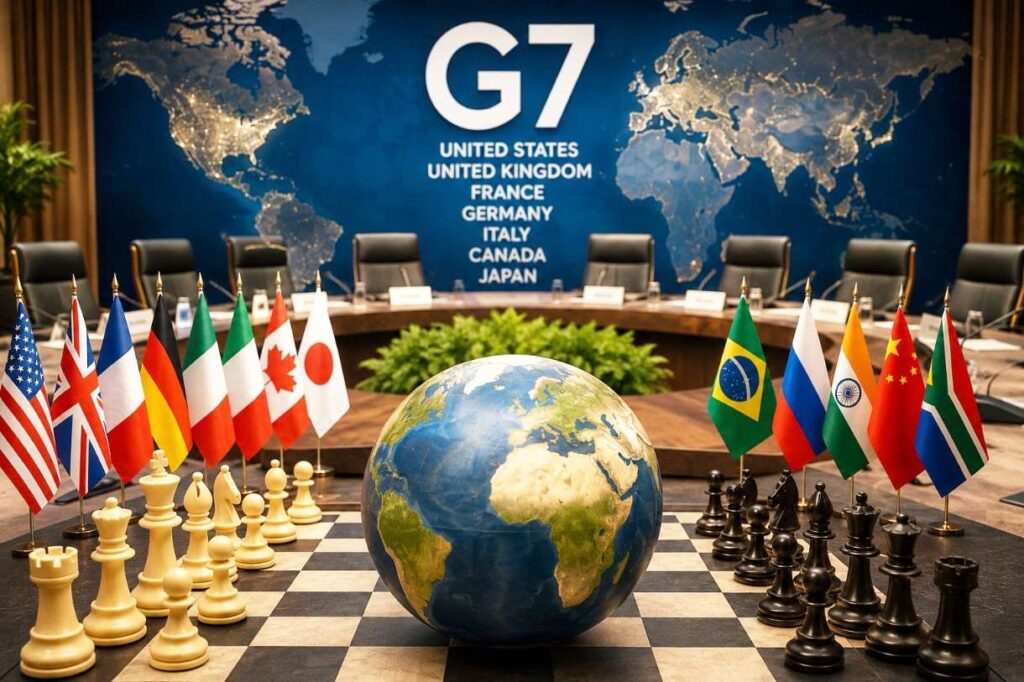
The G7 is often described as a relic of a bygone world order. In reality, the distribution of international power has fundamentally changed since the forum was established in the mid-1970s. At that time, the leading Western industrialized nations accounted for the majority of global economic output. Today, alongside traditional economic powers, China, India, and numerous emerging countries shape the development of the global economy.
However, it would be premature to underestimate the influence of the G7. Although their relative share of global economic output has declined significantly, the group remains a central forum for political coordination among the leading industrial democracies. The G7’s true importance today lies less in its economic dominance than in its ability to formulate common strategic guidelines.
From an economic club to a geopolitical actor
When the heads of state and government of the United States, the United Kingdom, France, Germany, Italy, and Japan met for the first time in 1975, economic issues were at the forefront. The oil crisis, inflation, and currency turmoil required close coordination among the Western industrialized states. With Canada’s subsequent accession, the G7 as we know it today was born.
For decades, the group reflected economic reality. In the 1980s and 1990s, its members accounted for a large share of global economic output, controlled the main financial centers, and largely determined the rules of the international economic order.
However, globalization has changed the balance of power. China’s economic rise is one of the most significant geopolitical developments since the end of the Cold War. At the same time, countries such as India, Brazil, Indonesia, and Saudi Arabia have gained considerable importance. The global economy has become multipolar, inevitably reducing the G7’s ability to determine global developments on its own.
The real strength: political coordination
Despite these changes, the G7 retains significant influence. Its members still account for a major share of global gross domestic product, dominate many high-tech sectors, possess leading financial markets, and form the core of the Western security architecture.
Above all, the forum enables rapid political coordination among the leading democracies of North America, Europe, and East Asia. Unlike international organizations with complex decision-making processes, the G7 operates informally. This flexibility makes it effective in times of crisis.
This has become particularly evident since the Russian invasion of Ukraine. Western sanctions against Moscow would not have been possible in this form without close coordination within the G7. The same applies to support for Ukraine, stabilising energy markets after the cutoff of Russian supplies, and discussions surrounding the management of strategic technologies.
Coordination is also becoming more important on future-oriented issues. The regulation of artificial intelligence, securing critical supply chains, access to rare raw materials, and the resilience of digital infrastructure affect all G7 states. Common standards and coordinated rules can have an impact far beyond the borders of member countries.
The limits of Western influence
At the same time, the structural limitations of the G7 have become clear. Many global challenges cannot be solved without the participation of major emerging economies.
Climate change is the most obvious example. Even the G7’s most ambitious climate protection measures would be ineffective if China and India did not make substantial contributions. The same applies to global trade. The People’s Republic of China is now the main trading partner of many countries and plays a central role in virtually all industrial supply chains.
The question of resources must also be considered. Many of the minerals needed for the energy transition are extracted or processed outside the G7 framework. Talking about lithium, cobalt, nickel, or rare earths necessarily requires including actors that are not part of the Western industrial camp.
Moreover, the economic dynamics of the coming decades will increasingly be shaped by the demographic and growth markets of Asia, Africa, and Latin America. The idea that a small group of Western states could alone set the direction of the global economy no longer corresponds to the realities of the 21st century.
The BRICS Challenge
This change is particularly visible in the rise of the BRICS countries. What began as a loose association of major emerging nations has become in recent years a geopolitical forum with growing self-confidence.
With the expansion to new members, the BRICS increasingly claim to represent the interests of the “Global South.” Many states see them as an alternative to the institutions of the post-war order dominated by Western countries.
However, the influence of the BRICS should not be overestimated. Unlike the G7, they have neither comparable political cohesion nor a common foundation of values. The interests of China, India, Brazil, or Saudi Arabia differ considerably on many strategic issues. Border conflicts, geopolitical rivalries, and divergent economic priorities complicate the adoption of a unified position.
This is precisely where the G7 format still has an advantage. Its members share fundamental political and economic principles and can therefore often develop common positions more quickly.
Normative power rather than economic dominance
The role of the G7 has therefore evolved. Whereas the group previously exerted its influence mainly through its economic superiority, its current importance rests more on its power to set standards and its political influence.
International standards often first emerge in the major Western economies. This applies to digital regulation as much as to financial market rules, export controls, or technological security standards. Due to the economic importance of their markets, decisions by G7 states can have global effects.
This form of influence is less visible than traditional power politics, but often more effective in the long term. Whoever sets the standards shapes the rules of the game for future developments.
The current debate on artificial intelligence illustrates this particularly well. While technological competitors are positioning themselves around the world, the leading democracies are trying to develop common safeguards for security, transparency and accountability. The resulting standards could have an impact far beyond the member states.
The history of the G7 is therefore also one of adaptation to a changed world order. Today, the forum is neither all-powerful nor insignificant. It no longer represents the global economy as a whole, but remains a central coordination mechanism for states that still possess considerable economic, technological and military resources.
This is precisely where the current paradox lies: the G7 is less dominant than it was thirty years ago, but remains indispensable in an increasingly fragmented world. When international crises intensify, geopolitical tensions rise or new technologies require global rules, attention still turns to the major Western democracies. The G7 may no longer be the world’s directorate, but it remains one of its most important reference points.
Author: Andreas M. Brucker