
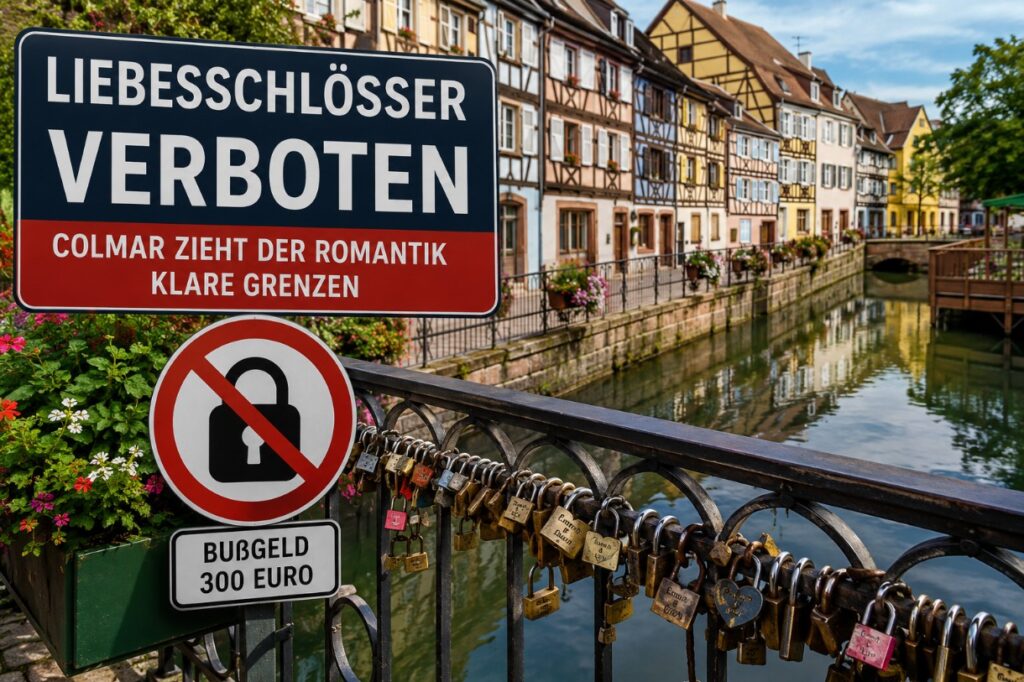
Anyone hoping to seal their love in Colmar with a padlock in the future is in for a surprise. The Alsatian city has officially banned the attachment of so-called love locks to bridges and railings in the famous “Petite Venise” district. Anyone who ignores the ban faces a fine of 300 euros. This brings an end to a tradition that had been inseparably linked to the image of the romantic quarter for years.
For a long time, the small metal locks were among the most popular symbols of eternal devotion. Couples from around the world engraved their names or initials on them, attached the lock to a railing and threw the key into the Lauch. The message behind it was simple: love should last forever. For many visitors, this ritual had become an almost natural part of a stay in Colmar.
But over the years, the romantic gesture developed into a serious problem. More and more locks covered the bridge parapets until hardly anything of the historic railings could be seen. Residents and business owners reported that entire sections had been completely covered in metal. As early as last year, the city had several hundred locks removed. Now, the complete ban marks the next step.
The decision was primarily driven by the need to protect the historic structures. According to the city, around 600 kilograms of metal had to be removed from bridges and railings. This additional weight placed considerable strain on the structures. At the same time, the appearance of the historic old town suffered, with its picturesque canals and half-timbered houses attracting millions of visitors every year. “Petite Venise” in particular is considered one of the best-known photographic motifs in Alsace – and this is precisely the historic atmosphere the city wants to preserve.
Not everyone welcomes the new regulation. Souvenir retailers in particular are critical of the ban. Love locks had been among the best-selling keepsakes for years. Some business owners now fear financial losses and may be left with unsold inventory. Some have also expressed doubts about the legal basis for the decision.
However, Colmar is not alone in taking this step. Other European cities have also had to learn that the romantic tradition has its downsides. In Paris, Rome, Florence and Venice, the growing number of love locks likewise led to restrictions or complete bans. There, the protection of historic structures ultimately took precedence over a cherished holiday tradition.
For couples in love, however, this by no means signals the end of romantic memories. The picturesque canals, flower-filled lanes and historic facades still offer countless opportunities for unforgettable moments. Only one thing will now belong to the past: the lock on the bridge railing.
By C. Hatty