
Commentary
Summer shows no mercy. But even more merciless is a society that has pretended for decades as if concrete wastelands, social exclusion, and political indifference were merely regrettable side effects. Now it has become a question of life and death.
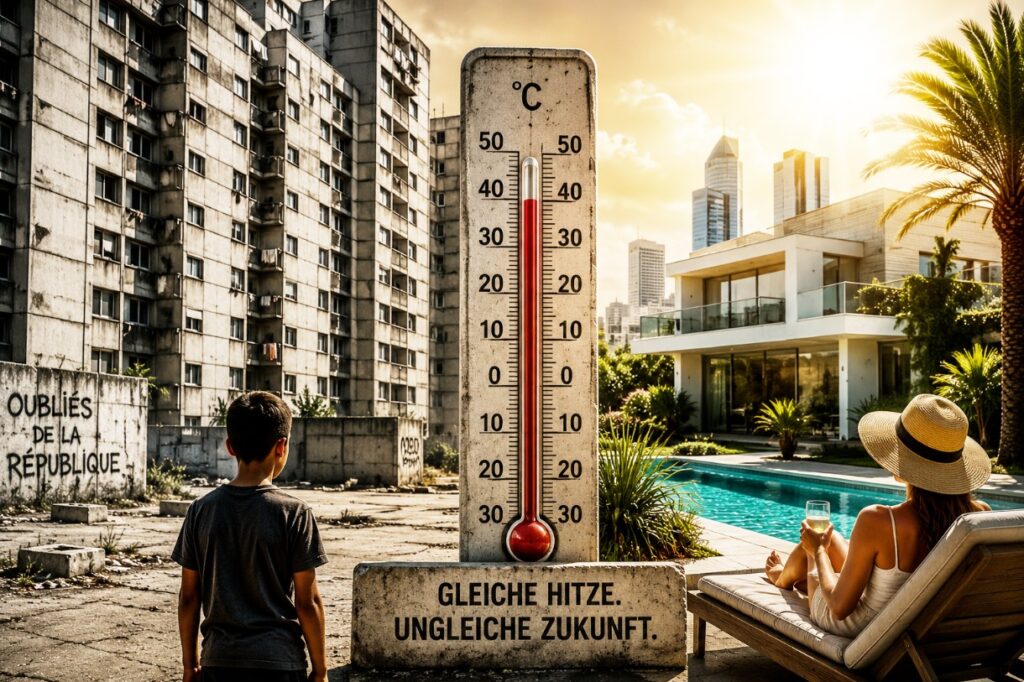
Because while some retreat to air-conditioned villas, keep their swimming pools at a pleasant 26 degrees, and consider whether to visit their second home on the Atlantic coast or rather their holiday house in the Alps, others are stuck in apartments that turn into ovens during the day and barely cool below 30 degrees at night. Welcome to the republic of two temperatures.
One almost has to congratulate France. It has s쳮ded in locking up hundreds of thousands of people in huge concrete silos, denying them trees, green spaces, and investments for decades – and now people are seriously surprised that the heat is particularly unbearable there. Who could have guessed?
Maybe urban planners. Maybe climate researchers. Maybe doctors. Maybe just anyone who has ever walked barefoot over heated asphalt.
But apparently it took temperatures beyond 40 degrees for it to suddenly become clear: concrete stores heat. What a revolutionary insight.
Of course, now they talk again about the “heatwave of the century.” That sounds dramatic and has a pleasant side effect: it suggests that no one is to blame. Just the weather. Force majeure.
No.
The heat comes from above. The social catastrophe was built from below.
It was planned. Approved. Financed. Managed for decades.
Those who house people in apartment blocks without shade, parks, or proper insulation must not be surprised later when these buildings become heat traps. This is no fate. This is politics made of concrete.
It becomes particularly cynical when tips are distributed afterwards.
“Drink enough water.”
Oh really.
“Avoid physical exertion.”
Tell that to the delivery driver carrying packages up to the fifth floor. The cleaning staff. The construction worker on the scaffolding. The caregiver without air conditioning. People who cannot choose their working hours according to the weather app.
And then comes the favorite sentence of affluent society:
“Go to a cool place.”
Which one?
The library that has long since closed?
The air-conditioned shopping mall where you should preferably consume?
Or maybe just your own holiday house? Oh no, wait – for that you’d have to be rich.
Because that is exactly what it is about now.
Wealth today does not only buy comfort. It buys security.
A well-insulated house.
An air conditioner.
A garden.
A shady plot.
A car with air conditioning.
The possibility to simply drive away.
Poverty, on the other hand, means: windows open – although the same scorching air is outside. Sleepless nights. Circulatory problems. Fear for the children. Fear for the grandparents. And the bitter realization that your bank account now decides how hot life feels.
The climate crisis affects everyone? That sounds nice on panel discussions.
In reality, it hits some with a gentle breeze and others like a sledgehammer.
Those who have money buy adaptation.
Those who don’t get advice.
One could almost laugh if it weren’t so pathetic.
For years, billions were invested in prestige projects. Glass facades, shopping centers, office complexes, stadiums, architectural dreams of concrete and steel. The suburbs often got the usual promise: we’ll take care of it someday.
Now the sun takes care of it.
It knows no electoral programs.
It knows no Sunday speeches.
It burns mercilessly on facades that were never built for such temperatures. And it makes visible what has been politically overlooked for decades: social division now also runs along the thermometers.
Those who are poor live hotter.
So simple. So brutal.
Of course, working groups will now be set up. Expert commissions. National strategies. Round tables. Action plans with nice-sounding names and glossy brochures.
Meanwhile, families try once again to survive the night somehow.
It is a remarkable contradiction of our time.
Never has so much been spoken about climate protection.
And rarely has so little been said about those whom climate change hits first.
Not on islands in the Pacific.
Not someday.
But right in France. Today. In the suburbs of the big cities.
Perhaps the greatest injustice of this heatwave isn’t the temperatures.
But that some people can escape it – and others are exposed to it.
Heat is no longer weather.
It is a class difference.
And as long as an air-conditioned living room says more about life expectancy than gender and statistics of past times, no one should claim that our society is sweating only because of the sun.
A commentary by Andreas M. Brucker