
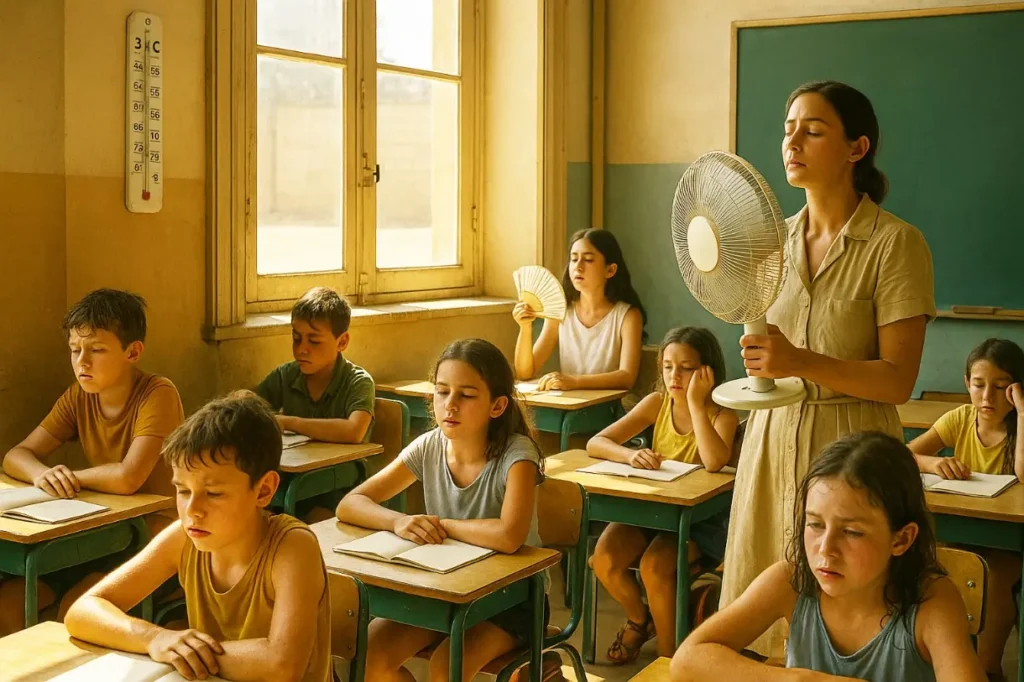
Classrooms that turn into stuffy hot boxes by mid-morning. Schoolyards that seem deserted at lunchtime. Teachers desperately searching for shady spots to make lessons somewhat bearable. With every heatwave in France, the same question arises — and it is more pressing than ever: Does the school rhythm still fit a climate that has noticeably changed?
The French school calendar comes from a time when extreme summer heat was more the exception than the norm. Today the reality is different. Heatwaves often begin as early as June and frequently extend well into September. Especially in the south of the country, temperatures regularly climb above 35 degrees Celsius while students are still sitting at their desks.
The problem affects not just certain regions. Many school buildings are considered poorly prepared for high temperatures. Thick walls only help to a limited extent, modern ventilation systems are often missing, and air conditioning is rare. On hot days, teaching can sometimes feel like an endurance contest.
The consequences for learning are obvious. Anyone who has tried to concentrate in stifling heat knows the feeling. Thoughts crawl instead of flying, attention drops, and mistakes multiply. In children, this effect is often even stronger. Fatigue, irritability, and sleep problems add further difficulties to everyday school life.
That is why experts have been discussing new models for years.
One idea is to start lessons much earlier. Instead of 8:30 a.m., the first classes could begin around 7:30 a.m. The advantage seems logical: the most demanding learning phases would take place during the comparatively cool morning hours. In some countries with consistently hot summers, this model has long been commonplace.
But implementation would have consequences. School buses would have to adjust their schedules, families would need to reorganize their daily routines. Many parents start their workday later than their children. This would quickly cause disruption.
Summer holidays are also part of the debate. Some education experts advocate for shorter summer breaks and longer holidays in spring or autumn instead. Others suggest the opposite: starting school later after the summer holidays, when the worst heat has already abated.
Behind this discussion lies another aspect. For decades, France has been among the European countries with particularly long summer holidays. Critics point out that lengthy breaks can promote learning setbacks. Especially children from socially disadvantaged families often lose their footing more easily during holidays.
Many experts, therefore, focus less on the calendar and more on the buildings themselves. They see modernization of schools as the crucial lever. Better thermal insulation, external blinds, greened schoolyards, and efficient ventilation systems could significantly ease daily life. In numerous cities, so-called “oasis schoolyards” are already being created, where trees, plants, and shaded areas noticeably lower the perceived temperature.
However, this debate extends far beyond the education system. It shows how significantly France must adjust to a new climate. For decades, weather conditions were considered relatively stable. This certainty is now melting away like ice in the July sun.
Whether earlier lesson times, changed holidays, or modernized buildings — probably no single path leads to the goal. Rather, a mix of different measures is emerging.
One thing is certain: the French school was designed for a different climate. The coming years will likely show how quickly it can make the jump into a distinctly warmer future.
Author: Andreas M. Brucker