
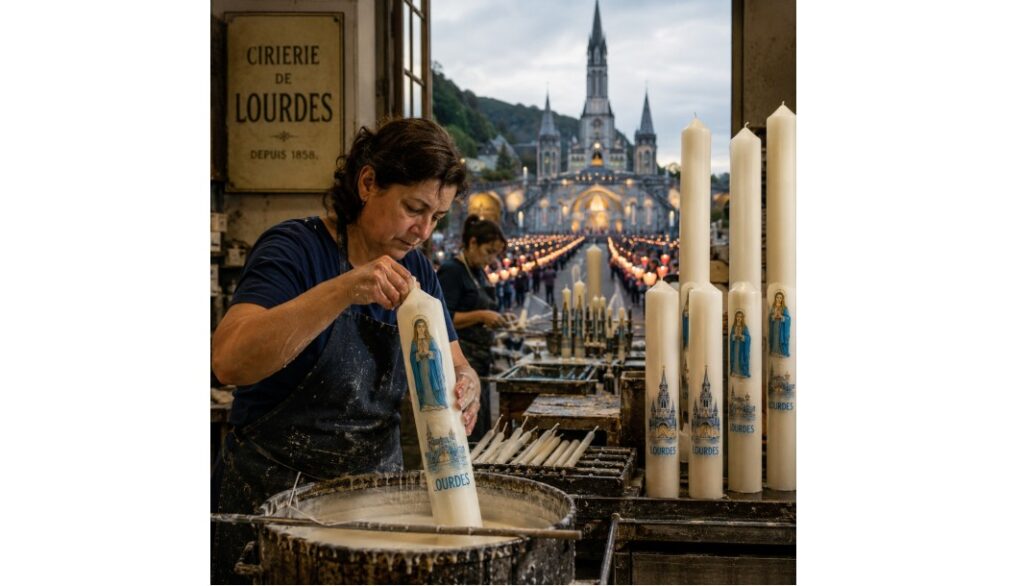
Early in the morning, a scent floats over Lourdes, difficult to describe. A bit of warm paraffin, a hint of soot, and that heavy atmosphere rising from the workshops where, for decades, the same gestures are repeated. While outside, the first groups of pilgrims are already walking along the Boulevard de la Grotte, work begins behind discreet facades, work that belongs to the soul of this town like the sound of the bells or the murmur of prayers.
There, women are lined up at long tables dipping wicks into liquid wax. Again and again. A movement, precise like a perfectly repeated dance.
Some have been working there for thirty years.
Others for forty.
Their hands almost think for themselves.
Lourdes lives on hope. At first, that sounds grand and poetic, almost like a phrase from a Sunday homily. But in this town at the foot of the Pyrenees, the term takes on a surprisingly concrete expression: in the form of a candle. Millions of people travel here each year, lighting small lights at the Massabielle grotto, carrying procession candles as tall as masts in the night, or placing a flickering flame for a deceased loved one. The candle is not just a religious object. It functions as an extension of human desire.
And somewhere between prayer and commerce, a surprisingly resilient craft is born.
Those who visit the workshops will not see a folkloric demonstration for tourists. No picturesque museum romanticism. But work. Real work. The premises seem functional, sometimes almost rough. Metal frameworks. Wax remnants on the floor. The heat. Large vats of molten material. In the middle, women in aprons who barely raise their eyes, because every movement must be precise.
Because a pilgrimage candle forgives no negligence.
Particularly the monumental specimens, carried during Marian processions, require experience that goes down to the fingertips. The wax must be neither too hot nor too cold. The wick must remain perfectly taut. The slightest irregularity is enough for the candle to burn crookedly or become unstable. Outside observers often only see a simple product. But in Lourdes, the making resembles a silent ritual.
“You don’t learn this in books,” says a worker in a local TV report, wiping splashes of wax off her skin with the back of her hand. The sentence seems simple. But it says a lot about France.
The country has been debating for years about lost industries, vanished crafts, and a working world that seems increasingly digitalized. Between artificial intelligence, start-up culture, and automated supply chains, places like Lourdes exist almost like a time capsule. Here, the gesture still matters. The repetition. The muscle memory.
Or, as the French so aptly say: to have the craft in your fingers.
To carry the know-how in your fingers.
What a beautiful turn of phrase.
It does not describe a technical qualification, but a bodily intelligence. A form of knowledge that is ingrained over decades in movements. The hands of these women remember the temperatures, resistances, and tensions of the material like musicians remember chords. Those who have been drawing candles for a long time apparently already recognize by the sound of the wax if the consistency is right. Almost incredible, isn’t it?
Yet, Lourdes itself often looks like a city between two realities. On one side the spiritual realm: pilgrims with rosaries, sick people in wheelchairs, night songs that echo across the squares. On the other, a highly organized economy of worship: hotels, souvenir shops, restaurants, vendors of devotional items. Faith generates demand, demand creates work.
Candle factories are part of this discreet engine of the city.
Few think of them when they light a flame at dusk.
And yet, entire livelihoods depend on them.
An older resident of Lourdes once recounted that almost every family used to know someone who worked in one way or another for the pilgrimage. Some drove pilgrim coaches. Others sewed religious banners. Still others made candles. The town functioned like a small universe centered around spirituality. Today, many things are changing. Cheap imports drive prices down. Young people leave for the big cities. Traditions quietly disappear, often without much drama.
It is precisely for this reason that the sight of these workshops moves people.
Because beneath this, something remains that has disappeared elsewhere.
Of course, candle production also involves modern elements. Safety standards, delivery logistics, machines for certain steps. No one seriously romanticizes twelve hours of work in hot air filled with paraffin fumes. Yet, the essence has remained surprisingly intact. Many gestures are still done by hand. Especially for the large processional candles, the task is still preferably entrusted to experienced workers rather than fully automated processes.
There, routine almost replaces all theory.
Because beneath this, something remains that has disappeared elsewhere.
Of course, candle production also involves modern elements. Safety standards, delivery logistics, machines for certain steps. No one seriously romanticizes twelve hours of work in hot air filled with paraffin fumes. Yet, the essence has remained surprisingly intact. Many gestures are still done by hand. Especially for the large processional candles, the task is still preferably entrusted to experienced workers rather than fully automated processes.
There, routine almost replaces all theory.
The manufacturing follows an almost meditative rhythm. Dip the wick. Remove it. Let it cool. Apply a new layer of wax. Dip again. Repeat. For hours. The process evokes the liturgical repetitions of a religious service. Perhaps it is precisely for this reason that this strange connection between production and spirituality is created. Even the work seems influenced by the rhythm of the pilgrimage town.
Outside, people walk singing in the streets.
Inside, the candles grow centimeter by centimeter.
And sometimes these worlds blend.
The night processions are particularly impressive. Thousands of little lights move slowly through the darkness. From afar, it looks like a glowing stream. Anyone who has witnessed it once hardly forgets this image. The large candles at the front have something almost theatrical about them. The flames flicker in the wind, the wax slowly drips, the voices resonate across the square.
But before this image exists, somewhere on the outskirts of town, women stood at workbenches and inspected every centimeter of these candles.
It is invisible work.
Perhaps that is why it fascinates so much.
In France, there is a deep cultural respect for savoir‑faire, that difficult-to-translate term that oscillates between skill, experience, and style. It is found among bakers, winemakers, seamstresses, or cheesemakers. Lourdes extends this tradition to a spiritual dimension. Here, the craftsmanship does not produce a luxury item for connoisseurs, but an object of emotional significance.
One rarely buys a candle in Lourdes without a reason.
It almost always carries a story.
A prayer for a sick mother.
A memory of a departed father.
The hope for a healing.
Or simply the desire for a small moment of consolation.
Perhaps this explains the seriousness with which they work in the workshops. There, they do not manufacture trivial consumer goods. Each candle will then enter a personal story. The workers know this. Some have followed the same pilgrimage seasons, the same peak summer periods, the same processions for decades. They live Lourdes as an annual cycle of light.
And yet, little is said about them.
Pilgrims photograph the basilica.
Almost no one photographs the workshops.
Yet these places tell a lot about Europe today. About regions trying to preserve their identity between tourism and tradition. About professions whose value is not measured solely in productivity. And about the work of women, often historically invisible, while entire sectors of the economy depended on it.
In Lourdes, candle production is mostly done by women. For generations. Many started young, sometimes just after school. The work demands endurance, concentration, and tremendous precision. The hands age faster. The heat and wax leave marks. At the same time, a silent solidarity forms among colleagues. They know each other’s movements, intervene without speaking, help carry heavy molds.
A little world apart.
Almost a family.
When traveling in France today, one often feels this sense of cultural acceleration. City centers look alike. Small shops disappear. Traditions become tourist decoration. Lourdes, on the contrary, seems remarkably resilient. Of course, there are also neon signs and plastic souvenirs. But beneath this surface, something surprisingly old remains.
The candle makers are part of it.
Their work is nothing spectacular. No glamour. No trendy rediscovery like urban factories. No one is filming Netflix series about paraffin workshops in the Pyrenees. And perhaps that is their entire dignity. They do not work for trends, but for continuity.
Day after day.
Flame after flame.
One could almost say: while the world outside spins at a frantic pace, Lourdes clings to a slower time. To a time of repetition. Of rituals. Of patience. Perhaps that is why so many people seek comfort there. Not just for religion, but for that rare experience of constancy.
A candle burns slowly.
It does not flicker.
It does not send notifications.
It demands attention.
And perhaps it contains a silent lesson for our time.
Because in an era of constant speed, the workshops of Lourdes seem almost subversive. There, experience matters more than exposure. There, products are made not in seconds, but layer by layer. There, hands still retain meaning.
Who would have thought that a candle could say so much about France?
About faith.
About work.
About memory.
And about people whose names almost no one knows, even though without them the famous luminous processions of Lourdes would never have the same impact.
When in the evening the flames dance along the basilica and the pilgrims raise their candles against the night sky, no one sees the workshops anymore. No one thinks of the melted wax or the heavy metal molds. Only the visible light remains.
Perhaps that is enough.
An article by Mr. Legrand