
Today, those who pick up a pen belong almost to a small silent minority. Notes end up on smartphones, letters in the cloud, memories on hard drives. Paper is everywhere and at the same time invisible. It is under printers, in archives and shipping boxes. Few anymore ask where it comes from, how it is made or who makes it.
In an old rural building in the heart of Auvergne, a young man asks himself exactly these questions.
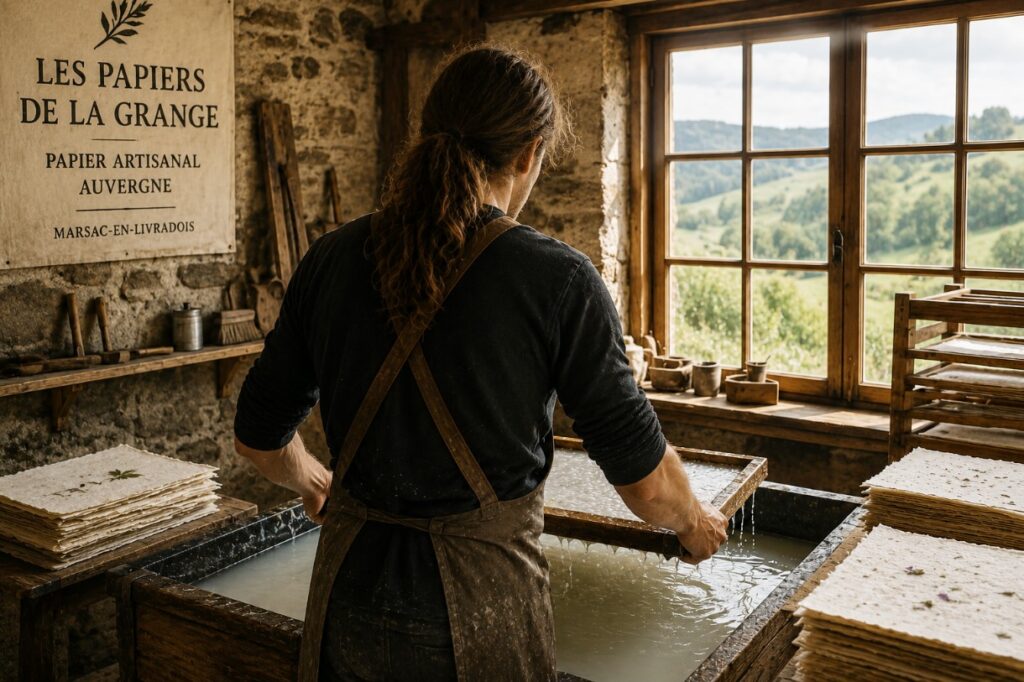
Étienne Gouttefarde, just over thirty years old, lives and works in Marsac en Livradois, a municipality in the Livradois Forez regional park. There he makes handmade paper. Sheet by sheet. Slowly. With concentration. Almost as people did centuries ago.
In an era when speed has become the measure of all things, this seems almost like a silent act of resistance.
Those who enter his workshop do not hear the noise of machines. No conveyor belts are running. No assembly line sets the pace. Only water, wood, textile fibers and hands. Many hands.
Here paper is not born as an industrial product. It grows.
The path was not at all straightforward. For a long time, nothing suggested that Étienne Gouttefarde would become a papermaker. His education initially led him elsewhere. Sports played an important role in his life. So did travel. Knowing the world, accumulating experiences, being on the move – for a long time this seemed to be his calling.
Then came 2022.
As often happens in life, a great story begins by chance.
Gouttefarde discovers the historic Richard de Bas, one of the last historic paper mills in France. The paper mill site is one of those places where the past is not displayed, but lived. Here, sheets of handmade paper have been produced for centuries, long before industrial processes revolutionized their manufacture.
For the young Auvergnat, a door opens to an unknown world.
Suddenly he is immersed in a craft that requires patience. Precision. Attention to details that many no longer notice.
He learns to prepare the fibers, to create the sheet, to press and to dry.
Above all, however, he learns to wait.
Because good paper cannot be rushed.
What begins as a professional experience quickly turns into passion. Working with the material fascinates him. Every fiber tells its story. Every surface reacts differently to light, humidity, or touch.
One could say: he falls in love with paper.
And as with every great passion, at a certain point the role of observer is no longer enough.
From collaborator he becomes creator.
From apprentice craftsman he becomes a full-fledged craftsman.
From craftsman to entrepreneur.
With “Les Papiers de la Grange” Étienne Gouttefarde founds his workshop. The name sounds modest. Almost rural. But behind it hides an ambitious project.
He wants to preserve ancient knowledge without turning it into a museum.
Because in this he sees a danger for many traditional crafts. They are admired, photographed, awarded. But they lose their place in everyday life. They become fossilized in folklore.
Gouttefarde thinks differently.
For him, paper has not only a past but also a future.
For this reason, he experiments with materials. In addition to classic plant fibers, he uses recycled paper and so-called chiffon paper, produced from old fabrics. Flower petals find their way into the pulp. Herbs. Seeds. Sometimes even small mineral elements from the landscape of his homeland.
This is how sheets that almost look like small landscapes are made.
No one is the same as another.
Those who touch them feel irregularities. Structures. Scars.
Traces of the production process.
While industrial products mainly aim at uniformity, handmade paper lives through its peculiarities. It is precisely the small imperfections that constitute its charm.
It somewhat resembles human faces.
Perfection often bores.
Character, on the other hand, remains imprinted in the memory.
Customers no longer come only from the region. Artists order his papers for watercolors and art prints. Bookbinders appreciate the high quality of the fibers. Designers seek materials with a story. Wedding couples want unique invitations.
In a world of standardized products, the desire for uniqueness grows.
Perhaps this also explains the success of many young artistic craftsmen.
Today people no longer buy just objects.
They buy stories.
And who could tell a more beautiful story than a sheet of paper born from old fabrics, local plants, and craftsmanship?
But the workshop alone is not enough for Gouttefarde.
He wants to show how his work is created.
For this reason, he often takes the camera in hand.
Under the ironic name “Le Dur de la Feuille,” he publishes videos on social networks. There he explains production phases now almost unknown outside small expert circles.
Millions of people use paper every day.
Very few have ever seen how it is made.
When Gouttefarde dips a mold into the water and lifts it slowly, the effect is almost meditative. The fibers gather forming a thin layer. From a cloudy liquid suddenly a sheet is born.
Almost like a magic trick.
Only more real.
His videos hit the mark.
Not because of spectacular effects.
But because of their slowness.
While many platforms thrive on frenzy, he shows processes that take time. Movements that demand concentration. Work phases that cannot be sped up.
A counterproposal to continuous scrolling.
And perhaps also an answer to the fatigue many people feel in the face of constant digital bombardment.
After all, who doesn’t like watching how something is born with care?
The response does not take long to come.
An ever-growing community follows his work. Artists, craft enthusiasts, the curious, and collectors follow his projects. Collaborations arise. Exhibitions. Meetings.
Suddenly a niche craft becomes a topic of conversation.
It is remarkable.
For a long time, the craft of the papermaker was considered almost extinct.
Today, craftsmanship is experiencing a small revival.
Not only in France.
All across Europe, young people are rediscovering traditional techniques. They seek tangible jobs. Professions whose results can be touched.
The digital economy often produces the invisible.
A papermaker produces something that rustles between the fingers.
The difference couldn’t be greater.
The recognition for Gouttefarde’s work is steadily growing. In 2025 he receives the craftsmanship award of the Auvergne Rhône Alpes region. The recognition does not only reward the quality of his products.
It rewards an attitude.
The conviction that tradition should not be a hindrance.
That innovation does not necessarily have to come from technology.
And that the future sometimes begins exactly where people rediscover ancient paths.
Whoever enters his workshop today does not meet a nostalgic. Gouttefarde does not dream of a return to centuries past.
He uses social media.
He collaborates with contemporary artists.
He thinks like an entrepreneur.
Yet he preserves something that has been lost elsewhere: respect for time.
Every sheet of paper requires attention.
Every fiber its place.
Every stage of processing its duration.
It seems simple.
But it is not.
Modern societies often consider time as a resource to be used in the most efficient way possible. In the workshop of Marsac en Livradois, a different logic applies.
Time is not an obstacle.
Time is part of the product.
Perhaps here lies the true charm of his work.
A sheet of handmade paper does not have spectacular value. It does not flash. It does not send notifications. It does not update automatically.
Yet it tells something about the world in which it was born.
About water and plants.
About patience and skill.
About a young craftsman who has chosen not to leave his material invisible.
Sometimes a single sheet of paper is enough to remind us that beauty does not come from speed.
But from attention.
And perhaps this is the true message of Étienne Gouttefarde.
While the world chases speed, somewhere among the mountains of Auvergne a man is sitting above a tub full of fibers, creating sheet after sheet.
Old-fashioned?
Perhaps.
Relevant?
More than ever.
An article by M. Legrand