
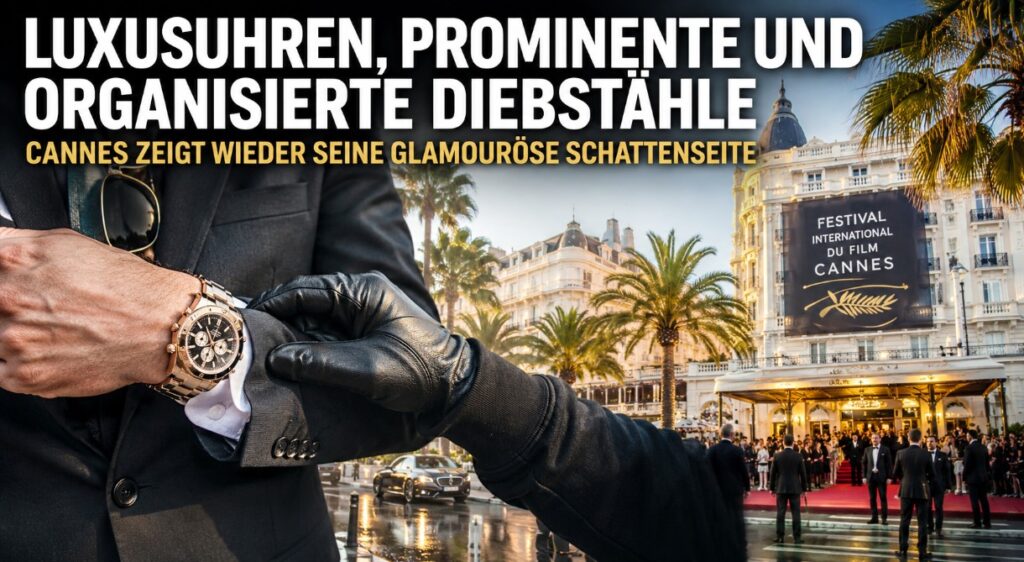
When the flashes shine in Cannes, limousines move slowly along the Croisette and actors leave exclusive hotels with sunglasses bigger than their roles on screen, the Côte d’Azur seems for a few days like a parallel world. Everything glitters. Everything sparkles. And this no longer only attracts photographers.
Around this year’s film festival, reports of spectacular luxury watch robberies are multiplying. It affects millionaires, producers, influencers and entrepreneurs — people who wear their wealth visibly on their wrists. Rolex, Patek Philippe or Richard Mille are no longer just watch brands. They function as small portable fortunes. Easily transportable, extremely valuable and coveted on the black market like gold bars.
French authorities speak openly of professionally organized criminal groups. They are not occasional thieves nor spontaneous assaults. Rather teams with a clear division of labor who travel expressly to Cannes during the festival. They watch restaurants, beach clubs and hotel lobbies. Often a quick glance at the wrist is enough.
Then everything happens very quickly.
A push in front of the hotel entrance. A brief distraction. Sometimes even a direct grab while passing by. In seconds a watch with the value of an apartment disappears. To outside observers it seems almost surreal — like a scene from a 1970s French gangster film. Only without a soundtrack.
Especially striking: thieves are increasingly acting offensively. Whereas these thefts used to happen discreetly, today they occur even on the Croisette itself, right in front of luxury hotels and in full view of numerous pedestrians. Thus Cannes presents itself once again as a place of extremes. There is the luxury of yachts, champagne receptions and diamond jewelry. And on the other hand, organized crime, specialized precisely in this world.
The political debate was not long in coming.
Conservative commentators see these incidents as a symbol of the state’s declining ability to maintain control. Left-wing voices, by contrast, argue that every year Cannes stages an almost provocative display of wealth — thereby inevitably attracting criminals. Indeed, the festival sometimes resembles a showcase for global luxury capitalism. Those who want to stand out there often wear on their arm what others earn in an entire year.
And therein lies the psychological particularity of these cases.
Luxury watches no longer just serve to tell time. They mark status, influence and belonging to an exclusive world. On social media, influencers present their models as trophies. Businesspeople talk about limited editions with the same passion with which others talk about classic cars or art collections. The problem: visible wealth also creates visible targets.
Many famous guests now consciously avoid flashy outfits or travel with additional security staff. Some hotels have strengthened their security measures, others offer discreet transport or private entrances. Even so, a feeling of constant nervousness persists. Behind the sunglasses and the flashes grows an atmosphere more reminiscent of high-security zones than a film festival.
Thus, Cannes remains a fascinating contradiction. A stage for cinema, glamour and the staging of power — but also a place where the dark aspects of extreme visibility are shown with particular clarity. The brighter the luxury, the more those who want to take advantage of it stand out.
A little crazy, yes.
Perhaps that says more about modern France than any political debate. Because between the red carpet and the police sirens, in Cannes there are often only a few meters.
Andreas M. Brucker