
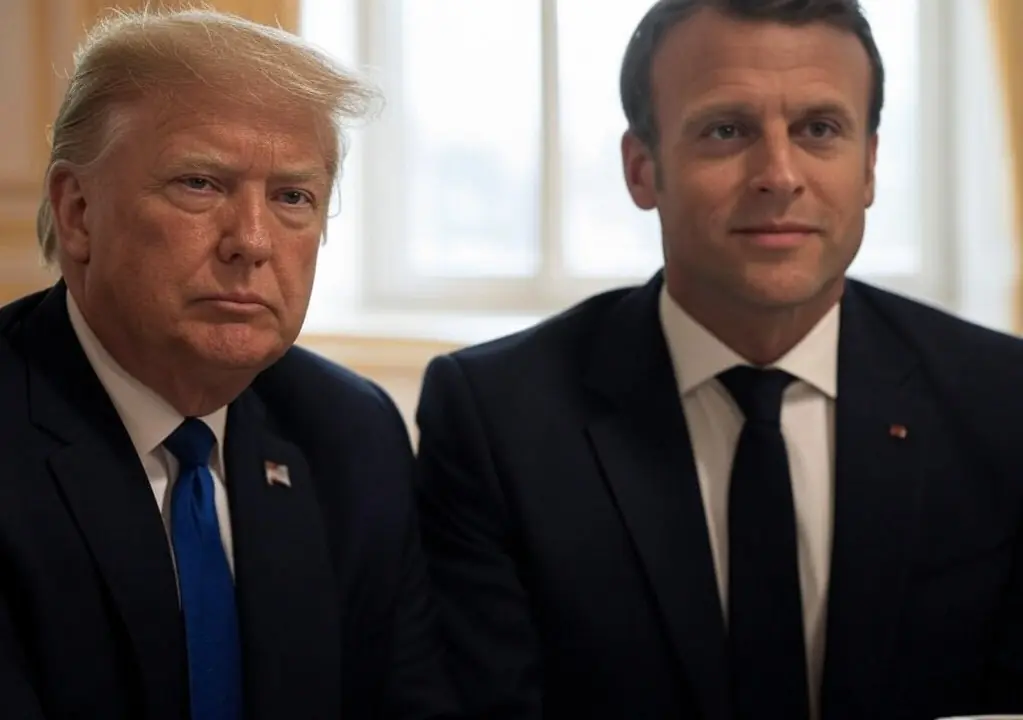
The G7 Summit in Évian was dominated by two crisis zones that have shaped international politics for years: the Russian war of aggression against Ukraine and the ongoing instability in the Middle East. At his closing press conference, France’s President Emmanuel Macron took the opportunity not only to assess the outcomes of the meeting but also to defend his own foreign policy strategy. The focus was particularly on the relationship with US President Donald Trump, whose stance on Ukraine Macron considered a remarkable step forward.
Convergence on the Ukraine Issue
Perhaps the most important message from the French president concerned the development of the American position towards Ukraine. Macron expressed his conviction that Donald Trump has now come closer to the European viewpoints than he did just a few months ago.
Notable was the personal assessment by the French head of state. He emphasized that he had always trusted Trump and pointed out that the American president, despite some political differences, generally honors his commitments. This statement is remarkable insofar as the relationship between Paris and Washington has repeatedly been marked by tensions in recent years – whether in climate policy, trade policy, or European security architecture.
From the French perspective, this development indicates that Washington now more clearly identifies Moscow’s responsibility for continuing the war and supports Ukraine’s territorial integrity more distinctly. This would be of considerable importance for the European countries. Since Trump’s return to the White House, there had been concern that the United States might reduce its commitment to Kyiv and largely leave the Europeans to bear the financial and military burdens alone.
Western Unity as a Strategic Goal
Macron highlighted the cohesion of the Western democracies as the central achievement of the summit. Despite differing domestic political interests, a common line towards Russia was maintained.
The G7 countries reaffirmed their support for Ukraine and discussed further economic pressure measures against Moscow. The focus was particularly on the energy sector, which remains a central source of revenue for the Russian state. At the same time, ways to expand Ukraine’s defense industry and further strengthen the country’s air defense capabilities were discussed.
For France, this unity holds not only military but also political significance. Since the beginning of the war, the Kremlin has sought to play Western states against one another and exploit signs of fatigue within the support coalition. Every visible unity among the G7 counters this strategy.
Macron made clear that a significant part of his diplomacy aims to permanently bind the United States to Europe’s side. The transatlantic partnership remains, despite all debates about European autonomy, the foundation of the Western security order.
The Middle East Remains a Geopolitical Risk Factor
In addition to Ukraine, the situation in the Middle East occupied a broad space. The summit took place against the backdrop of ongoing tensions between the United States and Iran. The fear of further escalation concerns not only the regional actors but also the major economic nations.
Macron advocated for a sustainable stabilization of the region and emphasized the particular importance of the Persian Gulf and the Strait of Hormuz. A significant portion of the world’s oil and gas transport passes through this narrow waterway. Any military escalation could therefore have immediate impacts on energy prices, inflation, and global supply chains.
France traditionally pursues the approach of keeping diplomatic channels open even in difficult conflicts. Macron thus stressed the necessity of political negotiations to prevent an expansion of regional conflicts. Given the economic uncertainty in many industrialized countries, another geopolitical shock to the global economy would be barely bearable.
The Controversial Dialogue with Donald Trump
Another focus of the press conference was Macron’s relationship with Donald Trump. The French president once again faced accusations of being too lenient toward his American counterpart.
Especially the festive setting of the summit and the subsequent meeting in Versailles had sparked criticism. Macron’s opponents accused him of elevating Trump through symbolic gestures. The president, however, firmly rejected these allegations.
According to his view, successful diplomacy consists precisely in maintaining dialogue with difficult partners. Macron recalled that he had never hidden his disagreements with Trump. At the same time, it is necessary to maintain personal communication channels to be able to influence political decisions.
This approach corresponds to a long tradition of French foreign policy. Charles de Gaulle already understood diplomacy as an instrument to remain communicative with as many relevant actors as possible – regardless of ideological differences. Macron clearly builds on this understanding and tries to position France as a mediator and interlocutor in an increasingly polarized world order.
France’s Claim to International Influence
The press conference also served Macron to underscore France’s claim to foreign policy leadership. He explicitly described Versailles as an instrument of French diplomacy and a symbol of national influence.
Behind this lies a strategic goal that Macron has pursued since taking office: Europe should be able to act more independently in a world of growing great power rivalry. The competition between the United States and China is increasingly shaping the international order. France sees this as necessitating the expansion of European capabilities in defense, technology, energy, and industrial policy.
The concept of “strategic autonomy” remains a core element of French foreign policy. It does not mean turning away from the United States but rather Europe’s ability to act independently if necessary. The war in Ukraine has exposed the limits of European defense capabilities as well as the continued dependence on American military support.
Macron’s appearance in Évian thus illustrates a fundamental balancing act of French policy: on the one hand, Paris relies on close cooperation with Washington; on the other hand, it pushes for more European independence.
From the French president’s perspective, the G7 Summit primarily achieved one goal: preserving the political cohesion of the West in a phase of growing uncertainty. However, it remains open whether the rapprochement Macron highlighted between Donald Trump and European Ukraine policy will last. Equally uncertain is the further development in the Middle East, whose crisis potential continues to pose significant risks for the global economy.
What is certain, however, is that France intends to actively expand its role as a diplomatic middle power. Macron presents himself as a bridge builder between Europe and the United States as well as an advocate for a capable Europe. In an international order increasingly shaped by conflicts and geopolitical rivalries, this balancing act will likely be among the central challenges of his remaining term.
Author: P. Tiko