
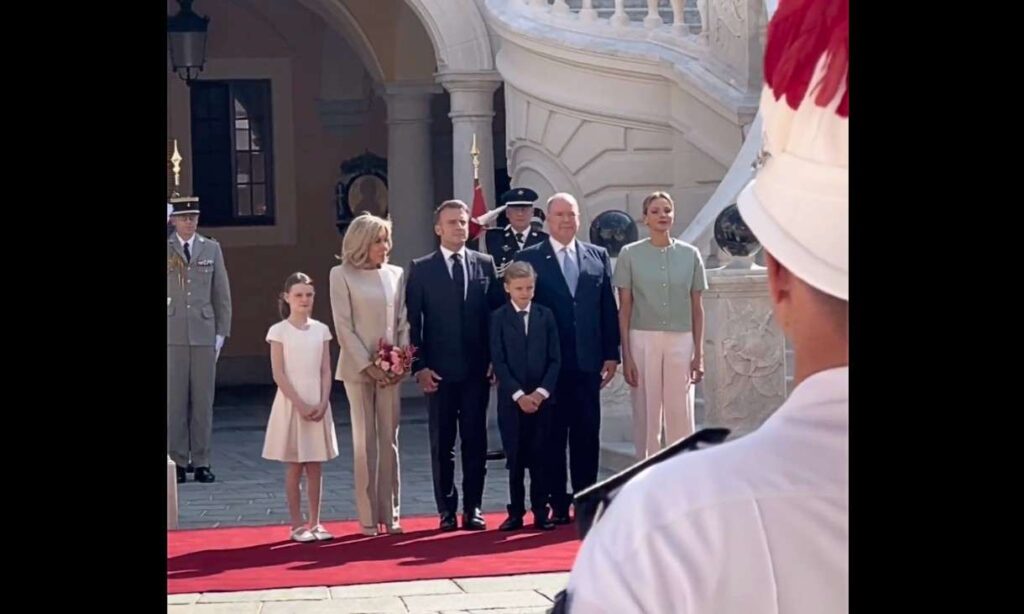
For the first time since 1984, a French head of state has again made an official visit to Monaco. Emmanuel Macron used his trip to the small Mediterranean monarchy not only to renew bilateral relations but also to put key issues such as security, environment, and European integration on the agenda.
On June 7 and 8, 2025, Macron traveled to the Principality together with his wife Brigitte – a historic visit, considering that François Mitterrand was the last president to undertake this diplomatic gesture. The Macrons were received in the Honor Courtyard of the Prince’s Palace by Albert II, Princess Charlene, and the twins Jacques and Gabriella. The ceremonial setting with anthems and troop parade emphasized the state-political character of the visit – and at the same time illustrated the close, yet independent, partnership between France and Monaco.
Bilateral rapprochement with strategic depth
The focus of the political talks was on strengthening bilateral cooperation – particularly in the area of customs administration. With a new agreement, Paris and Monaco reaffirmed their intention to exert stronger control over cross-border money flows. At a time when international financial flows are increasingly under regulatory pressure, the intensification of cooperation between France and the tax-privileged Monaco is a signal to Brussels – and a step towards increasing fiscal transparency in the common economic area.
A new emphasis has also been placed on traffic safety: The joint use of traffic and sanction data, especially with regard to the enforcement of fines, is intended to more effectively punish cross-border offenses in the future. The small city-state, embedded in the French road network, relies on close coordination with its neighbor. The fact that concrete agreements for harmonization have now been made is a sign of pragmatic diplomacy.
The Ocean as a Geopolitical Metaphor
A highlight of the visit was the symbolic naming of an underwater mountain in the Indian Ocean in honor of Prince Albert II. The “Mont Albert II” – a geological formation nearly 2000 meters high – is meant to commemorate the engagement of the Monegasque head of state for marine protection. With this gesture, Macron not only honored Albert’s decades-long work in the service of maritime sustainability, but also positioned France as a central actor in preparing for the upcoming UN conference on the protection of the oceans.
The ecological dimension of the state visit was by no means limited to symbolic politics. Macron informed himself about the innovative project “Seawergie,” in which seawater is used for energy-efficient heating and cooling of buildings – a model with signaling effect for urban coastal regions. At the Oceanographic Museum of Monaco, he also took a look into the future of the Mediterranean region, which was presented with an interactive exhibition project about the year 2050. Here, a diplomatic narrative manifested itself: environmental policy as a framework for transnational cooperation.
Closeness to the Population as a Political Gesture
Away from the protocols, the presidential couple also showed themselves to be close to the people. During a walk through Monte-Carlo, Macron and his wife engaged in conversation with passersby, visited well-known places in the city, and presented themselves as likeable guests in a state whose population lives the close connection to France not only institutionally but also culturally.
These moments away from the diplomatic agenda were not just photo opportunities. They conveyed a central political concern: the portrayal of a relationship that goes beyond agreements – supported by mutual respect and historical connectedness. Since the French-Monegasque Convention of 1918, which regulates France’s political protection over the principality, a form of coexistence has developed that is asymmetrical but remains unique in its form.
Diplomacy in the Face of Growing European Expectations
Macron’s visit must also be understood against the backdrop of European expectations of the small states on the continent. The EU is increasingly pushing for uniform standards in taxes, financial regulation, and ecological transformation. Monaco, which is not a member of the European Union but in many ways intertwined with it, faces the challenge of reconciling its sovereignty with the demands of its partner states.
In this tension, Macron acts as a bridge builder. The French president offered the principality a cooperative relationship without increasing diplomatic pressure. At the same time, he signaled to the international community that France is willing to moderate reliable partnerships even on sensitive issues such as financial transparency and tax harmonization.
The state visit to Monaco was therefore more than a polite ritual. It illustrated how modern diplomacy is shaped between large and small states – with symbolic power, clear agreements, and an awareness of the greater challenges of our time. It was a visit with depth – geological, political, and diplomatic.