
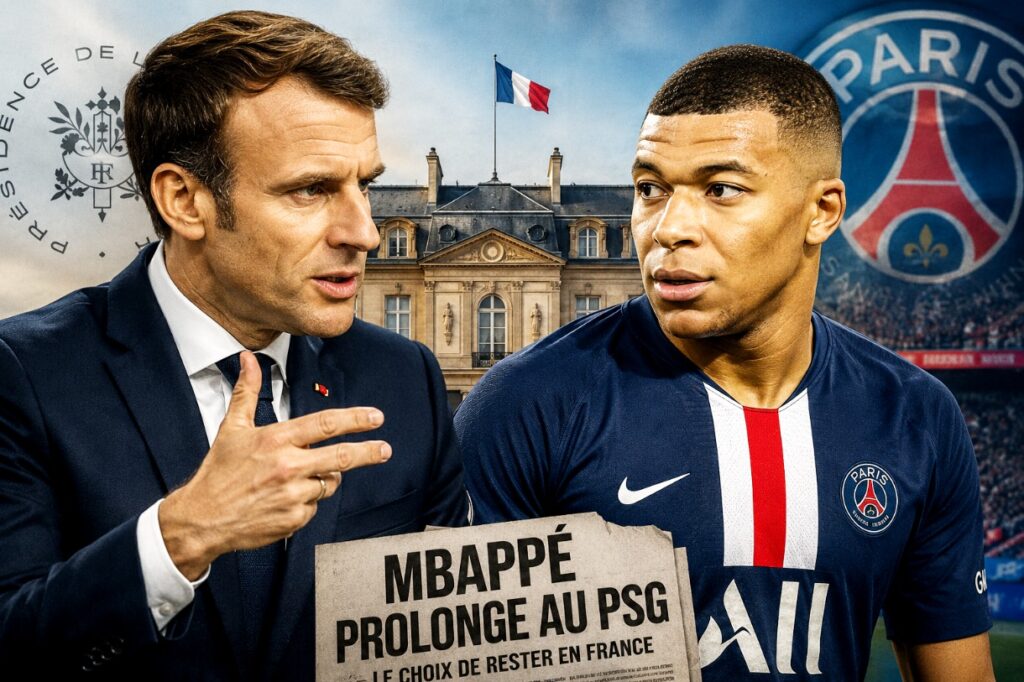
When Emmanuel Macron personally intervened in Kylian Mbappé’s future in spring 2022, it was no longer just about a spectacular football transfer. At the Élysée Palace, the World Cup winner was seen as far more than an exceptional striker: he was regarded as a symbol of French excellence, the showcase of national sport, and a personality with considerable influence far beyond the borders of football. Several subsequent reports and statements by those involved suggest that Macron saw Mbappé as a kind of strategic asset for France – almost like a national cultural asset that should not be allowed to leave for abroad.
At the time, the course of events already seemed clear. Mbappé’s contract with France’s leading club, Paris Saint-Germain, was nearing its end, and almost the entire international sports press agreed that his transfer to Real Madrid was imminent. In Spain, his arrival was already considered a done deal. Many observers saw Mbappé as the natural successor to Lionel Messi and Cristiano Ronaldo as the defining figure of world football.
Behind the scenes, however, an unusual political dimension was developing. Macron decided to get involved personally. The French president later publicly confirmed that he had held discussions with Mbappé before the final decision. He had advised him to continue his career in France for the time being. Macron justified his intervention by stating that it is the duty of a head of state to defend the country’s interests when a figure of such importance faces a decisive decision.
The conversations appear to have left a strong impression. Mbappé later said in several interviews that Macron had clearly indicated that he wanted him to remain in France. The president not only emphasized the sporting importance of the forward, but also mentioned his role in the country’s international reputation and the attractiveness of the French league. Mbappé himself admitted that the words of a head of state naturally carry particular weight.
The Élysée’s exceptional intervention can be explained by the context of the time. France was preparing for several major international events, including the Olympic Games in Paris. At the same time, the Football World Cup was looming in Qatar, whose sovereign wealth fund owns Paris Saint-Germain. The departure of France’s most famous footballer would have had repercussions not only in sporting terms, but also symbolically. Macron, who has taken an interest in the economic and social importance of sport for years, understood Mbappé’s significance for the international perception of French football.
According to the player, the president did not limit himself to a call to stay. On the contrary, he argued that a transfer abroad would always be possible later. The central message was as follows: Real Madrid will still exist in several years, but France needs its star now. This patriotic approach apparently struck a chord with Mbappé, who has always attached great importance to his identity as a French player and whose career is closely linked to the Paris region.
However, it would be reductive to attribute the decision solely to Macron’s influence. Equally important were the negotiations with Paris Saint-Germain, the sporting prospects within the club, and the exceptional financial terms of the new contract. Mbappé repeatedly emphasized that many people had participated in his decision-making process. Nevertheless, he confirmed that the French president was among the voices whose opinions he took seriously.
The staging of his contract extension in May 2022 underscored the political and symbolic dimension of the event. In front of thousands of spectators, Mbappé declared that he was staying in Paris and expressed his attachment to his hometown and to France. The choice of words was remarkably solemn and differed from the usual statements made during contract extensions in professional football.
In retrospect, this episode appears to be an exceptional moment at the intersection of sport, politics, and national identity. Although the transfer to Madrid ultimately took place, the events of 2022 show how important Mbappé was to France at that time. Rarely in recent European sporting history has a head of state intervened so directly in the future of an individual athlete.
This case also illustrates a shift in the perception of elite sport. Global stars such as Kylian Mbappé are no longer regarded solely as athletes. They serve as ambassadors for their country, influence their nation’s international image, and possess an economic and cultural significance that extends far beyond the playing field. For Macron, Mbappé embodied precisely this new generation of global sporting icons. His staying in Paris was therefore not only about football, but also a matter of national prestige.
Author: P. Tiko