
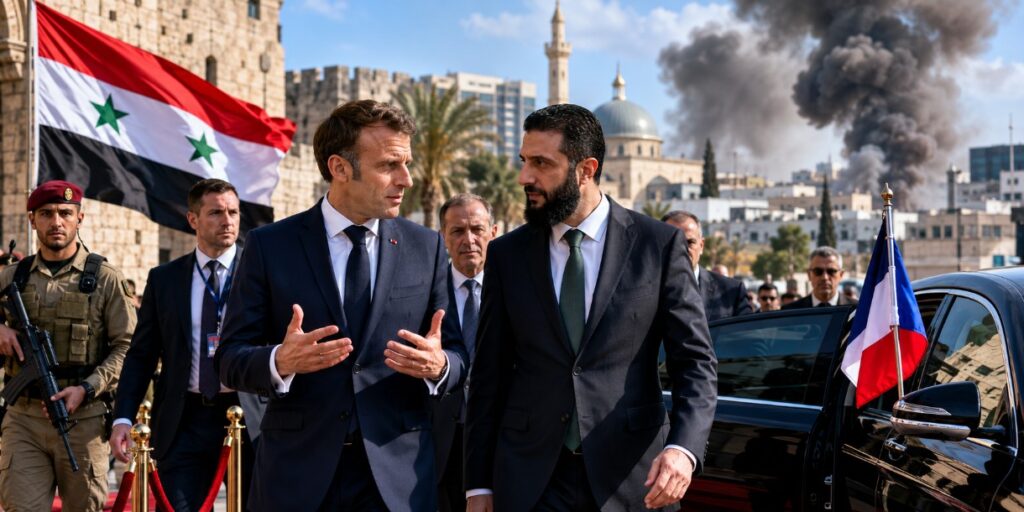
French President Emmanuel Macron sent a foreign policy signal of considerable significance with his trip to Syria. As the first head of state or government of an EU member state since the change of power in Damascus, he visited the Syrian transitional president Ahmed al-Charaa and openly expressed support for the political transformation process. The visit was, however, overshadowed by two bomb attacks in the immediate vicinity of the hotel where the French delegation was staying. The explosions, which according to Syrian authorities injured 18 people, underscore how fragile the security situation in the country remains despite the end of Assad’s rule.
Macron was not deterred from his schedule by the attacks. The French president continued all appointments as planned, thereby demonstrating determination toward those forces that want to destabilize the political transition.
France’s return to Damascus
The trip marks a turning point in France’s Syria policy. For years Paris had categorically ruled out any normalization of relations with the Assad regime and actively supported its international isolation. With the overthrow of Bashar al-Assad at the end of 2024, however, a new political environment opened up in which France was among the first Western states to seek dialogue with the new leadership.
In recent months Macron had already held several talks with transitional president Ahmed al-Charaa. The visit to Damascus now represents the most concrete step in this rapprochement to date. Both states agreed to fully restore diplomatic relations and to exchange ambassadors again. This ends a phase of diplomatic distance that had shaped bilateral relations for many years.
For Paris, normalization is not an end in itself. France aims to actively shape the political change while regaining influence in a region where Russia, Turkey and various Gulf states have grown significantly in importance in recent years.
Security remains the greatest challenge
The attacks during the state visit dramatically highlighted the existing risks. The two explosive devices detonated near the Four Seasons hotel, which is considered an especially secure residence for diplomats and international organizations. Macron was already on his way to the presidential palace at the time of the explosions and remained uninjured.
No organization has claimed responsibility for the attack so far. Security circles, however, consider several scenarios plausible. In addition to cells of the terrorist militia Islamic State, other armed groups could also be behind the explosions, aiming to sabotage the political transition or to deter international investors.
The new Syrian government faces the difficult task of stabilizing a country that has experienced more than a decade of civil war, international sanctions and the collapse of state institutions. Despite military successes against numerous rebel groups, regional militias, terrorist networks and criminal structures continue to exist that exploit the power vacuum.
Macron therefore emphasized that economic reconstruction and security are inseparable. France will support Syria in the fight against terrorist groups, while at the same time demanding the protection of all ethnic and religious minorities.
Economic interests come to the fore
Besides the political dimension, the trip has a clear economic component. Macron was accompanied by a delegation of French companies that are to explore opportunities for investments in infrastructure, energy supply, transport and logistics.
After years of destruction, Syria faces a gigantic reconstruction task. Roads, power grids, ports, industrial facilities and public institutions must be rebuilt in large parts of the country. International estimates assume that investments in the triple-digit billions will be required for this.
France wishes to position itself early as an economic partner. French companies traditionally have close ties in the Middle East and hope to secure significant contracts in the reconstruction. At the same time, Paris has the opportunity to expand its economic influence vis-à-vis competitors from China, Russia or the Gulf states.
However, reconstruction remains closely tied to political progress. International investors will only provide capital on a larger scale in the long term if legal certainty, political stability and reliable state structures emerge.
A foreign policy message to Europe
Macron’s trip is aimed not only at Damascus but also at European partners. While some EU states continue to show great caution toward the new Syrian leadership, France favors controlled political engagement rather than continued isolation.
Paris argues that lasting stability in Syria can only be achieved through international cooperation. Complete exclusion of the new government, by contrast, would increase the risk that other actors permanently take over political and economic influence in Syria.
France is pursuing several strategic interests at the same time. In addition to combating Islamist terrorist organizations, containing irregular migration, enabling the return of Syrian refugees, stabilizing the eastern Mediterranean and securing economic opportunities all play a central role.
The trip also underlines Macron’s ambition to continue positioning France as an independent foreign policy shaper within Europe. While international attention has recently concentrated above all on the war in Ukraine and tensions in the Indo-Pacific, Paris is once again attempting to set diplomatic accents in the Middle East.
Whether this strategy will be successful, however, depends less on symbolic state visits than on developments within Syria. The attacks in Damascus impressively showed that the political transition is far from over. The new leadership must prove that it can guarantee security, strengthen state institutions and integrate different social groups.
For France, the engagement therefore represents a balancing act between political support and cautious distance. Macron has made it clear that Paris is prepared to accompany Syria in reconstruction and international reintegration. At the same time, the expectation remains that the new government will continue on a reform path and create the conditions for lasting stability. Only when security, economic development and political reconciliation all make progress at the same time could the historic rapprochement between Paris and Damascus truly mark the beginning of a new phase in bilateral relations.
Andreas M. Brucker