
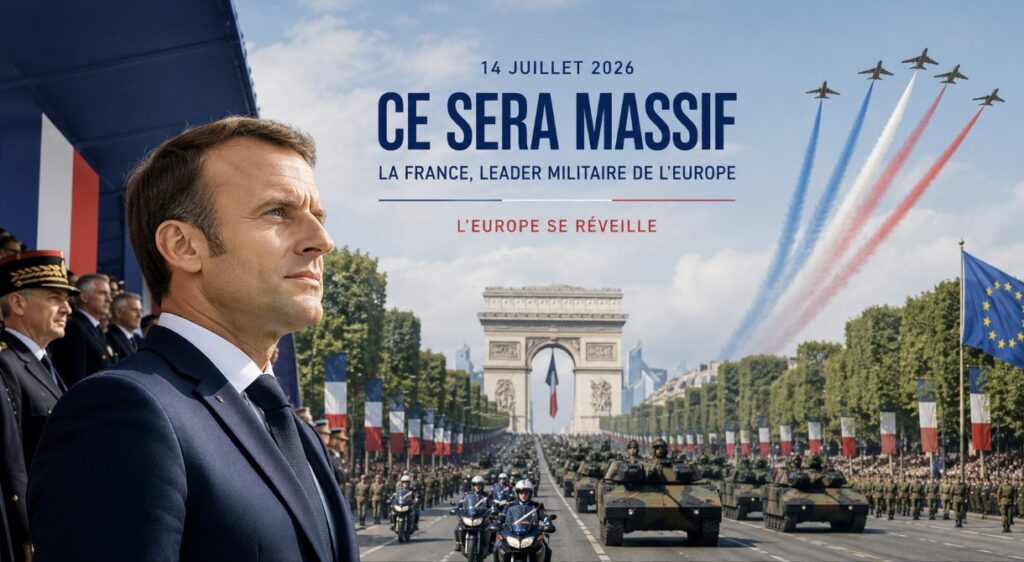
When troops march down the Champs-Élysées on 14 July 2026, it will be far more than the traditional celebration of the French national holiday. Emmanuel Macron is using his final military parade as President of the Republic for a political staging of exceptional symbolic significance. Less than a year before the end of his second term, France presents itself as Europe’s leading military power and combines national tradition with a clear message on European security and defence policy.
Under the motto “It will be massive” – “It will be grandiose” -, the parade is intended not only to demonstrate the capabilities of the French armed forces, but also to underline the ambition to lead Europe on security issues at a time of growing geopolitical uncertainty. The national holiday thus takes on a significance that goes far beyond the festive character of 14 July.
A departure charged with political symbolism
For Emmanuel Macron, this national holiday has particular personal significance. His second term will end in spring 2027, and the French Constitution prohibits him from running again. The parade thus becomes the final major state military event of his presidency.
While many presidents viewed 14 July primarily as an expression of republican tradition, Macron uses this occasion to highlight his record on security. Since taking office in 2017, he has regularly advocated for stronger European defence, greater strategic autonomy and increased investment in the armed forces. What was often perceived at the time as an ambitious vision for the future now appears much closer to political reality in light of Russia’s war of aggression against Ukraine.
France, Europe’s military anchor
This year’s parade conveys three central messages. First, France presents itself as the strongest military power in the European Union. Since the United Kingdom’s withdrawal, no other EU member state possesses comparable military capabilities, its own nuclear deterrent and worldwide deployment capabilities.
Second, European cooperation must become visible. The parade is explicitly held under the banner of closer military cooperation within Europe. France wants to demonstrate that European armed forces are increasingly planning, training and, if necessary, able to act together.
Thirdly, the deterrence capability of the French army is brought to the forefront. The war in Ukraine has profoundly changed European security priorities. The defense of national territory and the alliance has once again gained significantly in importance compared with overseas operations. Paris intends to demonstrate that France has armed forces that are rapidly operational, capable of conducting complex operations and acting alongside European partners.
The change since 2017
The contrast with Macron’s first national holiday in 2017 could hardly be more striking. At the time, Donald Trump was the guest of honor in the official stand. International attention focused primarily on a military band that surprisingly performed Daft Punk’s hit “Get Lucky”—a moment embodying lightness and cultural openness.
Nine years later, the tone is instead noticeably more serious. The international security situation has fundamentally changed. Russia’s war against Ukraine, growing tensions between major powers, and uncertainty about the long-term reliability of American security guarantees have placed European defense policy at the center of concern.
The 2026 military parade therefore deliberately forgoes spectacular moments of popular culture and instead emphasizes classic military symbolism. Strength, operational readiness, and deterrence dominate the picture.
Europe at the center
The European dimension of the event is particularly noteworthy. For years, Macron has advocated for Europe to become more autonomous in security matters and to rely more heavily on its own capabilities.
This message is now finding its most visible expression. For the first time, the parade is set to conclude with the European anthem. The French national holiday is thus deliberately enriched with European symbolism. The message is: national defense and European cooperation are not mutually exclusive; they complement each other.
For Macron, this is the logical continuation of his political line. As early as his Sorbonne speech in 2017, he had advocated for a common European defense. Many of his proposals at the time initially met with reservations. However, security developments in recent years have contributed to many European states significantly increasing their defense spending and intensifying their cooperation.
Military strength as a political signal
Thousands of military personnel as well as numerous armored vehicles, aircraft, and helicopters take part in the parade. The capabilities presented serve both national defense and multinational operations.
The event is not aimed solely at the French public. Its international impact is equally important. Allies must perceive France as a reliable military partner, while potential adversaries must recognize the operational readiness and deterrent capability of the French armed forces.
In a period of growing geopolitical uncertainty, military parades therefore fulfill a dual function. They serve national affirmation while also constituting strategic communication directed abroad.
A political legacy
The 2026 military parade will likely be remembered as one of the most symbolic moments of Emmanuel Macron’s presidency. It combines the republican national holiday with a foreign and security policy message that has marked his entire term: Europe must assume greater responsibility for its own security, and France sees itself in a leading role in this regard.
The question of whether this vision will endure after the end of his presidency will not be decided on the Champs-Élysées, but in European capitals. With his final parade as President of the Republic, Macron nevertheless makes a deliberate political statement. July 14, 2026, is intended not only to recall the history of the French Republic, but also to affirm the ambition of positioning France as a driving force behind a European Union capable of acting on security matters.
Andreas M. Brucker