
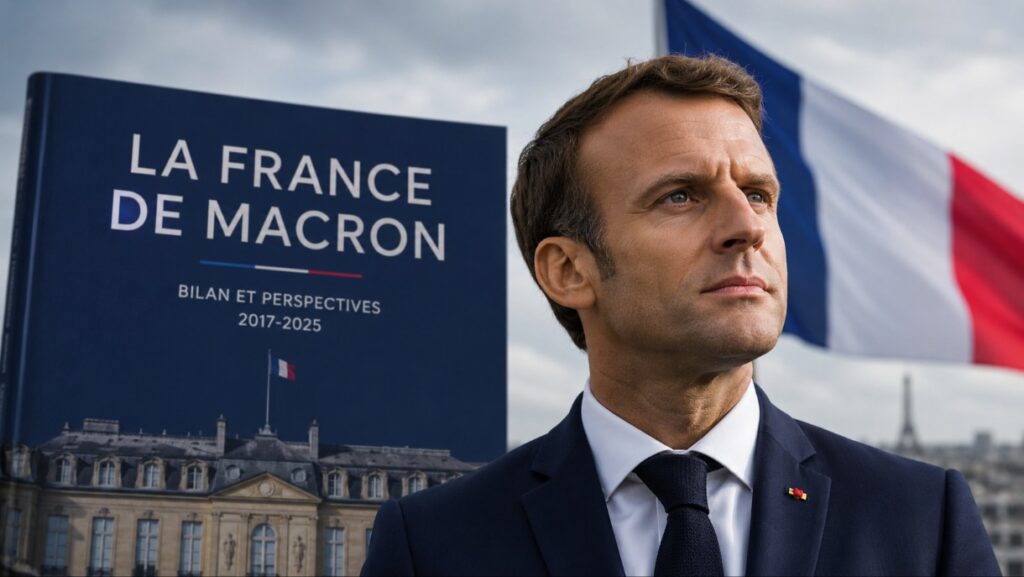
Less than a year before the end of Emmanuel Macron’s second term, the struggle over his political legacy has already begun in France. As the political debate increasingly focuses on the 2027 presidential election, former companions of the head of state are working to anchor the past ten years in as coherent a political narrative as possible. A dossier specifically prepared under the title La France de Macron is intended to document, contextualize and defend the reforms of the past two terms.
The initiative makes clear that the battle over the historical assessment of the Macron years has long since begun. Because although Emmanuel Macron cannot run again under the constitution, his political legacy is likely to shape French domestic politics for years to come.
A political legacy outside the Élysée
The dossier was not officially published by the Élysée Palace. Rather, it comes from several former staff members and advisers of the president who want to portray his time in office retrospectively as a coherent reform project. The goal is to present a comprehensive assessment of the measures implemented since 2017 and at the same time counter the numerous accusations that accompanied Macron during his presidency.
It’s not solely a listing of individual reforms. Rather, the so-called Macronism is to be described as a distinct political epoch—with a clear strategic guiding principle: strengthening French independence.
According to the authors, this motif runs through almost all political projects of recent years—from economic competitiveness to energy policy to defense and industrial policy.
Economy as the centerpiece of the assessment
The economic policy record is particularly extensive. The dossier highlights falling unemployment, numerous corporate relocations, and the strengthened reindustrialization of France. After years of industrial job losses, new factories emerged especially in battery technology, electric mobility, semiconductor production and the pharmaceutical industry.
France’s attractiveness to international investors is also considered a success. France repeatedly secured top positions in European rankings for foreign direct investment. Tax reforms, the abolition of the wealth tax on financial assets and extensive investment programs were intended to strengthen the business location and make the country more internationally competitive.
From Macron supporters’ perspective, these developments mark a fundamental change of course compared to the economic policies of previous governments.
Energy, defense and strategic sovereignty
Another focus is on France’s strategic autonomy. The authors point to the expansion of nuclear energy, new investments in renewables and extensive measures to secure energy supply after the start of Russia’s war of aggression against Ukraine.
At the same time, France invested heavily in its armed forces. The defense budget was raised several times, new armament programs were launched and France’s role within the European security architecture was strengthened. At the same time, Macron repeatedly advocated for greater strategic autonomy for Europe—a concept that gained importance especially after the geopolitical tensions of recent years.
Digital technologies, artificial intelligence and semiconductor production are also presented in the dossier as components of a comprehensive strategy for technological sovereignty.
The difficult path to historical assessment
However, the publication does not take place in a political vacuum. Rather, it falls into a phase in which many potential successors to Macron are already positioning themselves within the political center. Without an incumbent president as a repeat candidate, the debate begins about what lessons should be drawn from the past decade.
Against this background, the dossier is not only a retrospective. It also attempts to set the political framework for the period after Macron. The message is that the reform policy of recent years should not be understood as a sequence of individual measures, but as a long-term project to modernize France.
At the same time, this creates an ideological foundation that potential successors in the liberal and pro-European camp could refer to.
An assessment with considerable potential for conflict
Whether this portrayal will endure remains open. Hardly any French president of the Fifth Republic has polarized society as much as Emmanuel Macron.
His supporters point to deep structural reforms of the labor market, the pension system and to an economic modernization that has made France more resilient to international crises. From their point of view, the comparatively robust development of the labor market and the return of industrial investment are also seen as lasting successes.
Critics, however, recall the most serious crises of his presidency. The Yellow Vest protests shook the country for months and revealed deep social divisions. The controversial pension reform triggered mass protests and was implemented without a parliamentary vote. Added to this were the political deadlock after the loss of the absolute majority in the National Assembly and the surprising dissolution of parliament in 2024, the consequences of which continue to occupy French politics to this day.
For many French people, these events weigh just as heavily on the image of recent years as economic indicators or foreign policy initiatives.
The struggle over Emmanuel Macron’s political legacy has thus only just begun. The dossier La France de Macron is less a conclusive review than the start of a struggle over the interpretation of a presidency that has profoundly changed France. Whether in the end the narrative of a successful modernization or that of a president who both reformed and polarized the country prevails will not be decided by historians alone. The political debate up to the 2027 presidential election is likely to largely determine how the so-called Macron decade will be remembered in the future.
Author: P. Tiko