
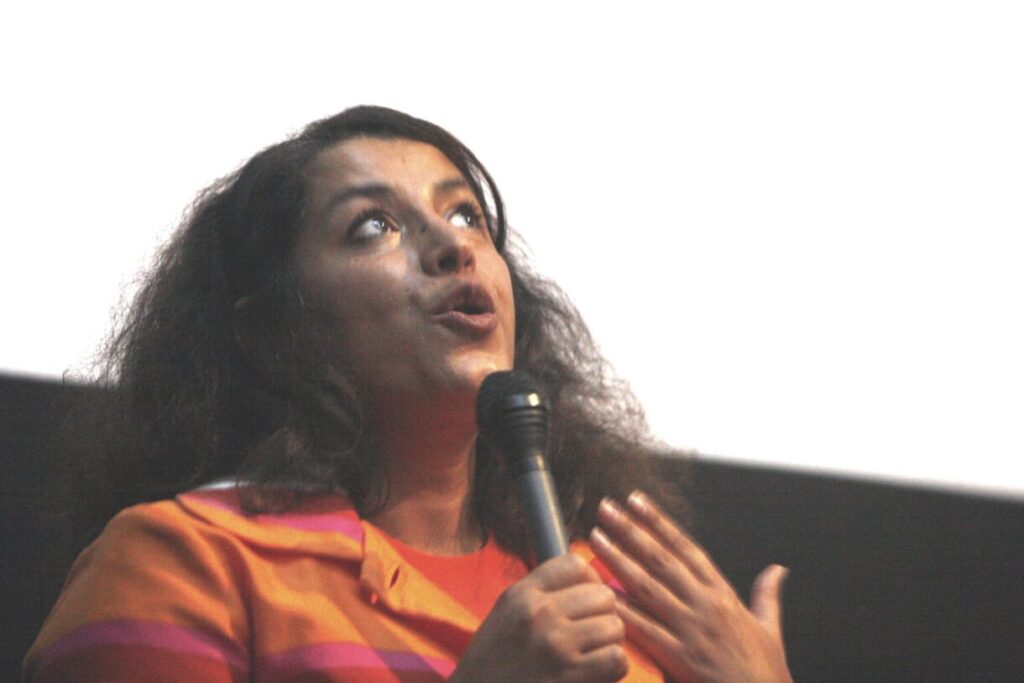
With Marjane Satrapi, the international and French cultural scene loses one of the most significant artists and storytellers of our time. The Franco-Iranian author, illustrator, and director died on June 4, 2026, in Paris at the age of 56. Her death caused deep sorrow far beyond France.
Particularly moving is the statement from those close to her. Satrapi was said to have “died of sadness.” An unusual expression that nevertheless reveals much about the last months of her life. Friends and companions report that she never overcame the death of her husband Mattias Ripa. The Swedish producer and screenwriter passed away in the spring of 2025. They had shared their lives for more than three decades. After this loss, Satrapi increasingly withdrew and apparently lost the strength that had distinguished her throughout her life.
Marjane Satrapi was born in 1969 in Rasht in northern Iran. Raised in Tehran, she experienced as a child the Islamic Revolution of 1979 as well as the years of the Iran-Iraq war. These formative experiences left deep traces and later became the foundation of her artistic work.
As a teenager, she left her homeland and initially went to Austria. The experience of foreignness, homesickness, and the search for her own identity accompanied her from then on. In 1994, she settled permanently in France. There she found not only a new home but also the creative freedom to tell her story.
Satrapi became world-renowned through her autobiographical graphic novel Persepolis. The work was published in the early 2000s and quickly became an international bestseller. With clear black-and-white drawings, she portrayed her childhood in Iran, the political upheavals in her homeland, and her path into exile. Millions of readers thus gained a rare, personal insight into a society that is often perceived in the West only through political headlines.
The success of Persepolis was not limited to the book pages. The 2007 film adaptation, which Satrapi co-directed, thrilled audiences and critics alike. The film was celebrated at the Cannes Festival and received an Oscar nomination. She achieved something extraordinary: she made a deeply personal story a universal tale about freedom, identity, and courage.
But Marjane Satrapi was much more than a celebrated artist. She repeatedly raised her voice against oppression and censorship. She was especially committed to supporting the Iranian protest movement “Woman, Life, Freedom,” which gained worldwide attention following the death of Mahsa Amini. For many Iranians at home and abroad, she embodied hope, resistance, and the belief that art can spark social change.
Her work remains.
Her drawings, films, and texts tell of loss, longing, freedom, and humanity. They build bridges between cultures and remind us that behind political conflicts there are always individual destinies.
With Marjane Satrapi, the world loses an extraordinary storyteller. Her voice has fallen silent, but her stories will live on for a long time.
By C. Hatty