
May 14th appears insignificant at first glance in the French calendar. No national holiday, no military parade. Yet this date holds a surprising political and cultural charge. After all, France would not be France if even an ordinary spring day did not offer starting points for historical debates, social tensions, and grand performances.
May 1968 remains particularly memorable.
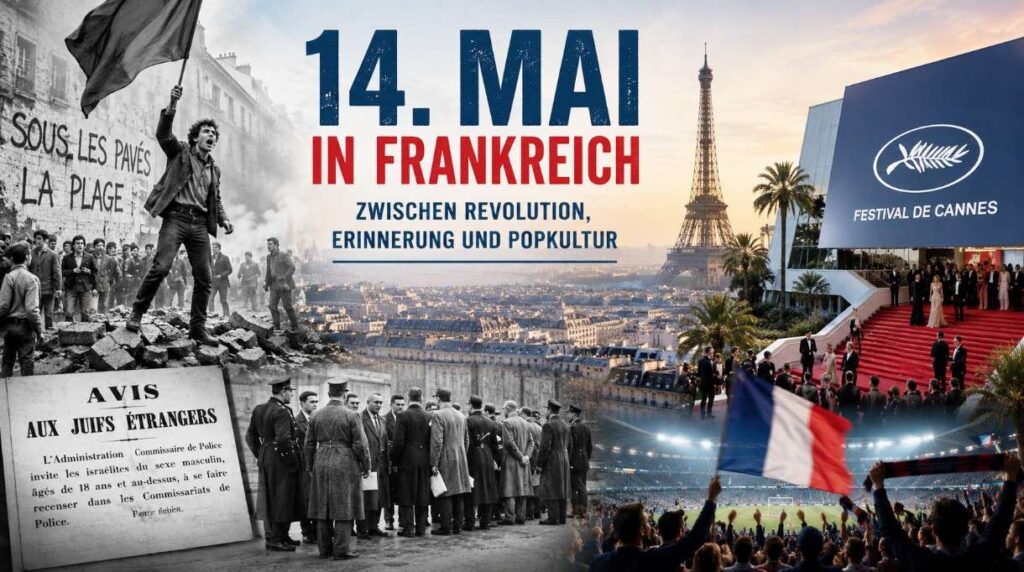
Around May 14th, the protest movement then reached a new dimension. What had started with student protests in Paris suddenly spread across the country. Occupied universities, striking workers, halted factories. Within a few days, France transformed into a powder keg. Millions of people stopped working — an event still considered one of the largest general strikes in Europe.
The images from those weeks still have an impact: barricades in the Latin Quarter, young demonstrators with stones in hand, columns of smoke over Paris. President Charles de Gaulle seemed at times to lose control of the country. Suddenly France was discussing everything together — power, freedom, capitalism, sexual morals, education, hierarchies. The old France cracked. And deeply so.
Even today, “May ’68” almost instinctively sparks controversy. For some, this uprising marked the beginning of a more modern and free country. Others consider it the start of the gradual loss of state authority and social order. In French talk shows, often just the slogan “68” is enough to immediately — trigger a new fundamental debate.
But May 14 also reminds France of a dark chapter in its history.
On May 14, 1941, the so-called “Green Ticket Roundup” began, one of the first major arrest operations against Jews in occupied France. Thousands of men, many of whom were foreign Jews, were summoned by the French authorities, arrested, and then interned. The fact that the French police took an active part in these operations remains one of the most painful points in the national memory culture.
France struggled for a long time to confront this past. For decades, the narrative of a country of the Resistance prevailed. Only later did the responsibility of the Vichy regime emerge more strongly in public consciousness. Today, this confrontation is an integral part of French political culture. Especially in the face of growing anti-Semitic tensions, the memory of such events gains importance again. History here never lies dusty in the archives — it sits at the table with us.
And then there is the other face of France: glamour, cinema, and the grand stage.
In May, attention is traditionally focused on Cannes. While photographers compete for the best shots on the beaches of the French Riviera, France presents itself as a nation of culture with global ambitions. The Cannes Festival is much more than a parade of beautiful dresses and famous faces. Here, politics, art, and self-staging meet. French cultural policy has considered cinema part of the national identity for decades — almost with the same seriousness with which other countries treat their foreign policy.
Sometimes Cannes seems like a parallel universe to the political life in Paris. There, strikes and debates about pensions; here, flashes and champagne. In some way, this contrast perfectly reflects France.
In sports as well, May 14 often falls during a heated phase of the season. Decisive football championships, cup finals scheduled, entire cities anxiously waiting. Football in France has long had a value that goes far beyond sport. Issues of integration, social mobility, and national cohesion are regularly reflected on the field.
May 14 thus exemplifies how France works: this country lives on memory, contradiction, and passion. Past and present continually collide. Even a seemingly ordinary date in the calendar suddenly opens a window onto the great French themes — revolt, responsibility, culture, and social identity.
By C. Hatty