
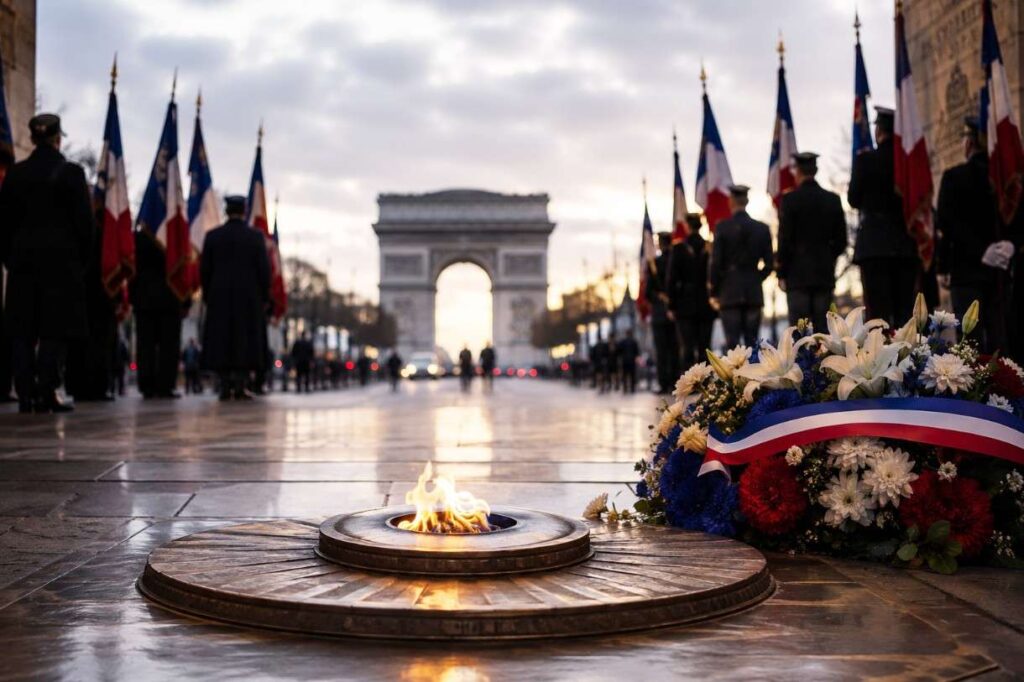
Under the Arc de Triomphe, the flame burns as it does every year. Trumpets sound short, sharp notes into the evening sky of Paris, uniforms shine in the last light, flags flutter in the wind. France masters this choreography of remembrance almost perfectly. May 8th has long been part of the established republican ritual — reliable, dignified, almost timeless.
And yet something else hangs over this day in 2026.
A restlessness.
You see it in the faces of the people standing at the edges of the ceremonies. In the past, many looked at the veterans, the wreaths, and the eternal flame with polite distance. History, after all. Significant, self-evident — but distant. Today, it feels different. War is back in Europe, and suddenly every speech, every moment of silence, and every verse of the Marseillaise sounds more immediate.
Almost oppressively close.
For decades, Western Europe lived with the idea that peace had become a kind of natural state. Borders disappeared, budget airlines connected capitals, young Europeans discussed climate goals, startups, and work-life balance. War belonged in history books or in regions called “crisis zones” in the news. The word alone already created distance.
Then came Ukraine.
Bombed residential buildings. Refugee convoys in winter. Sirens in big cities. Suddenly images appeared that many only knew from documentaries about the Second World War. And with them returned a feeling Europe had almost forgotten: vulnerability.
May 8th therefore no longer only tells of 1945. It also tells of the present.
In France, this shift can be felt most clearly. The official speeches still revolve around the liberation of Europe from National Socialism, but between the lines it is about something else — about democracy, deterrence, and resilience. Words that long sounded almost antiquated are suddenly again at the center of political debates.
It is quite astonishing: Only a few years ago, discussions about ammunition, tank production or defense capability seemed like specialized topics for military historians and security policy circles. Today, TV talk shows discuss missile ranges, reservist models and air defense systems as if they were stock prices or football league tables.
Europe has changed its tone.
And with it, the culture of remembrance is also changing.
For a long time, the celebrations on May 8th gradually lost their existential impact. The last contemporary witnesses died, and the war receded further and further into historical distance. For many younger people, World War II had become something museal — depressing yes, but abstract. One learned dates, visited memorial sites, saw old photographs. But there was an almost unbridgeable distance between one’s own everyday life and the stories of the grandparents.
Now this distance is shrinking again.
When air raid shelters are suddenly being discussed in European capitals, when governments massively increase their defense budgets, and when there is talk of “deterrence” again, the view of 1945 automatically changes as well. The past loses its dust. It begins to speak.
Perhaps this is precisely the real upheaval of these years.
Because the European post-war idea was based on an almost revolutionary promise: Military violence should never again become the decisive instrument between European states. Franco-German reconciliation was considered a historical miracle for decades. Arch-enemies became partners. Battlefields turned into economic axes. Where soldiers once marched, TGV trains later rolled through borderlands.
A success story like no other.
Precisely because of this, the return of war hits Europe so sensitively. It not only destroys geopolitical certainties. It shakes a self-image.
You can notice this in Germany as well. For decades, the Federal Republic defined itself through military restraint. Arms deliveries to war zones were almost considered a moral taboo. Today, the same republic talks about “war readiness,” invests billions in the Bundeswehr, and discusses models of compulsory military service. Just ten years ago? Hardly imaginable.
France, in turn, meets this development with a peculiar mix of historical self-confidence and concern. The country traditionally has a different relationship to the military than Germany. The army is more visibly part of the national identity. Nevertheless, the war in Ukraine is also changing the tone of the public debate there.
May 8 suddenly feels less like a historical obligation and more like a warning.
Perhaps that explains why the ceremonies now attract more people again. Not only older generations with medals on their lapels, but also young families, students, tourists. Some only stop for a few minutes. Others silently follow the military protocol. And yet many seem to be occupied by the same thought: How stable is this peace actually?
An uncomfortable question.
Because Europe is facing a strange paradox. On the one hand, the European Union emerged from the desire to make wars impossible. On the other hand, the same union is today discussing arms production, defense strategies, and military autonomy. A peace project and rearmament at the same time — a contradiction that unsettles many.
A deep cultural difference between Europe and other parts of the world becomes apparent. While power politics is considered a matter of course in some parts of the world, many Europeans long regarded military strength as a relic of past times. Diplomacy, trade, and international law seemed to have displaced the old mechanisms.
Now the old words are returning.
Frontline.
Deterrence.
Defensive capability.
These terms alone already change the political atmosphere.
And one more thing stands out: The memory of the Second World War is once again developing into a political instrument. In almost all camps. European governments refer to the lessons of 1938 and warn against authoritarian regimes and aggressive nationalism. Russia, on the other hand, continues to stylize the “Great Patriotic War” as the core of its national identity and even interprets the war in Ukraine through this historical lens.
History suddenly serves as a weapon again.
This makes the matter so delicate. Because memory has never only to do with the past. It influences the present and future equally. Those who control historical images often also shape political interpretations. Exactly for this reason, the celebrations on May 8 today appear less nostalgic than before. They carry a current message—sometimes openly, sometimes subtly.
This is particularly striking under the Arc de Triomphe.
There, the flame for the unknown soldier has been burning for over a hundred years almost without interruption. Tourists often photograph it casually during the day between croissants and selfie sticks. But in the evening, when the ceremony begins and Paris slows down for a moment, this place unfolds a peculiar power.
Then the flame suddenly no longer seems like a monument to a distant past.
But like a warning signal.
Perhaps that explains the emotional impact of this year’s May 8. People intuitively sense that peace is not a given. It never was. Europe merely had the rare historical fortune to spend several decades in relative stability. For many, this quietly became a certainty.
But history does not like guarantees.
Anyone walking through Paris today, past the wide boulevards and the crowded cafés, first notices little of this nervousness. The city lives, laughs, discusses. Tourists sit by the Seine, waiters balance wine glasses through narrow rows, somewhere an accordion player plays “La Vie en Rose.” Everything seems normal.
And yet underneath this surface lies a new seriousness.
May 8 brings it to light each year for a few hours.
Perhaps this is the real meaning of these memorial ceremonies in 2026: They remind Europe that peace is not a permanent state, but a fragile construction — laboriously built, constantly threatened, and never finally secured.
An uncomfortable realization.
But possibly the most important one.
An article by M. Legrand