
May 8th is far more than a historical date in France. The day not only marks the end of World War II in Europe but is also at the very core of French remembrance culture. While other European countries interpret the day differently – as defeat, liberation, or a warning – France understands it primarily as a moment of restored national dignity. The victory over National Socialist Germany became the symbolic endpoint of a deep national humiliation and at the same time the starting point of the modern French Republic after 1945.
To this day, this holiday shows how closely history, state, and national identity remain intertwined in France. May 8th is therefore not only a day of remembrance but also a political ritual. It tells of resistance and collaboration, of General Charles de Gaulle and the liberation of Paris, of national pride and European reconciliation. In a time of geopolitical uncertainty, this historical reference gains political significance once again.
The Defeat of 1940 as a National Trauma
To understand the emotional significance of May 8th in France, one must look back to the year 1940. The rapid military collapse of France against the German Wehrmacht deeply shook the country’s self-understanding. Within a few weeks, the Third Republic collapsed. The authoritarian Vichy regime under Marshal Philippe Pétain then collaborated with the German occupiers.
This experience continues to have an impact today. Historically, France saw itself as a great European power, as the heir of the Revolution, and as a military nation. The defeat of 1940 radically questioned this self-image. All the more, the narrative of resistance and liberation gained importance after the end of the war.
Charles de Gaulle became the central figure of this national assertion. With his famous appeal of June 18, 1940, from London, he embodied the idea of a “free France” that refused to surrender. After 1945, this became a republican myth: Although France had lost militarily, it had resisted morally.
This interpretation shaped French post-war society for decades. The role of the Résistance was emphasized, while the involvement of French authorities in deportations and collaboration was long pushed into the background. Only in the 1990s did a more open confrontation with the responsibility of the Vichy regime begin.
The State as Guardian of Memory
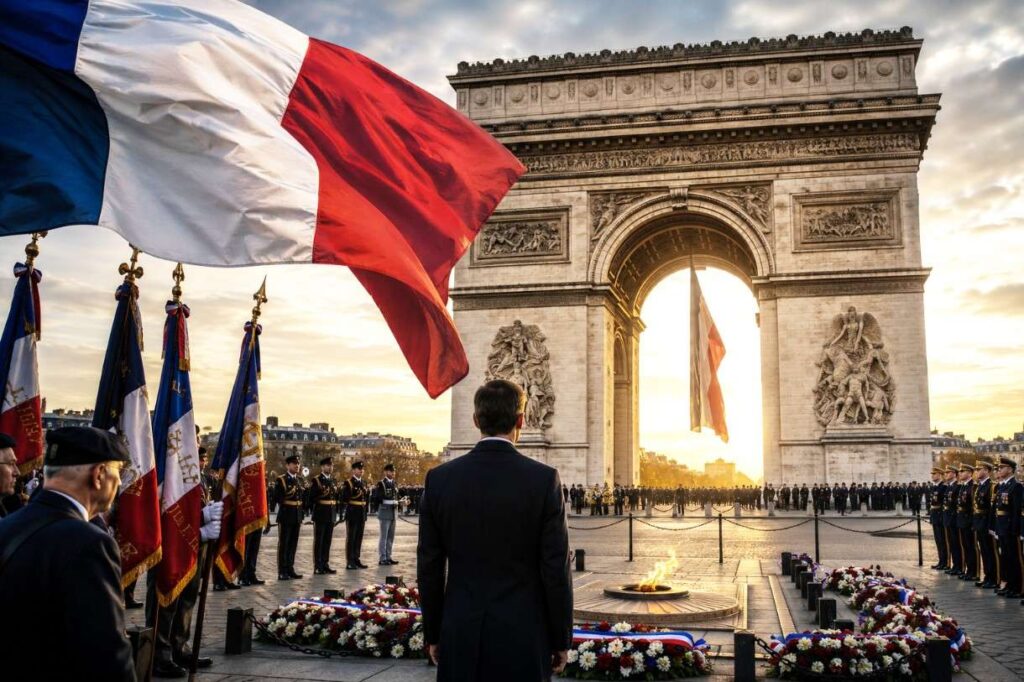
Hardly any other European country stages historical memory as state-centered as France does. The ceremonies on May 8 follow a precisely rehearsed republican protocol. The center is the Arc de Triomphe in Paris with the Tomb of the Unknown Soldier. Since 1923, the eternal flame of remembrance has been burning there continuously.
Every year, the French president walks along the Champs-Élysées, lays wreaths, and symbolically rekindles the memory of the fallen. Military bands play the Marseillaise, veterans’ associations form up, honor guards present arms. The ceremony combines pathos and discipline, national dignity and mourning.
In 2026, President Emmanuel Macron will again follow this tradition for the 81st anniversary of the end of the war. Alongside the commemoration of the victims of the war, the figure of de Gaulle will once again be at the center. Macron consciously builds on the historical narrative of an independent and sovereign France – especially in times of growing geopolitical tensions.
The symbolism of these ceremonies is not accidental. France traditionally understands the republican state as a carrier of historical continuity. Memory is not left primarily to private initiatives but is publicly organized and politically framed. The president appears as the embodiment of national unity across party lines.
Between Patriotism and European Warning
At the same time, the significance of May 8 has changed over the past decades. With the disappearance of the last eyewitnesses, the war is increasingly conveyed historically rather than personally remembered. The generation of direct experience is giving way to a culture of remembrance that functions more pedagogically and symbolically.
That is why French politicians today increasingly emphasize the democratic dimension of remembrance. May 8th no longer serves solely as a commemoration of the military victory, but increasingly also as a warning against authoritarian developments, antisemitism, and political extremism.
This change is also explained by the European experiences of the present. The Russian war of aggression against Ukraine has brought issues of war, territorial violence, and national sovereignty back to the center of European politics. Concepts such as resistance, freedom, and defense of democracy suddenly seem less historical than they did just a few years ago.
Macron regularly uses such days of remembrance to highlight the connection between historical memory and European responsibility. For France, European unification has itself become part of the lessons learned from World War II. The reconciliation with Germany is regarded as a historical success of almost civilizational significance.
The Franco-German Reconciliation as a European Myth
It is precisely here that the French approach to May 8th differs from previous decades. From the former arch-enemy Germany emerged the most important political partner of the Republic. Franco-German cooperation gradually developed after 1945 into the foundation of European integration.
The image of François Mitterrand and Helmut Kohl in Verdun in 1984 remained particularly symbolic. Hand in hand stood the French president and the German chancellor at a place that once was the site of the bloodiest battles in Europe. This image itself became part of European collective memory.
May 8 therefore carries in France today two seemingly contradictory meanings at the same time: national self-assertion and European reconciliation. The country remembers its victory and its victims – without questioning the political partnership with Germany. Rather, it is precisely this reconciliation that appears as the true historical achievement of the post-war period.
This dual perspective also explains why the holiday has remained comparatively uncontroversial in France. While Germany long debated the correct interpretation of May 8, France could largely view the day as a moment of republican continuity.
Memory in a fragile present
May 8 thus remains a mirror of French self-perception. The holiday connects history and the present, national memory and political message. The ceremonies under the Arc de Triomphe sometimes appear like relics of a past era – and it is precisely for this reason that they continue to unfold great symbolic power.
Because behind the military rituals and republican gestures lies a deeper European experience: peace, democracy, and political stability are historically by no means self-evident. France remembers on May 8 not only a past war but also the fragility of the European order itself.
Perhaps this explains the enduring significance of this date. While many French people experience the holiday today as an extended May weekend, the official ceremony in Paris remains a moment of collective self-assurance. The Republic remembers who it was, what it had lost – and why it still wants to defend its democratic foundations to this day.
By Andreas M. Brucker