
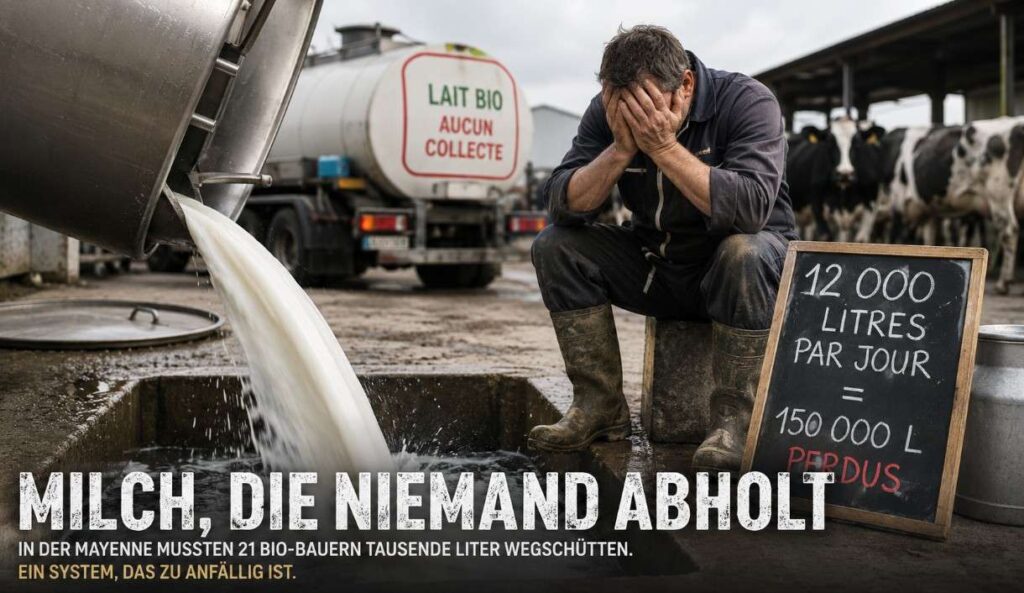
Milk is considered the epitome of the everyday. It sits on the table in the morning, disappears into coffee, ends up in cheese, butter or yogurt. Hardly anyone thinks about how fragile the path between the barn and the supermarket actually is. In the French Mayenne, that fragility has now taken on a shockingly concrete form.
Twenty-one organic dairy farmers suddenly faced an absurd problem: their cows kept producing — but no one came to collect the milk.
The trigger was the closure of a dairy in Entrammes at the end of April following a court-ordered liquidation. Overnight the entire logistics collapsed. Around 12,000 liters of organic milk per day no longer found a buyer. For many farms a race against time began. Cooling systems ran at their limits, tanks filled to the brim, phones were ringing off the hook. But milk does not pause.
After all, cows cannot be switched off like machines.
If you have never visited a dairy farm, it is easy to underestimate the merciless pacing of this profession. Milking is done morning and evening, every day, no holidays, no weekends. The animals keep giving milk whether the market works or not. If a tanker does not come, eventually there is only the bitterest of steps left: pouring it away.
That is exactly what happened in the Mayenne.
Within about ten days roughly 150,000 liters of organic milk are said to have been destroyed. High-quality goods, produced under strict standards, intended for consumers who want to shop regionally and ecologically. Instead, the milk flowed into pits and slurry tanks. An image that many farmers will likely have trouble getting out of their heads.
Especially bitter: there was no shortage of demand for food. The problem lay in between — in that often invisible chain of contracts, transport, processing and trade. If a single link breaks there, an entire system suddenly begins to wobble.
And very quickly.
The affected farmers apparently even tried to offer their organic milk at rock-bottom prices. In some cases there was not even a buyer for less than 50 cents per liter. That shows how little leeway small producers have when they suddenly fall out of existing supply chains. Milk is not a product that can sit in storage for days. Within hours the countdown begins.
In the meantime there is at least a provisional rescue. The French organic network Biolait is taking over the collection of the milk from the 21 farms. The contract runs for five years and covers around four million liters of organic milk annually. For the farmers this means above all one thing: planning security again.
But the incident raises questions that go far beyond Mayenne.
France likes to present itself as a country of regional quality, peasant tradition and short distances. Organic farming enjoys high political and social esteem. At the same time, this case shows how dependent even small regional structures are on a few industrial players. If a dairy fails, livelihoods can be jeopardized within days.
The story from Entrammes therefore not only tells of spilled milk. It tells of a food system that appears robust from the outside but remains surprisingly fragile inside. A single failure is enough – and suddenly even the best organic milk becomes waste.