
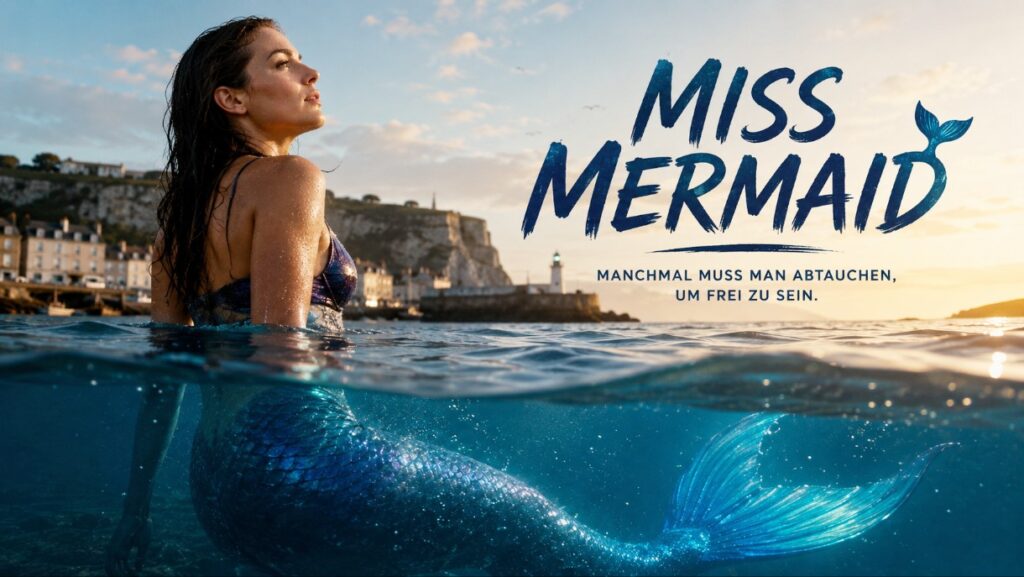
Mermaids have been regarded for centuries as mysterious beings between dream and reality. In “Miss Mermaid” this image transforms into something completely different. The feature film debut of French directors Pauline Brunner and Marion Verlé does not tell a fairy-tale fantasy story, but the portrait of a woman who fights against stagnation, debt and resignation. The result is an unusual tragicomedy that touches the heart without ever feeling sentimental.
Fanny lives in the Norman coastal town of Fécamp. After a failed marriage she has little left but a sofa and a pile of unpaid bills. She moves back to her parents’ house and makes a living as a cleaner in a fish processing factory. Night after night she scrubs floors and machines, while her own wishes recede further into the background. Everyday life feels like an endless cycle that seems impossible to escape.
But then she meets Anémone, a professional mermaid. With a deceptively real silicone tail she glides elegantly through the water in underwater shows. For Fanny a door suddenly opens into a world that at first glance seems completely crazy. That’s precisely its appeal. She decides to learn mermaiding herself and discovers a passion she never expected.
The directors use this extraordinary idea as a powerful metaphor. Of all things a fin that makes every movement on land difficult gives its wearer a feeling of boundless freedom underwater. Between glints of light and silent weightlessness Fanny finds the courage to reshape her life. This never feels contrived, but surprisingly believable.
At the same time the film does not lose sight of reality. The economic problems of many coastal towns, precarious working conditions and financial worries form the foundation of the story. Nevertheless the narrative remains light-footed. Humor arises from the characters themselves, from their idiosyncrasies, their conversations and the small moments of everyday life. This is exactly where the film’s charm lies.
It is also striking what is deliberately absent. No big love story pushes to the foreground, no hero rescues the main character. Fanny finds her way by her own strength, supported by people who accept her as she is. Aloäse Sauvage gives this character, with her natural charisma, a mixture of vulnerability, defiance and zest for life that lingers long after.
“Miss Mermaid” shows impressively that hope sometimes appears where no one is looking for it. From an unusual passion new self-confidence grows. From a mermaid’s tail a symbol of freedom emerges – and from a seemingly small story a film that proves that the greatest changes often begin with a brave leap into the unknown.
By C. Hatty