
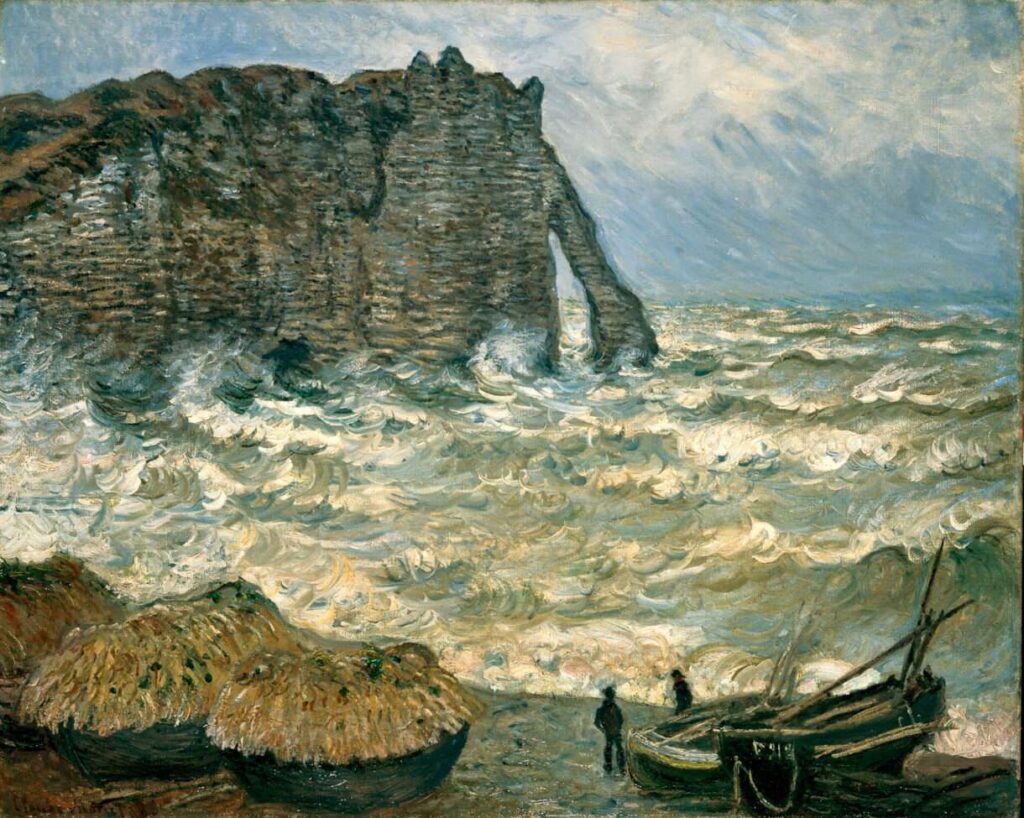
When Claude Monet is mentioned, many people immediately think of the water lilies at Giverny or of the paintings that made Impressionism famous around the world. Less well known, however, is the city where the foundations of his artistic creation were laid: Le Havre. The exhibition “Monet and Le Havre,” which explores this often overlooked setting, runs at the André Malraux Museum of Modern Art until the end of September 2026.
The exhibition focuses on the decades of the painter’s childhood in the year marking the 100th anniversary of his death. Monet came to Le Havre with his family at the age of five, and this port city on the Normandy coast had a profound influence on him. Between docks, ships and the ever-changing light of the English Channel, he developed the exceptional power of observation that would later define his entire body of work.
The exhibition follows his journey up to 1874, the year in which the first Impressionist exhibition took place in Paris and a new artistic movement was born. Around 100 works, sketchbooks, historical documents and photographs illustrate the young artist’s development. Many works come from public and private collections as well as from the holdings of Monet’s descendants.
The early drawings are particularly fascinating. From his youth, he made a name for himself by caricaturing local figures. His humorous and sometimes biting portraits attracted buyers and brought him his first recognition—something of an entry into the art world.
A key role in this process was played by his encounter with the painter Eugène Boudin. Boudin recognized the young Monet’s talent and encouraged him to paint nature directly on site. Today this may sound self-evident, but at the time it was almost revolutionary. Instead of working in the studio, Monet went to the coast and observed cloud formations, reflections of light, and changing colors on the water. Later, Johan Barthold Jongkind also influenced his development and sharpened his eye for the depiction of atmosphere.
This is precisely the exhibition’s special strength. It presents not the famous master, but the young artist in search of his path. Visitors can understand how, from the early sketches, a mode of expression gradually emerged that would make art history a few years later.
It also becomes clear that Le Havre was not merely a stop in Monet’s life. The city provided him with subjects, inspiration, and experience. Here he learned to capture the transience of the moment—the changing light, the harbor mist, and reflections on the water.
In other words, Impressionism had already begun to take shape in Le Havre before it was given its name. This exhibition is not simply about telling the story of a great painter, but about the birth of an entirely new view of the world.
Text: C. Hattie