
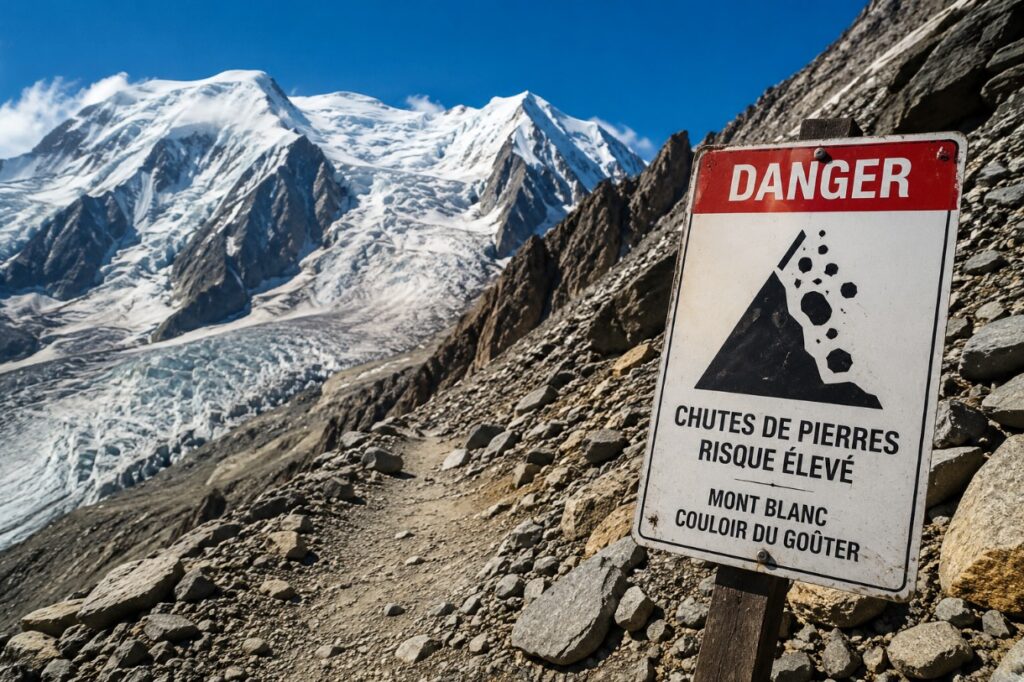
The deaths of two mountaineers on Mont Blanc have brought an old debate back onto the agenda with renewed urgency. Following a rockfall in the notorious Goûter Corridor, two Czech climbers lost their lives when their three-person rope team fell during the night. The accident occurred at a time when experts had been warning for days of exceptionally high temperatures and a significantly increased risk of rockfall.
For decades, the Goûter Corridor has been considered the most dangerous section of the normal route up the highest mountain in the Alps. Rockfalls are part of everyday life there. But this summer, the risk is appearing earlier and more intensely than usual. Conditions in mid-July already resemble those that normally occur only toward the end of summer.
The reason lies hidden deep within the mountain.
So-called permafrost ice acts like a natural glue in high-alpine rock faces. As long as the permanently frozen ground remains stable, it holds blocks of rock together. When this ice melts, the rocks lose their grip. The result is increasingly frequent rock collapses and rockfalls – often without any warning. This is precisely the development glaciologists have been observing in the Alps for years. Climate change is not altering the high mountains gradually, but in increasingly visible ways.
The two mountaineers who died were roped together with a third person when a rockfall broke loose at around 2:30 a.m. Although many climbers deliberately set out in the early morning hours to avoid the hazards caused by daytime warmth, even the cool nighttime hours are now often no longer enough. If temperatures remain high for many hours, the rock continues to lose stability even at night.
This is precisely where the real challenge lies.
For a long time, spring and summer were considered the classic season for climbing Mont Blanc. These time windows are now shifting noticeably. Many mountain guides are already adapting their tours and favoring spring or early summer, when snow and frozen ground still stabilize the rock more effectively. While this does not eliminate every risk, it significantly improves conditions.
On the Italian side of Mont Blanc, some ascents have already been temporarily suspended because of the exceptional heat. In France, the situation is more complicated. The summit remains accessible in principle, but responsibility for an ascent lies more than ever with mountain guides and climbers themselves. Weather reports alone have long ceased to be sufficient. What matters is the development of temperatures over several days and their impact on glaciers and rock.
Experienced mountaineers have been reporting for years that familiar routes are changing. Glaciers are visibly retreating, snowfields are disappearing, and paths once considered relatively safe now demand far more attention. Some look at a route they climbed without difficulty ten years ago and barely recognize it. That is quite striking – and at the same time, it is the reality in the Alps.
The current events therefore reveal more than an isolated tragedy. They represent a fundamental transformation in the high mountains. Objective hazards are changing faster than many habits and tour plans. Anyone wishing to climb a 4,000-meter peak today must not only be physically fit, but also carefully assess the new climatic conditions.
The crucial question is therefore no longer whether climbing Mont Blanc is fundamentally possible. Instead, the right timing is becoming the central concern. With every unusually warm season, the window in which an ascent can take place under acceptable safety conditions grows shorter. The highest mountain in the Alps remains a fascinating objective – but today it demands more respect, more flexibility and, above all, a new understanding of a mountain world that is changing faster than ever before.
By C. Hatty