
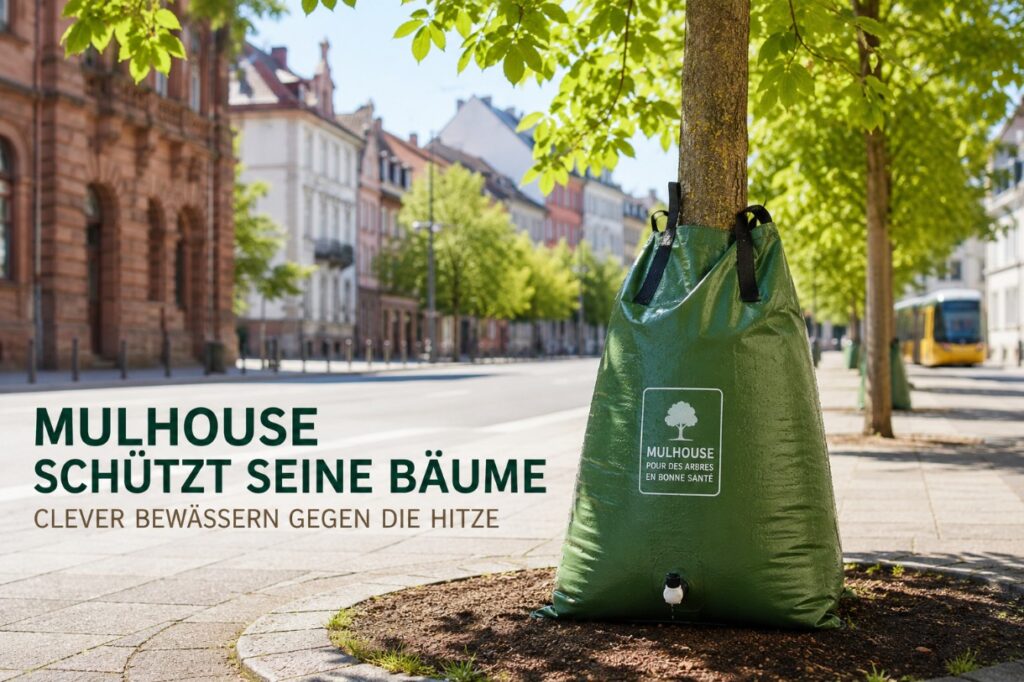
When the thermometer climbs above 35 degrees for days on end, it is not only people who start to sweat. Trees in cities are also fighting for survival. Young trees in particular suffer during prolonged dry spells because their roots have not yet grown deep enough to reach sufficient water. The Alsatian city of Mulhouse is responding to this challenge with an idea that is as simple as it is effective: special watering bags are intended to make irrigation more efficient and help trees cope better with hot summers.
The principle behind it seems remarkably straightforward. Grounds maintenance staff attach a sturdy watering bag around the trunk of a young tree. Once filled, it does not release the water all at once, but slowly and evenly over several hours. This allows moisture to penetrate deep into the soil instead of evaporating at the surface or running off over pavements and streets. It ultimately reaches exactly where the young roots need water.
Every litre counts, especially in cities. The slow release means significantly less water is lost. At the same time, the trees receive a more sustainable supply that strengthens their resilience during long periods of heat. It sounds simple – and that is precisely the appeal of this method.
Young urban trees already grow under difficult conditions. Between asphalt, paving stones and underground utility lines, there is often little room for their roots. Compacted soils further hinder the absorption of water and nutrients. Add high temperatures, exhaust fumes and the heat that builds up particularly intensely between buildings. Who would thrive effortlessly under such conditions?
During the first years after planting, a reliable water supply often determines whether a tree lives or dies. Without it, the plants lose their leaves prematurely, grow much more slowly or even die. This means the loss not only of an individual tree, but also of an important investment in the city’s future.
After all, urban trees do far more than simply look attractive. They provide shade, filter pollutants from the air and create natural cooling through evaporation from their leaves. Under a large tree canopy, a summer day often feels far more pleasant than in an unprotected square. This natural air-conditioning system becomes more important with every hot summer.
Yet this is where an apparent contradiction emerges. At precisely the times when water must be used especially sparingly, trees need sufficient moisture to be able to provide their cooling effect at all. Efficient irrigation systems therefore offer a sensible way to combine both goals. Why waste precious water when it can be used specifically where it delivers the greatest benefit?
In addition to the benefits for the plants, the new system also makes the work of municipal staff easier. Because the watering bags dispense their contents in measured amounts over many hours, the trees do not need to be watered again constantly. This saves time and enables better planning of maintenance work, especially during long dry spells.
Of course, this technology is no substitute for a comprehensive strategy against the effects of climate change. The watering bags must be checked regularly and refilled. Damage or vandalism cannot be ruled out either. Moreover, they do not solve the fundamental problem of the many sealed surfaces where roots simply lack space.
In the long term, further measures are therefore needed. Cities must store rainwater more effectively, create more unsealed areas and, when planting new trees, choose species that can better withstand heat and temporary drought. Only the combination of different solutions will create resilient green oases in urban areas.
Nevertheless, the trial in Mulhouse shows that climate adaptation does not always require spectacular large-scale projects. Sometimes effective solutions emerge from pragmatic ideas that can be implemented directly in everyday life. Every young tree that survives a heatwave thanks to better irrigation will later grow into a valuable source of shade. That is what matters for the cities of the future – tree by tree.
An article by M. Legrand