
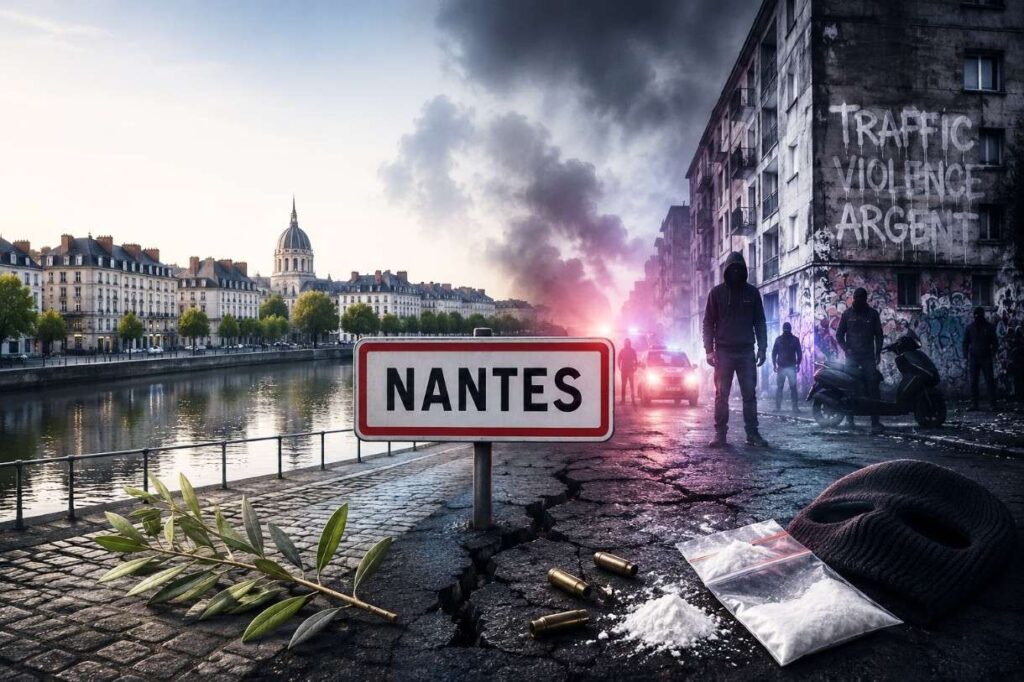
For a long time, Nantes was considered a dynamic Atlantic city with high quality of life, culture, and economic growth. Today, the name of the western French metropolis increasingly appears in connection with shootings, drug trafficking, and violence. This development alarms police, judiciary, and residents alike. Because the problem has long gone beyond ordinary crime. In some neighborhoods, a real parallel economy is emerging — brutal, highly profitable, and frighteningly well organized.
The numbers tell a clear story. Automatic weapons crackle more and more often between apartment blocks, young people take on roles as couriers or lookouts, residents live in fear of being in the wrong place at the wrong time. Many parents hardly let their children go outside alone in the evening anymore. “There used to be trouble here, now you hear Kalashnikovs,” a resident recently said, more or less, in a television report. A sentence like a punch.
The French state is responding with massive police presence. Targeted controls, special units, surveillance cameras, raids — Nantes has been experiencing an intensive security strategy for months. The state wants to remain visible and prevent entire streets from effectively falling under the control of dealers. This is the first major challenge: territorial control.
Because once criminal networks settle permanently, their own order arises. Dealers secure streets, control entrances, organize lookouts and intimidation. For many residents, this feels like a creeping expropriation of their neighborhood. The public sector does not officially withdraw — but sometimes it feels awfully close.
But police pressure alone does not solve the problem permanently. Experience from France, Belgium, or the Netherlands shows: when one dealing spot is closed, often the next opens a few streets away. The drug trade works like water — it finds new paths. The reason lies in the enormous profit. Some sales points move sums daily that small businesses can only dream of.
Therefore, the focus is increasingly on the money. Investigators no longer just try to arrest small-time dealers, but to destroy the economic structures behind them. Luxury cars, real estate, money laundering networks, hidden cash flows — that is where the real power of the organizations lies. Those who arrest only the young lookouts often just scratch the surface.
The role of minors is particularly disturbing. Many networks recruit teenagers at 13 or 14 years old. Some are lured by quick money, others seek recognition or simply a place in a group. In socially disadvantaged neighborhoods, drug trafficking replaces for some young people what school, family, or the job market no longer provide: status, belonging, and perspective.
That sounds harsh, but that is exactly the core of the problem.
As long as a teenager earns more in a few hours of lookout work than his father does in several days of work, the state loses credibility. Prevention then quickly sounds abstract. Nevertheless, there is no way around it. Sports clubs, educational opportunities, apprenticeships, social work, and stable schools unfold their effects slowly — sometimes only after ten years. Politically, that does not sell well. A police raid provides images for the evening news. A saved school diploma does not.
Additionally, there is one aspect about which France has long surprisingly rarely spoken: demand. The drug market does not exist only in disadvantaged neighborhoods. Cocaine, cannabis, and synthetic drugs circulate among student milieus, at middle-class parties, in affluent city centers, and even in parts of the business world. The violence in the suburbs is often financed by consumers far from the hotspots.
That is precisely why many experts now view narcotrafficking as a national economic phenomenon — with its own supply chains, financial structures, and territorial power struggles. Nantes is exemplary of this.
In the short term, the city needs security and consistent state pressure. But in the long term, a different factor decides: whether France can offer young people credible alternatives to the shadow economy. Otherwise, every dismantled dealing point disappears only for a moment — and shortly thereafter reappears elsewhere.
Andreas M. B.