
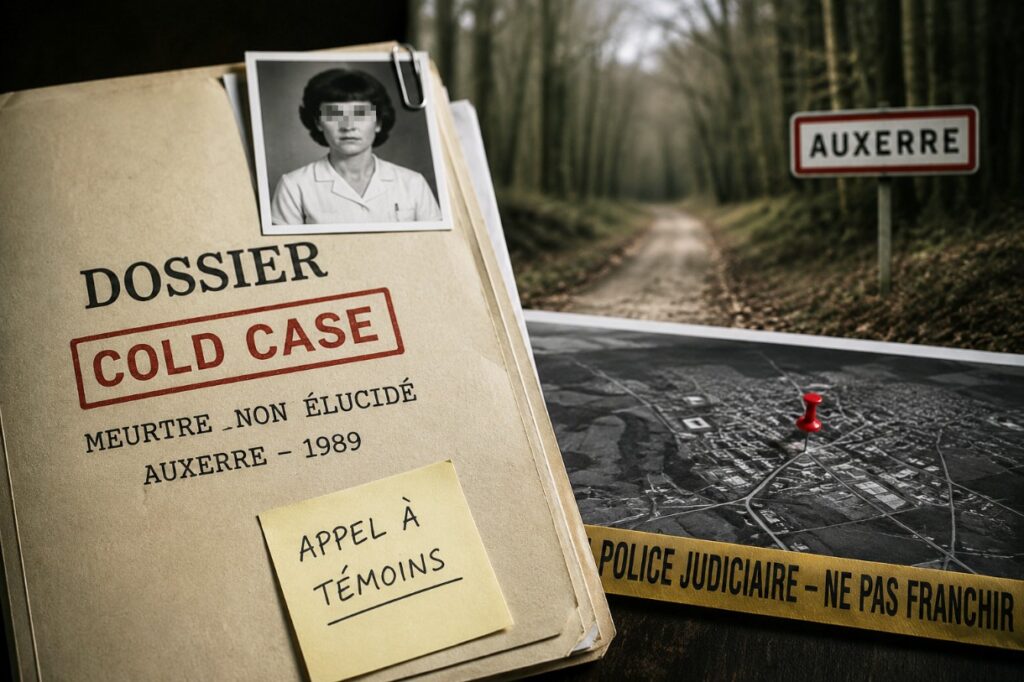
Some crimes never completely fade from the collective memory. They linger like a shadow over a region, even as years turn into decades. Exactly such is the case with the murder of Marie-Agnès Bedot, a nurse from Auxerre, whose violent death remains unsolved to this day. Now, the French judiciary is making a new effort to shed light on one of the most mysterious criminal cases in the Yonne department.
Almost 37 years after the events, the national center for serial and unsolved crimes in Nanterre has intensified the investigation once again. With a public call for witnesses, investigators hope to receive clues that could finally bring a decisive breakthrough to the case.
Marie-Agnès Bedot was 32 years old when she disappeared without a trace on October 16, 1989. The nurse had left her workplace and never returned home. A few days later, search teams found her body in a wooded area near Auxerre. It was quickly established that she had fallen victim to a violent crime.
Despite extensive investigations at the time, it was not possible to identify the perpetrator or any accomplices. The case became one of those unsolved criminal puzzles that continue to preoccupy both relatives and investigators. With each passing year, the hope for resolution seemed to diminish.
This is precisely where the work of the so-called “cold case” unit in Nanterre begins. The specially formed unit is dedicated to old crimes where traditional investigative approaches have so far been unsuccessful. Modern scientific methods, new forensic possibilities, and a fresh look at historical files offer opportunities that were not available during the original investigations.
The investigators now place special importance on potential witness information. The current appeal is primarily addressed to people who lived in the Yonne region or were professionally active there in the late 1980s. Often, what seem like trivial details can suddenly take on a central role years later. Unusual behavior, a long-forgotten remark, or an observation that seemed insignificant at the time—all of this could be important today.
Experience from other old criminal cases shows that memories sometimes only come to light after decades. Statements withheld for many years often decide the success of an investigation. Sometimes it is only the passage of time that overcomes inhibitions, fears, or loyalties.
The case of Marie-Agnès Bedot also has particular significance for the region. During the 1970s, 1980s, and 1990s, the Yonne region was repeatedly the scene of missing persons cases and crimes that left many questions unanswered. Several of these files have been reopened in recent years to review previously overlooked leads.
For the relatives of the nurse, the reopening of the investigation means above all one thing: hope. Hope to receive answers after decades of waiting. Hope that the truth will finally come to light.
Whether the new initiative will actually provide the crucial clue remains uncertain. But one thing is clear: the judiciary has not forgotten the case. Even after almost four decades, investigators pursue the same goal as on the first day—to identify those responsible for the murder of Marie-Agnès Bedot and finally bring an end to one of the region’s major unsolved criminal cases.