
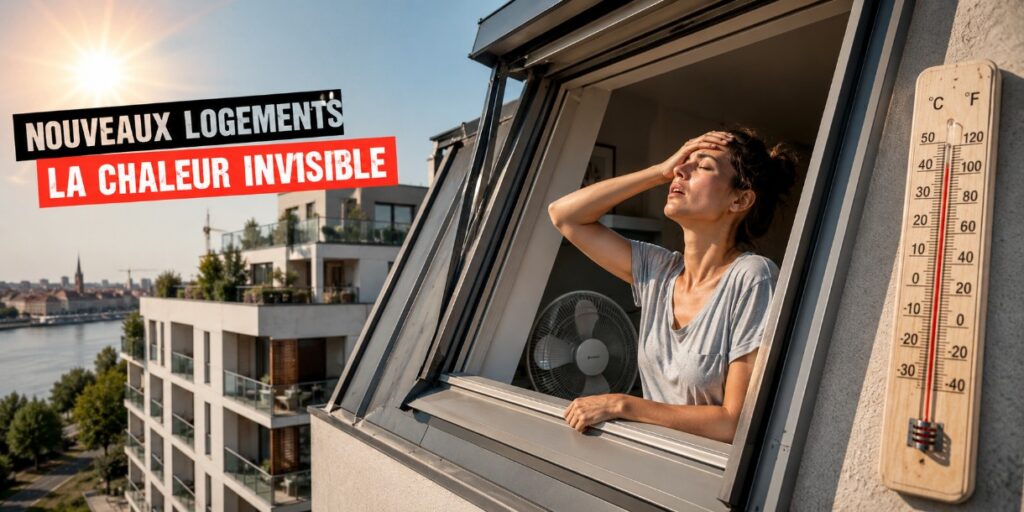
Modern new buildings are supposed to stand for comfort, energy efficiency and sustainability. Yet it is precisely in some of the newest housing developments that an unexpected problem has emerged. In the Brazza eco-district in Bordeaux, residents complain that their apartments reached temperatures of up to 37 degrees Celsius during the recent heatwave. Attic apartments are particularly affected, heating up strongly during the day and cooling only minimally even at night.
Many residents report sleepless nights and rooms that feel like an oven even after sunset. Even with windows open, the heat remains trapped inside the apartments. Some resort to running multiple fans at once—with limited success. Others accept nighttime street noise because only open windows provide any relief. Frustration is high. After all, these are newly constructed buildings that meet the most modern environmental standards.
The case raises a fundamental question: Are many new buildings at all adequately prepared for the consequences of climate change? For many years French building regulations focused on saving heating energy. Buildings received particularly effective insulation so that as little heat as possible would be lost in winter. That very strength, however, shows its downside in summer. Once heat penetrates an apartment, it is often stored in the building for a long time.
Other factors that favor overheating compound the problem. Large window areas do provide bright living spaces but allow enormous amounts of heat to enter on sunny days. If there are no external shading devices such as shutters or sun protection systems, room temperatures rise quickly. Inadequate natural ventilation also plays a decisive role. Apartments without cross-ventilation options, in particular, hardly cool down at night. Roofs and facades exposed to the sun all day further worsen the situation.
The problem is by no means limited to Bordeaux. Reports are also increasing from other French cities about modern residential buildings that become barely habitable during prolonged heat periods. Attic apartments, above all, regularly reach their limits. The growing number of extreme heatwaves makes clear that peak winter energy performance alone is no longer sufficient.
With the current environmental regulation RE2020, France is already trying to include summer thermal protection more strongly in the planning of new buildings. A specific evaluation standard is intended to prevent apartments from overheating in summer. Critics, however, consider these requirements not far-reaching enough. Reality is developing faster than many planning models, because heatwaves now occur more frequently, last longer and are more intense than a few years ago.
For the affected residents, a new term is therefore coming into the focus of the discussion: thermal housing quality. Many rightly ask whether a new apartment can still be considered comfortable if it regularly reaches temperatures well above 35 degrees on hot summer days. As climate change progresses, this issue is likely to become far from isolated and instead one of the major challenges of modern housing construction.
By C. Hatty