
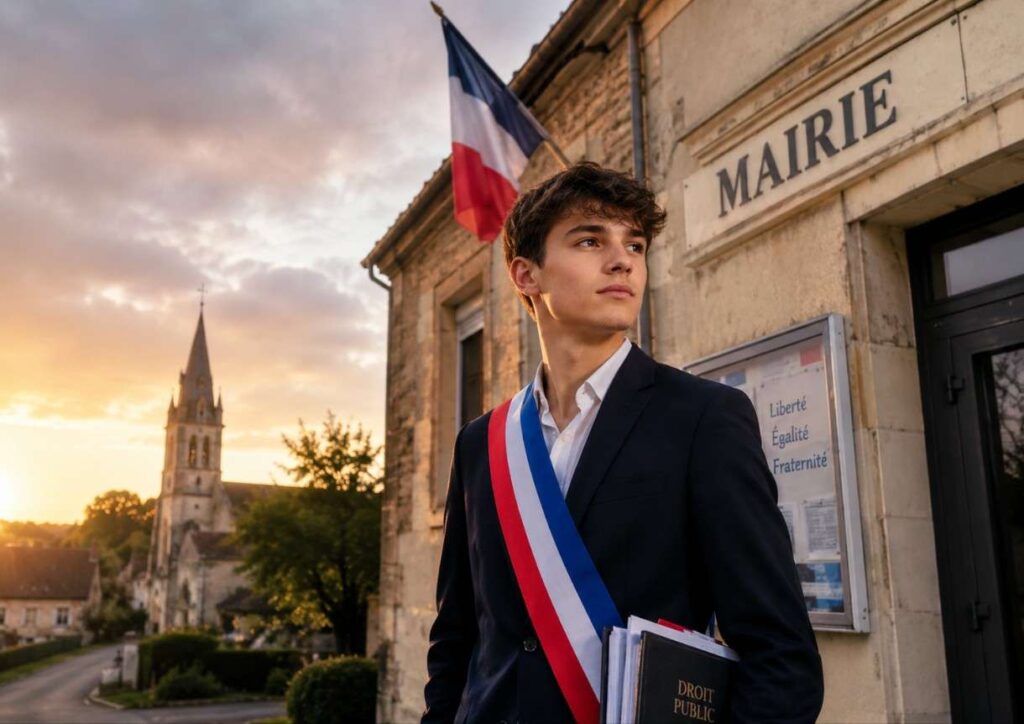
Sometimes a political change does not begin in Paris, not under the gilded ceilings of the National Assembly, but in a village of a few hundred inhabitants, somewhere between fields, county roads and mailboxes where time sticks more slowly than elsewhere.
This place is called Pré-Saint-Évroult.
A little spot of France in the Eure-et-Loir department, quiet, rural, unspectacular. And precisely because of that, the story of Brian Pellerin reads like a small political tale with great symbolic force. The young man is nineteen years old. An age when others are still considering which master’s program to start or whether to move to Bordeaux. Pellerin, by contrast, now runs a municipality. Mayor. With sash, meeting minutes and responsibility.
France is looking on, astonished.
For the Republic may love its youth as an idea, but in practice it often greets it with polite distrust. Young talents are celebrated in sport, in music, in start-ups — but political responsibility? That usually remains reserved for people whose temples have already gone gray. France’s mayors, on average, belong to a generation that still grew up with phone booths.
And suddenly there sits a law student.
Town hall by day, university later. Meetings, files, lectures, exams. One almost automatically imagines this scene: a young man in the lecture hall, laptop open, classmates with coffee cups beside him — and somewhere between administrative law and municipal finances his phone buzzes because a roadworks problem has appeared in the village.
Sounds a bit crazy.
Perhaps that is precisely why it is so fascinating.
The story has something deeply French about it. This country loves political symbols almost as much as good cheese and long dinner-table debates. A nineteen-year-old mayor in a rural community appears as a counter-image to that France that has been lamenting political disenchantment, declining trust and the estrangement between capital and provinces for years.
Because in many small municipalities there is now hardly anyone left who wants to run.
Mayors of small places often carry a quiet burden. They settle neighborhood disputes, take care of broken street lamps, organize village fêtes, answer complaints about garbage collection or potholes. Much responsibility. Little glamour. Sometimes hardly any recognition.
High politics shines on television.
Local politics, by contrast, smells of ring binders and cold meeting-room coffee.
Perhaps that is exactly the surprise of Pré-Saint-Évroult: that a young person willingly ventures into this terrain, even though his generation is often described as politically distant. Digitally distracted. Impatient. Not resilient enough.
And then this sentence appears.
„J’ai confiance en cette génération.“
I have confidence in this generation.
A simple sentence. Almost unassuming. Yet precisely for that reason it unfolds power. It comes from a resident of the village, a teacher. Not a grand political comment, no ideological battle cry. Rather a quiet observation taken from everyday life.
Trust.
How rare that word has become.
In political debates you usually hear the opposite: doubts about youth, worries about commitment, complaints about TikTok, smartphones and declining attention spans. Entire talk shows now live by playing generations against each other. The old against the young. The experienced against the sensitive.
And now a village entrusts its administration to a nineteen-year-old.
That seems almost subversive.
Of course there is also a bit of French romanticism behind the story. The idea of the committed young republican has a tradition in France. The Revolution already adored young men who pushed into politics with ideas and pathos. Emmanuel Macron himself owed part of his early success to that yearning for renewal.
But between a presidential palace and a village with a few inhabitants lies a world.
In Pré-Saint-Évroult it’s not about geopolitical strategies or television duels. There politics decides whether the street lighting works and whether the village hall is renovated. Perhaps for that reason everything seems more believable. More approachable.
Almost touching.
The family constellation also contributes to the peculiar atmosphere of this story. Pellerin’s mother also sits on the municipal council. One could see material for a French tragicomedy in that. Family dinners with political discussions. Debates between mother and son about budgetary issues. Doors slamming after council meetings.
But the mother put it remarkably matter-of-factly: during meetings he is no longer her son, but the mayor of the village.
A sentence full of republican discipline.
France loves such sentences.
They recall that almost ceremonial relationship the Republic cultivates with its offices. The office stands above the person. Above relationships. Above family. At least in the ideal.
And yet behind all that political symbolism a human question remains: how does a nineteen-year-old actually live with such responsibility?
One remembers one’s own life at that age. The insecurity. The searching. The improvisation. Many at nineteen hardly know which furniture they’d buy, let alone how to run a municipality.
But perhaps there is also a strength in that.
Young politicians often lack the routine of political language. No finely polished formulations. No automatic evasions. They come across as more direct, sometimes awkward, occasionally naive — but precisely that many citizens now find refreshing. Politics in many parts of Europe has turned into a perfectly trained communications machine. Every sentence tested, every gesture calculated.
A young mayor from a village thus almost seems like a person from another time.
Authentic.
Or at least closer to that idea of politics that citizens would like.
Of course one must not romanticize the story. Youth alone does not solve structural problems. A mayor needs experience, patience and administrative knowledge. Enthusiasm does not replace budget planning. And yet the impression arises that France at such moments rediscovers a kind of counter-image to its own fatigue.
For the country seems exhausted from constant crises.
Yellow vests. Pension protests. Polarization. Anger. Retreat. Distrust.
Then a village that hands the keys of the town hall to a student appears almost like a small republican tale of hope.
Almost too good to be true.
But perhaps politics needs exactly such stories. Not as fairy tales, but as a reminder that democracy does not consist solely of grand speeches. But of people who take responsibility even though they know it will be tiring.
Those who become mayor of a small French municipality today rarely choose prestige. Rather service. Proximity. Permanent accessibility. The mayor of a small place often remains the last directly tangible figure of the state. When something goes wrong, the anger lands with them first.
That makes Pellerin’s case all the more remarkable.
For while many of his peers search social networks for visibility, he takes on an office that produces rather invisibility. Administrative work instead of self-promotion. Stacks of paper instead of influencer aesthetics.
Somehow crazy.
Perhaps that is why the story touches so many people. It contradicts the popular image of a young generation that supposedly only cares about speed, self-optimization and digital attention. Instead there stands a young man in a village taking care of local politics — probably the most unspectacular form of politics there is.
And in that lies dignity.
Perhaps even the future.
For Europe’s democracy problem often begins not at the top but at the bottom. In municipalities where citizens feel left alone. In places where no one wants to stand for election anymore. Where politics becomes the tired duty program of aging volunteers.
When young people take responsibility there, more is changed than just the average age of a municipal council.
It changes the atmosphere.
The notion of who politics actually belongs to.
Is politics a space for professional politicians? Or does it remain a communal project, open to people who have not yet spent decades in a career?
Pré-Saint-Évroult offers a quiet answer to that.
The symbolism even seems literary. A young law student commutes between university and village administration while older residents place their trust in him. You could easily make a French film out of it. One of those quiet films in which much is left unsaid and people stare out of train windows for a long time.
And somewhere, Charles Aznavour would probably be playing.
But beyond all the poetry, the story shows something concrete: democracy lives from people feeling responsible. Not someday. Not later. Now.
Perhaps that is the real message of this young mayor.
Not his age alone matters.
But the willingness to carry responsibility, not just to comment on it.
In an era when political debates often resemble endless waves of outrage, this attitude is almost old-fashioned. In the best sense.
The French philosopher Raymond Aron once wrote, in essence, that politics consists of the art of dealing reasonably with imperfect circumstances. Maybe that art sometimes begins not in ministries but in villages like Pré-Saint-Évroult.
There, where politics still has faces.
Where mayors know the people whose street lamps break.
Where democracy does not sound abstract but like a village hall.
And perhaps that is why France is looking at Brian Pellerin with such attention right now. Not only because of his age. But because his election touches a longing that reaches far beyond this small village.
The longing for politics that feels closer again.
Younger perhaps, too.
But above all more human.
An article by M. Legrand