
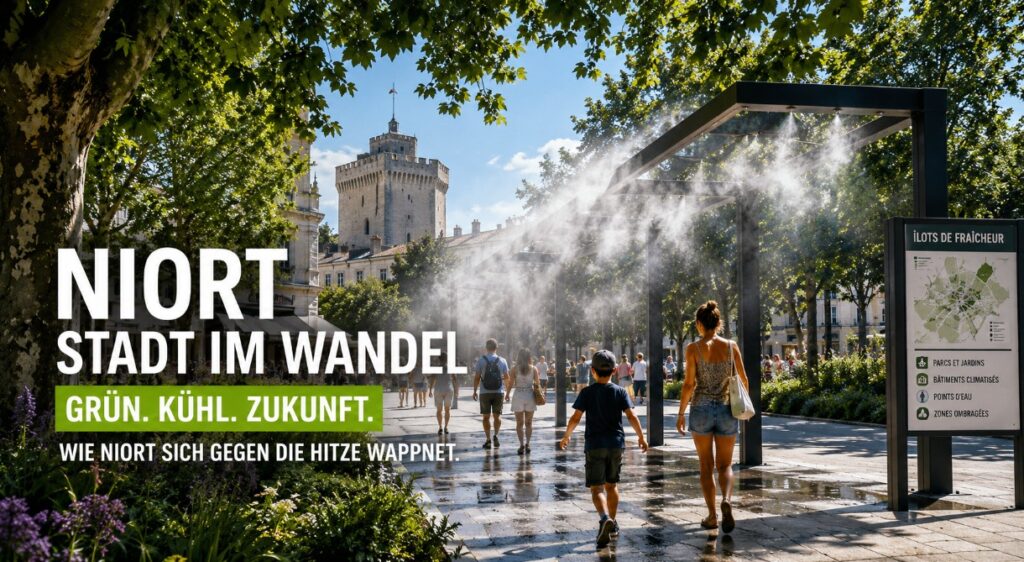
Summers in France are growing hotter, heatwaves are becoming more frequent and are putting increasing strain on cities. Niort is one of the municipalities adapting its public spaces to this trend for the long term. Rather than relying solely on short-term emergency measures, the city pursues a comprehensive concept that combines nature, modern infrastructure and social precaution.
At the center of this strategy are trees and green spaces. For several years the city has been intentionally investing in the renaturation of public squares and streets. The conviction behind it is simple: dense vegetation is among the most effective means of noticeably lowering temperatures in densely built-up urban areas. This effect is particularly clear in the Brèche gardens. There the perceived temperature on hot days is several degrees lower than on fully sealed surfaces. This principle is now to be gradually transferred to other neighborhoods so that an interconnected network of so-called “cool islands” is created.
The concept is complemented by mobile measures. During extreme heat the city installs misting showers in heavily frequented locations in the center. They provide passers-by with immediate cooling and particularly during midday hours offer some relief. Additionally, an overview map provides information about parks, gardens, air-conditioned buildings and other places where the population can protect themselves from the heat.
Large summer events are also adapting to the changed climatic conditions. For the 2026 edition of “Niort Plage” the event area was deliberately expanded into more wooded parts of the Pré-Leroy park. Additional misting showers improve the stay for visitors. Furthermore, opening hours and the event program are flexibly adjusted according to the prevailing temperatures. This keeps the offering attractive without losing sight of guests’ health.
The adaptation does not end with urban design. During particularly hot days the city administration activates a comprehensive protection plan for people at risk. An air-conditioned rest area is available, certain municipal services operate with adjusted opening hours, and registered seniors and other especially vulnerable people receive regular phone calls. In particularly severe heat phases more than 400 people are contacted daily. A permanently maintained register includes around 1,600 residents who can quickly receive support if needed.
Niort thus impressively demonstrates how cities can adapt to climate change. Trees no longer serve only an aesthetic function but have become an important part of public health provision. Together with technical solutions and forward-looking organization, a concept emerges that makes people’s everyday lives significantly more livable even during extreme heat.
Author: Andreas M. B.