
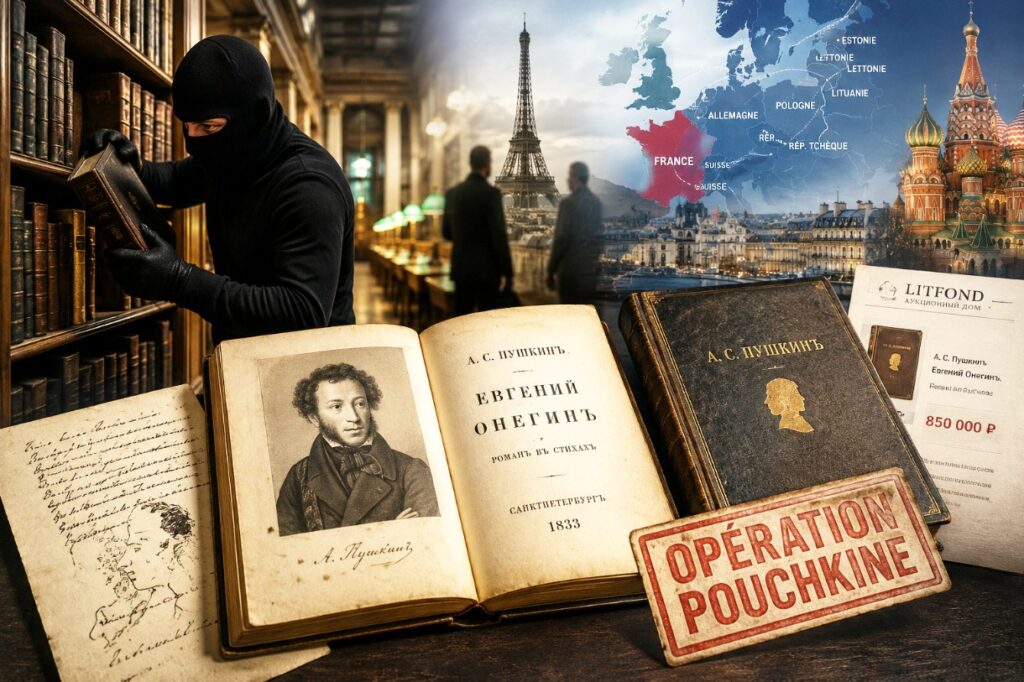
Some criminal cases sometimes look like the script of a historical thriller. The trial currently underway in Paris against seven Georgian nationals undoubtedly falls into that category. At the center of this case are not jewels, masterpieces, or glamorous bank robberies, but rare books and manuscripts in the history of Russian literature. The charges are serious: the defendants are accused of stealing valuable original publications from France’s most prestigious libraries and replacing them with sophisticated forgeries.
The victims include the French National Library in Paris, the University Library of World Languages and Cultures, and the library of the École Normale Supérieure in Lyon. The suspects’ methods demonstrate remarkable preparation. Instead of violence or rushed actions, they appear to have worked patiently like artisans. They first conducted precise investigations of rare works, photographing and even measuring them. Then experts produced high-quality replicas, which were used to secretly replace the originals.
Particularly notable is Russia’s national poet Alexander Pushkin. His works are valued so highly that their cultural worth is difficult to estimate in Russia. For many Russians, Pushkin symbolizes the birth of modern Russian literature. For this reason, the case holds significance far beyond the scope of ordinary property crime.
The investigation results point to a complex, intertwined international network. In recent years, similar theft incidents have been reported in several countries, including Germany, Poland, Switzerland, the Czech Republic, and the three Baltic states. Investigators tracked suspects across multiple European countries, requiring close cooperation between international agencies. In spring 2024, numerous suspects had already been arrested.
However, the true tension in the trial lies not merely in who stole the books. The greater interest is the motive. Was it simply for financial gain? The market for rare Russian first editions has significantly increased in value in recent years. Collectors sometimes pay six-figure amounts for a single historical edition.
Meanwhile, another hypothesis is also being raised. Some investigators suspect that beyond mere profit-seeking, there might have been an attempt to return important Russian cultural heritage items back to Russia. So far, there is no evidence to prove such political motives, but some clues attract attention. For instance, one of the stolen works later appeared on the list of a Moscow auction house.
This incident reveals the astonishing vulnerabilities of the modern knowledge society. Libraries are among the few public places where trust plays a crucial role in daily operations. Researchers are granted access to valuable collections without constant suspicion. It appears that this very principle was exploited by the suspects.
Now, the focus is on the Paris court. What is at stake here is not just the missing books, but also how cultural heritage has become so vulnerable in a globalized world. Literature, the art market, and geopolitical interests intermix complexly, blurring boundaries. What initially seemed like a sophisticated library theft could ultimately reveal a much more complicated story.
Written by C. Hatty